Showing posts with label psyche. Show all posts

Tuesday, September 8, 2015

Merritt on Guns and the American Psyche

Article by Dennis L. Merritt

The issues of gun violence and gun control will not be resolved unless addressed at the most basic level--the Second Amendment right to keep and bear arms. Even the gore of Sandy Hook barely moved the needle towards significant changes in gun control, implying a need for a more archetypal approach to the problem. (1)

The Founding Fathers wrote the Constitution to be the mythic foundation of America as a nation of laws. Archetypically the Constitution and the Bill of Rights are in the realm of the Bible: they are like the Ten Commandments for Americans. They strike the collective American psyche as the Word of God in a nation without a religious foundation, an important aspect of our uniqueness during the Age of the Enlightenment when they were written. (2)

The Second Amendment right “to keep and bear arms” is loaded with archetypal imagery in the guns themselves. There is a fierce and frightening beauty in these technological marvels of relative simplicity in design. With soul-frightening noise the bearer can project great and deadly force with these phallicy objects. The Lakota Sioux say such objects have great wakan, great power; archetypal power in a sacred sense. A gun in one's hand engages an ultimate archetype—death. Guns can impart a deadly sense of power to those feeling fearful and disempowered, but a power that moves one towards black-and white, good-and-evil distinctions because of the life-and-death potential guns wield. The power to kill and maim can quickly sweep the bearer into the domain of the god of war, Ares/Mars, the god behind the intoxication of gang warfare. An individual or a group can take justice into their own hands, subverting a society of laws.

Friday, July 10, 2015

Lowinsky on Grandmothers and The Motherline

https://fisherkingpress.com/n/product-category/naomi-ruth-lowinsky
—Naomi Ruth Lowinsky, from The Motherline: 
Every Woman's Journey to Find Her Female Roots

"Standing at the crossings of family history, generational change, and archetypal meanings, a grandmother locates her grandchild in the life stream of the generations. She is the tie to the subterranean world of the ancestors; she plays a key role in helping a woman reclaim essential aspects of her feminine self. Standing close to death, she remembers the dead. She tells their stories, hands down their meanings and their possessions. Often she is the first to tell her granddaughter the stories from her Motherline. Evoking the Eleusinian emotions of the life cycle, these stories return a woman to her place of emergence, reminding her that she is woman, born of woman. Telling these stories enacts an archetypal healing principle found in tribal cultures and in psychotherapy: the 'return to origins.'"
Fisher King Press publishes an eclectic mix of worthy books including 
Jungian Psychological Perspectives, Cutting-Edge Fiction, Poetry, 
and a growing list of alternative titles. 

Wednesday, June 19, 2013

News Release: New Title Alert - The Dream and Its Amplification

June 19, 2014

Just Published by Fisher King Press:

Erel Shalit & Nancy Swift Furlotti (eds.)

The Dream and Its Amplification is now available for shipping.

Fourteen Jungian Analysts from around the world have contributed chapters to this book on areas of special interest to them in their work with dreams. This offers the seasoned dream worker as well as the novice great insight into the meaning of the dream and its amplification.

The Dream and Its Amplification unveils the language of the psyche that speaks to us in our dreams. We all dream at least 4-6 times each night yet remember very few. Those that rise to the surface of our conscious awareness beckon to be understood, like a letter addressed to us that arrives by post. Why would we not open it? The difficulty is in understanding what the dream symbols and images mean.

Through amplification, C. G. Jung formulated a method of unveiling the deeper meaning of symbolic images. This becomes particularly important when the image does not carry a personal meaning or significance and is not part of a person's everyday life.

Contents and Contributors
  • The Amplified World of Dreams - Erel Shalit and Nancy Swift Furlotti
  • Pane e’ Vino: Learning to Discern the Objective, Archetypal Nature of Dreams - Michael Conforti
  • Amplification: A Personal Narrative - Thomas Singer
  • Redeeming the Feminine: Eros and the World Soul - Nancy Qualls-Corbett
  • Wild Cats and Crowned Snakes: Archetypal Agents of Feminine Initiation - Nancy Swift Furlotti
  • A Dream in Arcadia - Christian Gaillard
  • Muse of the Moon: Poetry from the Dreamtime - Naomi Ruth Lowinsky
  • Dreaming the Face of the Earth: Myth, Culture, and Dreams of the Mayan Shaman - Kenneth Kimmel
  • Coal or Gold? The Symbolic Understanding of Alpine Legends - Gotthilf Isler
  • Sophia’s Dreaming Body: The Night Sky as Alchemical Mirror - Monika Wikmam
  • The Dream Always Follows the Mouth: Jewish Approaches to Dreaming - Henry Abramovitch
  • Bi-Polarity, Compensation, and the Transcendent Function in Dreams and Visionary Experience: A Jungian Examination of Boehme’s Mandala - Kathryn Madden
  • The Dream As Gnostic Myth - Ronald Schenk
  • Four Hands in the Crossroads: Amplification in Times of Crisis - Erel Shalit
  • Dreams and Sudden Death - Gilda Frantz
Attending the IAAP Congress in Copenhagen? - Don't miss the The Dream and Its Amplification book launch on August  21st at 19:00 !

Paperback: 230 pages (Large Page Format 9.25" x 7.5")
Publisher: Fisher King Press; 1st edition (June 15, 2013)
Language: English
ISBN-13: 978-1-926715-89-6

Fisher King Press publishes an eclectic mix of worthy books including 
Jungian Psychological Perspectives, Cutting-Edge Fiction, Poetry, 
and a growing list of alternative titles. 

Wednesday, December 26, 2012

The New Year and Jung’s Stages of Life

by Erel Shalit

C.G. Jung introduced the idea of studying and defining the goals of the second half of life. Daniel Levinson thus considered him “the father of the modern study of adult development.”[1]

Jung originally published his essay ‘The Stages of Life’ in 1930,[2] about twenty years before Erikson drew his epigenetic chart of psychosocial development. Jung emphasized the contrary directions of man’s focus during the first and second halves of life. Whereas in the first part of life, the development of a firm ego that takes its foothold in the world predominates, in the second part of life, the individual must turn toward Self and spirit.

‘The Stages of Life’ appeared in 1933 in Jung’s book Modern Man in Search of a Soul. It had initially been published as ‘Die seelische Probleme der menschlichen Alterstufen’ in Neue Zürcher Zeitung in 1930, but was later revised. His ideas regarding the stages of life will be our point of departure and guiding light throughout our discourse.

When Jung set out to “discuss the problems connected with the stages of life,” he devoted several pages of this brief essay to discuss the notion of problem. He claims that problem is the kernel of culture and consciousness. “There are no problems without consciousness,” says Jung. Confronting a problem instigates toward consciousness, and due to the development of consciousness, problems come into existence.[3] Furthermore, Jung emphasizes the psychological truth that serious problems can never be fully resolved—if they appear to be, then “something has been lost.” The meaning as well as the purpose of problems lie not in their solution but, rather, in being constantly worked on.[4] Similarly, happiness and welfare do not lie in wait to be found at the end of the rainbow, but are aspects of the process and of our attitude, with sadness and misery appropriate company at times of pain, difficulty and loss. The journey entails both the road we take and how we take that road, our conscious attitude.

Unmistakably, Jung’s conceptualization of the stages of life pertains to living the conscious life.

The first stage of life concerns the child’s evolving consciousness, which is based on perceiving the connection between different psychic contents. However, lacking a continuous memory in early childhood, consciousness is sporadic, rather like “single lamps or lighted objects in the far-flung darkness.”[5] Only when there is continuity of ego-memories does the ego-complex constellate, with a budding sense of subjective identity, whereby the child comes to speak of itself in first person.

Problems arise, says Jung, with the psychic birth and “conscious differentiation from the parents” in puberty.[6] This is not only an external process. By internalization, the external limitations become internal divisions, for instance, between opposing impulses. That is, the rise of consciousness both creates and is the result of an inner division between the ego and the perceived other—whether that other is an internal instinct or an external object, an autonomous complex detracting energy from the ego, or a split-off shadow.

The period of youth entails the transition from what Jung considers to be the dream of an essentially problem-free childhood to the harsh demands of life. The problem may be external, due, for instance, to “exaggerated expectations, underestimation of difficulties, unjustified optimism, or a negative attitude.” Nevertheless, problems unmistakably may arise, as well, from internal conflicts and disturbances in the psychic equilibrium; Jung mentions the sexual instinct and feelings of inferiority.[7]

It is in youth, says Jung, that the individual needs to recognize and accept “what is different and strange as a part of his own life,” in spite of the desire to cling “to the childhood level of consciousness,”[8] that is, a wish to avoid unpleasure, and to regress into a conflict-free existence.[9]

Achievement and usefulness, says Jung, “are the lodestars that guide us … to strike our roots in the world,” to find a place in society, which is essential in the first half of life. Development of a wider consciousness, “which we give the name of culture,”[10] is left, however, for a later stage in life. Therefore, while the child struggles to shape its individual ego, the aim in youth—or young adulthood—is to gain a place in society.

Jung’s main concern as expressed in this essay is the arrival at midlife. “The social goal,” he says, “is attained only at the cost of a diminution of personality. Many—far too many—aspects of life which should also have been experienced lie in the lumber-room among dusty memories; but sometimes, too, they are glowing coals under grey ashes.”[11]

Jung notes that around the age of forty, a slow process of character-change takes place. Interests and inclinations alter. Simultaneously, however, moral principles tend to harden and grow rigid, “as if the existence of these principles were endangered and it were therefore necessary to emphasize them all the more.”[12]

Jung ascribed the neurotic disturbances of adults to the common desire to prolong youth, and a reticence to crossing the threshold into maturity. The neurotic is someone “who can never have things as he would like them in the present.”[13] Typically, the neurotic person projects the cause of his suffering onto the past or the future, and we often hear him or her say, “if only this or that would/would not have happened,” or “if only … then …” The cult of youth and the widespread difficulty of accepting old age, typify the pathology of our era.

The fear of midlife is not of death, claims Jung, but of the sun’s descent, which means “the reversal of all the ideals and values that were cherished in the morning. … The sun ... draw[s] in its rays instead of emitting them. Light and warmth decline and are at last extinguished.”[14]

However, it seems to me that ultimately the fishing rod of midlife fears does indeed dip into the lake of death, when light and warmth are extinguished. This, then, may be compensated by, for instance, what for many may be a reassuring faith and belief in existence after death, or, alternatively, the ambition to live a meaningful life. In his essay ‘The Soul and Death,’ published in 1934, Jung does state that,
From the middle of life onward, only he remains vitally alive who is ready to die with life. For in the secret hour of life’s midday the parabola is reversed, death is born. The second half of life does not signify ascent, unfolding, increase, exuberance, but death, since the end is its goal.[15]
The challenge in midlife is to come to terms with hitherto neglected features, sometimes conflicting with one’s conscious attitude and recognized values. Jung mentions, as well, how bodily characteristics of the opposite sex can be discerned in the older person.

The psychological and biological changes that a person undergoes in the second half of life may thus blur the distinction between male and female traits, though this may be a far cry from the erotic character of juvenile androgyny. Consequently, the man must now put his feminine substance to use, and, says Jung, the woman “her hitherto unused supply of masculinity.”[16] According to Jung’s Weltanschauung, certainly influenced by the Zeitgeist, the spirit of his time, he associated the masculine with logos and the feminine with Eros.

Thus, in midlife it may happen that “the husband discovers his tender feelings and the wife her sharpness of mind.”[17] These changes are dramatic and, says Jung, may lead to marital catastrophe. If so, I suppose that the wife’s sharpness of mind may be more threatening to the man, than showing his tender feelings would pose a danger to his wife.[18]

Jung expressed the essence of midlife transition beautifully when he says that, “what was great in the morning will be little at evening, and what in the morning was true will at evening have become a lie.”[19]

In the second half of life, man must withdraw from external preoccupations, and seriously prepare for old age, death and eternity—which amounts to a (not necessarily formal) religious attitude. “An old man who cannot bid farewell to life appears as feeble and sickly as a young man who is unable to embrace it,” says Jung sharply and poetically.[20] Rhetorically he wonders if not culture, beyond the nature to which family and children pertain, is the “meaning and purpose of the second half of life.”[21]

To sum up, Jung’s ideas on the stages of life pertain to the development of consciousness as it manifests in the life cycle. The essence lies in the problem that faces the individual at each stage; a problem less to be resolved, but rather to be confronted and challenged. Jung thus emphasizes life as a process of becoming conscious, which transforms the experience of life into a living experience.

As the individual traverses the arc of life, he or she may be resistant to the problems posed by each transition, such as an expanding ego consciousness; striking roots in society; confronting the decline and integrating the opposites, including those of gender; and then death and eternity. Jung says that, “the art of life is the most distinguished and rarest of all the arts.”[22] For some travelers along the journey of life, the art of life becomes increasingly conceptual, for others more and more esthetic; for some minimalistic, for others increasingly abstract.

The second half of life should not merely be a repetition of one’s youth and young adulthood, but rather a period that enables integration by accentuating those matters of one’s psyche that have not been taken care of well enough.

Jung divides life into four parts. The Cycle of Life: Themes and Tales of the Journey elaborates on the respective stages less from a developmental perspective, but rather as an effort to extract the archetypal images at the core of each age.

[1]  The Seasons of a Man’s Life, p. 4.
[2] Carl Gustav Jung, The Collected Works of C. G. Jung, vol. 8, par. 749-795. NOTE: CW refers throughout to The Collected Works of C. G. Jung.
[3]  CW 8, par. 750, 754.
[4]  CW 8, par. 770.
[5]  CW 8, par. 755.
[6]  CW 8, par. 756.
[7]  CW 8, par. 761, 762.
[8]  CW 8, par. 764.
[9]  Cf. Sigmund Freud, Beyond the Pleasure Principle, SE 18. The word unpleasure is “used to translate the German ‘Unlust,’ the pain or discomfort of instinctual tension, as opposed to ‘Schmertz,’ the sensation of pain. The pleasure principle is correctly the pleasure-unpleasure principle.” (Charles Rycroft, A Critical Dictionary of Psychoanalysis, p. 174).
[10]  CW 8, par. 769.
[11]  CW 8, par. 772.
[12]  CW 8, par. 773.
[13]  CW 8, par. 776.
[14]  CW 8, par. 778.
[15]  CW 8, par. 800.
[16]  CW 8, par. 782.
[17]  CW 8, par. 783.
[18]  As in some other instances, Jung’s formulation here is quite archaic. Sharpness of mind is not egodystonic to women, whether young or old. Also, many a young man today need not wait till midlife to expose his tender feelings.
[19]  CW 8, par. 784.
[20]  CW 8, par. 792.
[21]  CW 8, par. 787.
[22]  CW 8, par. 789.


Fisher King Press publishes an eclectic mix of worthy books including 
Jungian Psychological Perspectives, Cutting-Edge Fiction, Poetry, 
and a growing list of alternative titles. 

Saturday, September 1, 2012

In the Garden of the Gods

The Sculpture Garden as Temenos, Transitional Space, and Mundus Imaginalis

Article by Randall Mishoe

This paper is a reflection on a visit to a most unusual public sculpture garden and the experience shared by six dream group members during an exquisitely beautiful April weekend on the southeastern coast. I will begin by describing the place, followed by comments about the dream group members, adding thoughts about the psychological nature of the event, and concluding with observations from the dream group members themselves.

The site is Brookgreen Gardens, an outdoor museum designated a National Historic Landmark. As the curator, Robin R. Salmon explains, "Whatever label is bestowed upon it -- historic site, art collection, zoological facility, horticultural display, protected habitat -- Brookgreen Gardens is completely unique among American museums." (Brookgreen Garden, p. 8)

"Brookgreen," in short, as it is referred to by the locals, was created in 1931 by Archer and Anna Huntington. Archer Huntington (1870-1955) was one of the wealthiest men in the US, a businessman, but also a patron of the arts who became a poet, a linguist, and a specialist in Hispanic culture. Anna Hyatt Huntington (1876-1973) was a self-taught sculptor who developed her keen skills of observation at the side of her scientist father, paleontologist and pioneer marine biologist, with ties to Harvard and MIT. Having early on created the sculpture Joan of Arc for New York City in 1910, she received critical acclaim and became world renown with works placed in locations not only throughout this country but also throughout the world.

Tuesday, June 26, 2012

Tantra & Erotic Trance


June 26, 2012 - News Release

Fisher King Press to publish John Ryan Haule's Tantra & Erotic Trance in two volumes.

Tantra & Erotic Trance
Volume One - Outer Work

A recurring metaphor Tantra & Erotic Trance is that of the ladder of mystical ascent, sometimes called the “diamond” ladder, evoking the Tibetan concept of dorje and the Hindu lingam but especially the diamond body of Buddhism.  An ascent is described, beginning in the very first chapters where controversies about sex lead to the conclusion that human sexuality has both a horizontal meaning as the foundation of the nuclear family in a stable society and a vertical meaning as the engine of consciousness change in Tantra.

We embark on the vertical path only by developing a new relationship with our body, in fact reversing some of the assumptions most of us take for granted.  This first volume, “Outer Work,” describes the influence our body can have on our consciousness, beginning with a new valuation of orgasm and its role in human sexuality.  We also learn that being separated from our partner can be no less important than being together.  Finally, Tantra takes us into conflict with the values of society at large and recommends an heroic stance in which we court the most disturbing and overwhelming emotions in a spirit of equanimity.  The first volume ends with the reforms of the great tenth century devotee of Shiva, Abhinavagupta, who urged his disciples to turn their attention away from the outer forms of their practices and to attend instead to the changes occurring in their consciousness.

Abhinavagupta made the essential mystical move recognized in every religious tradition:  that we must learn to reverse our attention, away from the deity or sacred object before us to the effects such beings cause in our awareness.  His contribution, then, becomes the foundation for Volume Two, “Inner Work.”

Volume One - Outer Work
ISBN 978-0-9776076-8-6
9.25 x 7.5 x .75
Est. 215 pages
Index, Bibliography
Publication Date November 15, 2012

* * * * *

Tantra & Erotic Trance
Volume Two - Inner Work

In Volume One of this study, “Outer Work,” we described managing our orgasmic response so as to cultivate “erotic trance,” the altered state of consciousness that is the foundation of all Tantric activity;  and we used it to climb the “diamond ladder” of mystical ascent to a rung characterized by the management of overwhelming emotions.

Now in Volume Two, “Inner Work,” we turn our attention away from “outer” goals having to do with our physiology and our relation to society at large and its prescriptions, to the much more subtle “interior” changes occurring in our consciousness.  Continuing our climb up the rungs of the diamond ladder, we are introduced to the landscape of mysticism, a topography whose several regions are each characterized by the mastery of a different psychological capacity.

Yoga gives us an interior ladder in the form of the subtle body that is comprised of the chakras, each of which opens onto a distinctly different emotional realm.  In this work our “feeling function” becomes highly differentiated.  Tibetan mandala meditation disciplines our imaginative capacity, as we bring the heavenly palace of copulating gods and goddesses into being.  By cultivating emptiness, we pare away our attachments to the memories that have been holding us back and the aspirations that narrow our future so that we can dwell in the present moment, without the props of doctrine and method.

Passing beyond our personal self, we are introduced to the divine oneness of the cosmos, pulsing between accomplished union and the vision of that with which we are united.  We return from such ecstasy to live our temporal lives on two planes simultaneously as spiritual wayfarers.

John Ryan Haule holds a doctorate in religious studies from Temple University. He is a Jungian analyst trained in Zurich and is a faculty member of the C.G. Jung Institute-Boston.

Volume Two - Inner Work
ISBN 978-0-9776076-9-3
9.25 x 7.5 x .75
Est. 220 pages
Index, Bibliography
Publication Date November 15, 2012

Fisher King Press publishes an eclectic mix of worthy books including 
Jungian Psychological Perspectives, Cutting-Edge Fiction, Poetry, 
and a growing list of alternative titles. 

Friday, December 16, 2011

Annunciation and Mythos

by Mariann Burke
In the sixth month the angel Gabriel was sent by God to a town of Galilee called Nazareth, to a virgin betrothed to a man named Joseph, of the House of David; and the virgin’s name was Mary. He went in and said to her, “Rejoice, so highly favored! The Lord is with you.” She was deeply disturbed by these words and asked herself what this greeting could mean, but the angel said to her, “Mary, do not be afraid; you have won God’s favor. Listen! You are to conceive and bear a son, and you must name him Jesus. He will be great and will be called Son of the Most High.” (Luke:1:26-38)
I had read this passage many times but it was soon to take on richer meaning.

Since we know nothing of Jesus’ conception and birth, legend and myth “fill in.” The word ‘myth’ comes from the ancient Greek word ‘mythos’ meaning ‘word.’ Both ‘logos’ and ‘mythos’ mean ‘word.’ While ‘logos’ refers to rational thinking, ‘mythos’ describes poetic or intuitive thinking. “Biblical accounts of Jesus’ birth and resurrection are ‘mythos.’ Biblical historical facts of his life are ‘logos.’ Both are true.”(1) Myths or mythos express truth closer to life’s meaning than facts. Myths resonate in the soul. For example, stories about the quest for the Grail resonate with all “searchers.” We long to experience the Holy, the numinous. The Annunciation, the birth in the stable, the shepherds’ adoration, and the journey to Egypt, all of these give valuable insights into our personal spiritual journey. And the artists who have painted these scenes have provided us with “windows” into depths unknown perhaps even to them.

Some of these “windows” would eventually open for me into other images of Mary, as Virgin Mother, Black Madonna, and Wisdom Sophia. But, at that moment down in my basement study, I was captivated only by the Annunciation. I longed to see other artists’ versions of the scene. In Milan, Arezzo or Florence, I sat in churches just looking at sculptures and frescoes. In museums, I marveled at the number of artists who had painted the scene with such depth, delicacy and power. Now these images of Mary, masterpieces from another age, stirred something vital within me. Writing these pages helped awaken me to their personal and symbolic meaning.

Over many years of paying attention to images from my unconscious in dreams and in artistic works, I was beginning to “see” a connection between the image and myself. I had known that through the history of Christianity there have been two ways of interpreting images or symbols: the historical and the poetic or imaginative. I had been exposed to the historical or literal. Now I began to realize that the two are not mutually exclusive. Early Christians honored both approaches but the historical and literal gradually took precedence. In this view the Annunciation is something that happened in the past. In the poetic or mythic approach, we are not so much viewing an image as experiencing it. My personal experience and my study of Jung would open me to see the Annunciation not as history, but as something happening now.(2) Taken in this way, the image reflects something within me. Like a dream, the image is happening within.

Certainly this is not new, for mystics of every religious tradition are “seers.” And the early Christian Gnostics valued the inner knowledge of God, but they were regarded as heretics. The thirteenth century Dominican Meister Eckhart suffered a similar fate for expressing his beliefs that God and the soul are somehow united. One of Eckhart’s favorite sayings found in his sermons is that the Divine Birth is always happening. If it does not happen within our soul, of what value is it? This insight we find echoed in the writings of Angelus Silesius, a seventeenth century mystic, speaking of the Annunciation:
If by God’s Holy Ghost thou art beguiled,
There will be born in thee the Eternal Child.
If it’s like Mary, virginal and pure
Then God will impregnate your soul for sure.
God make me pregnant, and his Spirit shadow me,
That God may rise up in my soul and shatter me.
What good does Gabriel’s ‘Ave, Mary’ do
Unless he give me that same greeting too?(3)

1. Seminar notes by Dr. Richard Naegle, Guild for Psychological Studies, San Francisco, 1995. In St. John’s Gospel “Logos” refers to the eternal existence of the Word. See also Karen Armstrong, A Short History of Myth, p. 31.
2. Joseph Campbell, The Mythic Image, p. 58.
3. C.G. Jung, Mysterium Coniunctionis, CW, Vol. 14, p. 319.


You're just read an excerpt from Mariann Burke's:

Saturday, November 19, 2011

News Release: Wisdom in the Gospel Healing Stories

Another New Fisher King Press Publication!

Transforming Body & Soul
Therapeutic Wisdom in the Gospel Healing Stories
Revised Edition with Index, larger pages & font
by Steven A. Galipeau

Publication Date: Dec 1, 2011

"Religion has become sick. Jesus’s teaching and healing ministries point out this frightening and important truth. The worst enemies of religion usually lie within religion itself. A subtle rigidity takes over that blocks the flow of healing."
—Chapter 7 of Transforming Body & Soul

With all the scholarly attention given to the Scriptures in the Christian community, it is remarkable how little study has been done of the Gospel healing stories. These stories embody and reflect powerful interpersonal dynamics, which are being rediscovered today in the practice of psychotherapy. As a healer, Jesus forms a bridge between the most ancient of healers, the shamans, and recent developments in psychosomatic medicine and depth psychology. Body and soul are intimately connected--health in one is often reflected in wholeness in the other.

Blending the insights of Biblical scholarship with those of modern psychology, Galipeau examines each of the Gospel healing stories in depth. Transforming Body and Soul is a valuable resource for psychotherapists and counselors as well as clergy and pastoral ministers. Anyone seeking health and wholeness of body and spirit will find this a rewarding, challenging and therapeutic book.

Originally published by Paulist Press in 1990, Transforming Body & Soul is a significant contribution to Jungian psychology and to the relationship between psychological and spiritual development.This Revised Edition, now includes an Index, Larger pages, Larger font and a Foreword by the author.

Steven Galipeau is a Jungian analyst in private practice and executive director of Coldwater Counseling Center in Studio City, California. A member of the C. G. Jung Institute of Los Angeles, he is a frequent lecturer in the intersection of Jungian psychology and popular culture.

Product Details
* Paperback: 180 pages
* Revised Edition, now includes an Index
* Publisher: Fisher King Press (Dec 2011)
* Language: English
* ISBN-10: 1926715624
* ISBN-13: 978-1926715629
Fisher King Press publishes an eclectic mix of worthy books including Jungian Psychological Perspectives, Cutting-Edge Fiction, and a growing list of alternative titles.
    • International Shipping.
    • Credit Cards Accepted.
    • Phone Orders Welcomed +1-831-238-7799 
    • skype: fisher_king_press

    Wednesday, November 2, 2011

    Drawing a Line in the Sand

    Drawing a Line in the Sand and 
    Cultivating the Unlived Promise 
    of Your Creativity . . .


    Listen to Bonnie Bright Interview Naomi Ruth Lowinsky

    Bonnie Bright is the founder of Depth Psychology Alliance, a central gathering place, a global village for academic discussion, research, and development of Depth Psychology ideas and views as well as a place to connect with like-minded colleagues, old and new. As the first online community of its kind, it is quickly building a powerful collection of content and methods, enabling Depth Psychology to emerge more fully into the everyday world.

    Naomi Ruth Lowinsky is a Jungian analyst and the author of several books, including The Sister From Below: When the Muse Gets Her Way, and her latest poetry collection Adagio & Lamentation. Visit Naomi's blog at www.sisterfrombelow.com and read about the many forms of the muse.
    Fisher King Press publishes an eclectic mix of worthy books including Jungian Psychological Perspectives, Cutting-Edge Fiction, and a growing list of alternative titles.
      • International Shipping.
      • Credit Cards Accepted.
      • Phone Orders Welcomed: +1-831-238-7799 skype: fisher_king_press

      Monday, September 19, 2011

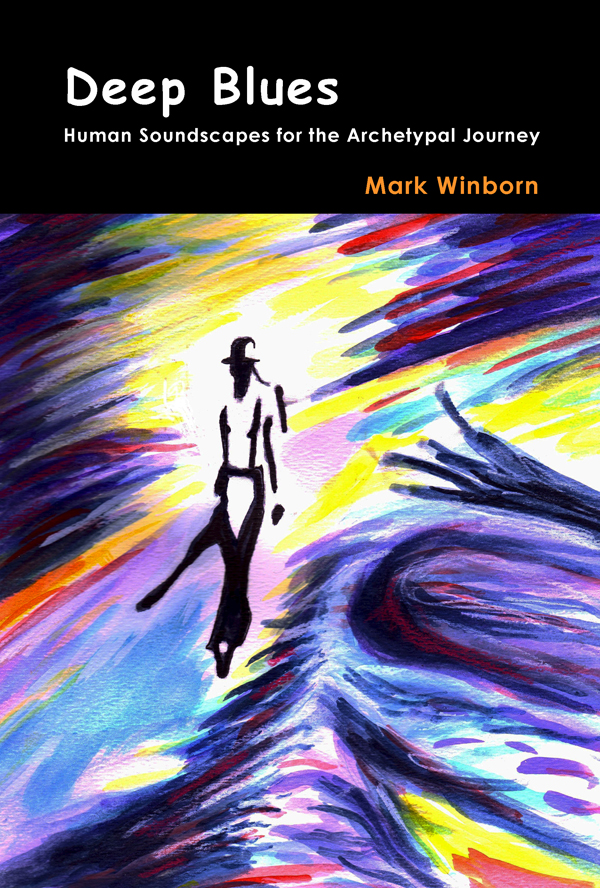
      "Deep Blues - Relational Healing" by Mark Winborn


      The blues have been close to my heart since I was about 13 or 14 years old. I didn’t know why I was attracted to the blues but I knew it resonated with something in me as soon as I heard it. The gritty, visceral, deep feel of the blues expressed something for me that I couldn't express for myself.  Some have even referred to the blues as the "education of the heart."

      This blues is about hearing and resonating with the pain, suffering, joy, or sadness in the voice of the singer.  The understanding of the blues comes through the direct experience of the music rather than through the intellect.  In this respect, understanding the blues is similar to a perspective about images offered by Carl Jung - "Image and meaning are identical . . . the pattern needs no interpretation: it portrays its own meaning."

      It is this universally felt and understood meaning that gives power to the blues for both the performer and the audience.  The music of the blues is the only genre specifically created for the evocation of an emotional response.  In fact, the phrase “the blues” refers to both the music and a feeling.  While all forms of music create a connection on an emotional level – it is only with the blues that this becomes the primary focus.  The word “blues” is derived from the term “blue devils” which referred to contrary spirits that hung around and caused sadness.

      The early influences of the blues originate in West Africa, transported to America by African slaves. The first generation of African slaves sang African songs and chants. By the second generation those songs were replaced by work songs with the conditions of their American environment as the focus.  It is impossible to identify when the unique pattern of musical form, now labeled the blues, first emerged. However, most evidence suggests that it originated in the Delta cotton country of northwest Mississippi during the late 1800's from the work songs of former slaves, sharecroppers, and chain gang prisoners.  The music is typically sung from an individual perspective but about issues and emotional experience common to all – for example - lost love, joy, sexuality, rage, sadness, grief, oppression, relief, addiction, migration, or transcendence. 

      When a blues musician refers to himself as a "bluesman" he is not only referring to the type of music he plays but also the type of life he has led and the attitude he has about life. It is in this last sense that the blues begins to comment upon or amplify the anima mundi, or world soul. An awareness of the world soul can be detected in many blues songs,  such as Elmore James’ - The Sky is Crying where the tears of the singer and the tears of the world run together: 

      The sky is crying, look at the tears roll down the street
      I'm waiting in tears for my baby, and I wonder where can she be?
      I saw my baby one morning, and she was walking down the street
      Make me feel so good until my poor heart would skip a beat
      I got a bad feeling, my baby, my baby don't love me no more
      Now the sky been crying, the tears rolling down my door  

                  The blues philosophy, expressed through the music, includes the idea that the blues is something to be accepted; not something to be gotten rid of or fixed.  The blues is experienced, lived through, and survived; not conquered or overcome. One hopes to eventually feel better but the intent is to acknowledge and cope with the deeply visceral experience of the blues as in Going Down Slow by Mance Lipscomb:  

      Don't send no doctor, he can't do me no good.
      It's all my fault, mama, I didn't do the things I should.

      But I think it is in the power to transcend boundaries of individual and group experience that the blues speaks and acts most powerfully.  A Jungian psychoanalyst, Erich Neumann, uses the phrase “unitary reality” to describe experiences in which the boundaries and distinction between individuals becomes blurred and there is an experience of a shared reality.  At times this blurring occurs between the individual and their environment and such experiences are common in the blues.  Blues musician Little Whitt Wells says, "You know, the blues is a trance music. If it can't take you there, it ain't worth the effort, and if folks can't get there, well I guess it’s not meant for them . . . The blues is where it’s at with me. I am the blues, it’s my life."  This blurring can occur between the musician and the music, between performer and instrument, and between audience and performer.  Mythologist Joseph Campbell draws our attention to similar patterns between the mystic and the artist:

      For the reality in which the artist and the mystic are exposed is, in fact, the same. It is of their own inmost truth brought to consciousness: by the mystic, direct confrontation, and by the artist, through reflection in the masterworks of his art. The fact that the nature of the artist (as a microcosm) and the nature of the universe (as the macrocosm) are two aspects of the same reality. 

      In our increasingly isolated and technologically engrossed culture there are fewer and fewer opportunities to move into these shared experiences of unitary reality in which the bubble of our individualism is pierced and we are able to move into felt, relational connection to our environment and those around us.  The blues allows us to move into a deeper communion with our own emotional life, especially the more difficult emotions that are often shunned in our relentless pursuit of happiness, material acquisition, and activities designed to occupy time rather than expand soul.  Often it is only by moving into and through sadness that we can be released into an experience of joy.  The blues facilitates this process.  In this regard the bluesman, by communicating feelings in song that resonate within the listener, serves as a modern day shaman who heals through the ritual of music.  The blues originated in experiences of trauma, oppression, and enslavement but now serves to liberate our emotional lives and facilitate a deeper union with our environment and those around us.  Robert Johnson, Muddy Waters, and Howlin Wolf  all have something significant to contribute to the care of our soul.

      *This article includes some excerpts from the book Deep Blues: HumanSoundscapes for the Archetypal Journey.
                 Click to Listen to Son House - Death Letter Blues
      Fisher King Press publishes an eclectic mix of worthy books including Jungian Psychological Perspectives, Cutting-Edge Fiction, and a growing list of alternative titles.

      • International Shipping.
      • Credit Cards Accepted.
      • Phone Orders Welcomed: +1-831-238-7799 skype: fisher_king_press

      Saturday, March 26, 2011

      Jigging in the Deep Blues: News Release

      Another Fisher King Press title is on the way:

      Deep Blues: Human Soundscapes for the Archetypal Journey

      by Mark Winborn

      Deep Blues explores the archetypal journey of the human psyche through an examination of the blues as a musical genre. The genesis, history, and thematic patterns of the blues are examined from an archetypal perspective and various analytic theories. Mythological and shamanistic parallels are used to provide a deeper understanding of the role of the bluesman, the blues performance, and the innate healing potential of the blues.  Universal aspects of human experience and transcendence are revealed through the creative medium of the blues. The atmosphere of Deep Blues is enhanced by the black and white photographs of Tom Smith which capture striking blues performances in the Maxwell Street section of Chicago.  Jungian analysts, therapists and psychoanalytic practitioners with an interest in the interaction between creative expression and human experience should find Deep Blues satisfying. Deep Blues should also appeal to enthusiasts of music, ethnomusicology, and the blues.

      about the author
      Mark Winborn, PhD, NCPsyA is a Jungian Psychoanalyst and Clinical Psychologist. He is a training and supervising analyst of the Inter-Regional Society of Jungian Analysts and is also affiliated with the National Association for the Advancement of Psychoanalysis and the International Association for Analytical Psychology. Dr. Winborn maintains a private practice in Memphis, Tennessee where he is also currently the Training Coordinator for the Memphis Jungian Seminar, a training seminar of the IRSJA.
      Fisher King Press publishes an eclectic mix of worthy books including Jungian Psychological Perspectives, Cutting Edge Fiction, and a growing list of alternative titles.
        • We Ship Worldwide.
        • Credit Cards Accepted.
        • Phone Orders Welcomed: +1-831-238-7799 skype: fisher_king_press

        Wednesday, December 8, 2010

        Music and Soul

        About Music and Psyche

        Paul Ashton and Stephen Bloch are Jungian Psychoanalysts living and working in Cape Town. They both have an abiding interest in music of different sorts and Music and Psyche came together from that interest as well as a fascination and curiosity about how music functions both as an agent of healing and as a medium that touches areas of the psyche that words cannot. Realising that they could not themselves cover such a vast subject in the depth that they wanted to, they invited authors with differing interests and backgrounds to participate in the project by submitting essays on any aspect of music that gripped them at the time of writing.

        The result is a lovely book which has been written by 13 different authors. Two of them are music therapists, one a composer, one a singer and theologian, another a psychoanalyst and the remainder from a Jungian background. All share a love of music. To enhance the experience of what the writers are expressing a CD accompanies the book. About half the chapters in the book are "illustrated" on this CD.

        There are two interviews, both with individuals who may be referred to as "grandfathers" in the tradition of depth-psychology, as well as having been steeped in music. Mario Jacoby was a professional classical violinist before he became a Jungian analyst and author of many books and papers. Michael Eigen is a psychoanalytic psychotherapist with a passion for music. He is also a prolific writer with about 18 books to his credit. These interview subjects use music primarily as a metaphor for the analytic process and encourage psychotherapists to listen within theirsessions with a musical ear.

        Although Kevin O'Connell's essay on Stravinsky's Rite of Spring is written from a musician's point of view, it is deeply psychological too, raising ideas that connect as much with "soul" as with compositional techniques. When William Willeford writes about "the blues" he is writing as much about the human condition as he is about the music of that name. His essay is one that has been put with two others that demonstrate the healing power of music in a more communal setting. One of these is Melinda Haas's chapter that describes the Venezuelan-developed idea called El Sistema. This is based on a concept that true democratic principles as well as feelings of self-worth can be developed through orchestral playing and that every child should have that opportunity. Chris Wildman writes about his experience as musician in a "playback" theatre type group that assists individuals and groups deal with difficulties that have affected them as a community. His examples bring us insight into the lives of the people he describes as well as into music itself.

        Recently a journal appeared with a paper describing the usefulness of music in a neuroscience institution in the US. There was no mention of what type of music was being played and when one of the authors was contacted her response was: "Well we just play music." What an undifferentiated reply! There are so many different types of music and so many individuals in the world who reacte differently to the same music. In Stephen Bloch's chapter on the Black Sun he describes music as an "acoustic image" and demonstrates how different compositions evoke different psychological experiences of what has been described in largely visual terms as "The Black Sun". That chapter and his chapter on Mercy deepen one's psychological understanding as well as supplying examples of music from many different sources that are outside our usual ambit.

        In another idiom Paul Ashton writes about the varied effects of sounds generated by different instruments and brings together diverse theories about the different parts of the brain that are implicated in processing the various aspects of which music is composed. These encompass rhythm, tone, tune or melody, and harmony, etc. Music can have an effect on the body and the mind, generating pain relief or aggravating pain, causing excitement or restfulness and giving rise to distinct emotions. How that happens is the subject of his chapter.

        Larry Wetzler has written two chapters that link clinical and theoretical concepts (of Winnicott, Bion and Lacan) with the idea of music as a healing "substance." Something similar is discussed, but in a very different way, by Helen Anderson who explores the nature of Beethoven's Piano Sonata No 31. Both authors' give clinical examples from their practices. It is apparent that one of them chose the music for the patient whereas the other worked with the music brought. In both cases the music, and the process, was healing.

        Two New Yorkers describe musical compositions as products, or at least descriptors, not only of the composer's individual time and place, but of his psychological make-up too. Melinda Haas writes movingly about Mahler and his Ninth Symphony and Laurel Morris about Robert Schumann's life and music. Both writers broaden one's understanding of both music and the psyche.

        Bringing us into the 20th Century by exploring particularly its less formal music, John Beebe develops the idea of the anima as expressed though the voices of popular singers. This soulful chapter deepens our thinking about voices, performers, men, women and human psychology. William Willeford in his chapter about "the blues" expands our understanding of that very human condition and demonstrates how effective "singing the blues" or listening to "the blues" can be in alleviating it. Patricia Skar describes her development as musician and analyst and articulates the idea of music being a bridge to the deepest recesses of one's mind or to the widest reaches of the infinite, whichever way one would like to see that.

        Music and Psyche ends appropriately with a chapter by the Irish singer and theologian Noirin Ni Riain. Through her writing, and her voice on the accompanying CD, the reader/listener is transported, through silence and music, into a new experience of the ineffable beyond.

        Fisher King Press publishes an eclectic mix of worthy books including Jungian Psychological Perspectives, Cutting Edge Fiction, and a growing  list of alternative titles.
        • We Ship Worldwide.
        • Credit Cards Accepted.
        • Phone Orders Welcomed. +1-831-238-7799. skype: fisher_king_press

            Friday, July 31, 2009

            The Father Spirit: At the Turning Point

            an article by Bud Harris, Ph.D.

            A Guide for Rediscovering and Renewing
            the Foundations of Fatherhood


            The Father Spirit at the Turning Point

            As I was reflecting on Fathers' Day this year and developing the material I'm going to use in a Fall lecture and workshop, "The Father Quest: A Guide for Rediscovering and Renewing the Foundations of Fatherhood," I was moved to write the following article. I titled it "The Father Spirit at the Turning Point." Good friends who publish Western North Carolina Woman magazine included it in their June issue; every year their June issue is "Honoring the Y Chromosome." Because of the enthusiastic response to the article, I've decided to share it with you. I hope that you will find it inspiring and enriching.

            A few mornings after Christmas my wife and I were sitting at the breakfast table with my daughter. While I slowly sipped my tea, she was explaining how the slump in the economy had impacted their holidays. As a family of five with three children, finding their income reduced substantially had ushered in a holiday stress that was new to them. When she finished talking she sighed and added, "I've given up any hope that we can leave our children any better off than we were."

            I was shocked by the discouragement in her voice. Leaving our children better off than we were when we started adult life has been a major part of the American Dream for as long as I can remember. I don't know how old that part of our dream is but I'm sure my father, who lived through the Great Depression, devoted much of his life to it. For his age-group, being sure your children went to college was considered a guarantee for the chance at a better life. My father's generation came out of the depression, World War II and the atomic age with a colossal yearning to create a healthy, sound world. They wanted their children to have lives that were smooth and prosperous. As we lived into the nineteen fifties our society and our families tried to make problems taboo. We wanted to have certainties. Or, rather, our parents wanted to have them for us even as the world was spiraling into the chaos of the nineteen sixties. I don't blame them for their longings because I know they were born out of the fear and traumas they endured and their desire to create a safer world for themselves and their children. Yet, this longing eventually became the root of their problems as it narrowed their perspective on life and now it has become the root of our problems as we have concretized the symbols of well-being onto financial success and material abundance.

            I can easily remember that in the nineteen seventies our societal goal was to have more leisure time for our families and recreation. But, as we moved into the recession and energy shortage of the early nineteen eighties our old economic terrors began to re-emerge and we refocused on becoming workaholics; the trend-setting movie of that decade was Wall Street, famous for the speech in it that "greed is good." Instead of being a warning, this movie forecast the future.

            The fear, anxiety and profound challenges that had caused a generation of men to become our "greatest generation" left them so wounded that they were unable to train and mentor their sons to be capable of meeting new challenges. My father and my coaches and teachers were more concerned that we be able to get "good" jobs than they were with teaching courage and the importance of character. They had lost track of the fact that the world is always spinning into a future of new challenges that we can rarely predict. This kind of a world can only be met effectively when we have learned something about the importance of having character, which includes love, openness, courage, integrity, and the respect for creativity. The dream of our Founding Fathers was to create a country where individuals could experience freedom, dignity, respect, equal protection under the law, the right to a representative government, the right to worship according to our own conscience and the pursuit of happiness. While this vision was imperfectly implemented it was the most profound social vision in history.

            Let us remember now that the reason we call these men the Founding Fathers is no accident. In archetypal terms it is the positive, inspiring Father Spirit that calls for transformation, a renaissance of the spirit of the times in the culture or in each of us. From the perspective of Jungian psychology it is the positive Father Spirit that has called me to transform myself and grow through and beyond the crises in my life, and it is the positive Father Principle (both coming from the same archetype) that demands I must give a personal response to new life and a protective field for it to grow in. This is an important part of the definition of father love whether it is to mother and child or to the concerns of culture. It is the responsibility of father love to build a place for new life to thrive in.

            Let us remember also that every archetypal image has a negative, destructive side as well as a positive, nurturing one. There is a negative destructive Father Spirit that we must watch out for. We have seen this image pictured in stories and movies. Darth Vader may be the one that is best known, or the father whose son committed suicide in Dead Poets' Society. Of course, some of us have experienced personifications of the destructive father spirit personally if our father was abusive or supported the Great Santini approach to sports, confrontation or aggression. The negative father spirit is also one that is fearful, afraid of being overwhelmed by life, and is therefore afraid of change, new life, and creative potentials. When we are possessed by this spirit we live in the illusionary hope that the way we did it in the past will be the best way to do it in the future.

            These descriptions of the negative father spirit remind me of the experiences of an old college friend. We went to Georgia Tech and he majored in industrial engineering. His father owned a plant that produced concrete blocks. My friend looked forward to the day he could join his father and uncles in the family business. After his graduation his father said he wanted to teach him the business from the ground up and he started him at a low-paying, nasty, back-breaking job in the plant. In reality, my friend learned to hate the business and the true nature of his father that he discovered in the process. He realized his father had no respect for his intelligence or achievements in a tough university, and little respect for his desire to be close to him. And he was unable to nurture his son's ability to bring a new spirit of creativity into the business. His father's interest in maintaining his power and superiority was more important to him than his love for his son.

            When my daughter spoke to me a few days after Christmas, I was too surprised to answer her very well. But after thinking about what she said I realized that we are at a turning point in history. I believe that we can leave our children and our grandchildren better off than when we entered adult life. But I also believe that our quest today is to leave them better off spiritually than we were. We can teach them more about reality than we were taught. We can help them learn while they are still in the safety of our love that life is full of uncertainty and anxiety, faith and nagging doubts, profound emotions, health and sickness, love, despair and grandeur. Our goal should not be to help them search for security but for competence in adult endeavors and for meaning along with the kind of passion that is soul deep rather than settling for the good life based on materialism. We must also teach by example or our efforts will be without substance.

            If we are going to leave them better off spiritually than we were, we must be living a life supported by a spiritual purpose that is more profound than appearances, the security of fundamentalism, practices that help us avoid looking into our own souls, or the naïve answers of groups immersed in positive thinking. We should be able to show by how we live that we are aware of our ability to confront our deepest fears and hopes, our joys and sorrows, our wounds of love and how we've failed our own ideals at times. And, as our children mature we must be able to share some of what we've learned from these experiences.

            The new president we've elected symbolizes a turning point. So far, he is facing our many problems with foresight and intelligence. I'm impressed that he doesn't see war as the solution to every problem ranging from cancer to terrorism. It is about time we learned, or relearned the lesson from our Founding Fathers, that masculine strength, wisdom and courage, when used in support of life's greatest principles, can overcome the efforts of mighty empires whose major focus is on power and commerce.

            Our new president is a symbol of the new potential that has been aroused in our country. But, he is not a savior and he knows it. We must answer our own call to transform our model of living into one that isn't based on the fear of losing our never-ending material growth. The Father Spirit at its best calls us to look for balance and depth, for spiritual growth to balance our material growth and spiritual depth to provide the meaning that can give purpose and support to our lives-because neither the material alone nor the spiritual alone can give us the needed fullness of life.

            We are also in a dangerous time. When great new potentials are born, the forces of the old order are threatened and fight back. Just as King Herod slaughtered the innocents, all of the new creative potentials he could get his hands on, the voices of conventional wisdom, of fear and the status quo, will fight viciously to retain their power and control. But, this is an era for men to live with new courage, creativity and love-in the support of life. I am looking forward to seeing my grandsons live into this world, and I want to do everything I can to help prepare them for it and it for them.


            The Father Quest: Rediscovering and Elemental Force
            by Bud Harris
            ISBN 978-0-9810344-9-2
            Available from your local bookstore, a host of online booksellers, and directly from Fisher King Press by phoning 1 831-238-7799.

            Thursday, May 14, 2009

            News Release: The Motherline

            With Great Pleasure Fisher King Press announced the publication of:

            The Mothering: Every Woman's Journey to Find Her Female Roots

            by Naomi Ruth Lowinsky
            (Recent recipient of the for Obama Millennium first prize writing award.)

            Our mothers are the first world we know, the source of our lives and stories. Embodying the mysteries of origin, they tie us to the great web of kin and generation. Yet, the voice of their experience is seldom heard. The Motherline describes a woman’s journey to find her roots in the personal, cultural, and archetypal realms. It was written for women who have mothers, are mothers, or are considering motherhood, and for the men who love them. Telling the stories of women whose maturation has been experienced in the cycle of mothering, it urges a view of women that does not sever mother from daughter, feminism from “the feminine,” body from soul.

            Here what a few reviewers have had to say about The Motherline:

            “(In) this perceptive and penetrating study . . . (Naomi Ruth Lowinsky) imaginatively applies Jungian, feminist and literary approaches to popular attitudes about . . . mothers and daughters and movingly, to personal experience.”
            —Publisher’s Weekly

            “A combination of years of scholarship and recordings of personal journeys, this book belongs in every woman’s psychology/spirituality collection.”
            —Library Journal

            “In this accessible volume, Jungian psychologist Lowinsky explores the pain that women feel when their mother-love is undervalued or erased.”
            —ALA Booklist
            In addition to The Motherline: Every Woman’s Journey to Find Her Female Roots and The Sister from Below: When the Muse Gets Her Way, Naomi Ruth Lowinsky is the author of numerous prose essays, many of which have been published in Psychological Perspectives and The Jung Journal. She has had poetry published in many literary magazines and anthologies, among them After Shocks: The Poetry of Recovery, Weber Studies, Rattle, Atlanta Review, Tiferet and Runes. Her two poetry collections, red clay is talking (2000) and crimes of the dreamer (2005) were published by Scarlet Tanager Books. Naomi is a Jungian analyst in private practice and poetry and fiction editor of Psychological Perspectives.

            Naomi Ruth Lowinsky has recently been awarded first prize in the Obama Millennium contest for her poem “Madelyn Dunham, Passing On” in which she imagines the spirit of of Obama’s deceased grandmother visiting him as he speaks to the crowds in Chicago after his election. The poem will be published in the literary magazine New Millennium Writings this fall. www.sisterfrombelow.com

            The Motherline: 
            Every Woman’s Journey to Find Her Female Roots
            —ISBN 978-0-9810344-6-1
            Published by and available for purchase directly from Fisher King Press.
            Also available from your local bookstore, and a host of on-line booksellers.
            Publication Date: June 1st, 2009