Showing posts with label psychology. Show all posts

Sunday, November 25, 2018

Advent and Psychic Birth - An Introduction

From Advent and Psychic Birth by Mariann Burke

Meister Eckhart in a Christmas sermon paraphrasing St. Augustine says of Christ's birth, "This birth is always happening. And yet, if it does not occur in me, how could it help me? Everything depends on that."(1) The thesis of this book is that our own psychological "birth" is related to the "birth" of God within us, and that this birth is "always hap­pening." The paradox is that we long for this birth and yet we fear it. For centuries our unconscious fears and longing have been mirrored and "contained" in the religious dogma and symbolism of the church, a channel to the riverbed of the unconscious. But in a church and a culture that general­ly devalues the feminine realm--earth, the body, sexuality, instinct--these energies flow back into the psyche. Today the longing for consciousness and the integration of these energies have led many to leave the church which, they feel, no longer speaks to their needs. Others find spiritual ful­fillment in a strong adherence to traditional doctrinal and Biblical interpretation. Still others, in increasing numbers, find that a more personal inner journey leads not only to greater self-awareness, but also to a richer appreciation of their religious heritage.

My approach throughout Advent and Psychic Birth is to try to make connections between the archetypal images and personal experience, in both ancient and modern modalities, through associations, amplifications and clinical material. In one sense this approach has evolved out of my training in ana­lytical psychology. Yet it has become deeply personal and flows out of my own felt sense of the Advent imagery and my own journey toward psychic birth. Far from diminish­ing my faith in Christ, it has broadened and deepened my understanding of the meaning of incarnation. Jung writes: "The efficacy of dogma by no means rests on Christ's unique historical reality but on its own symbolic nature, by virtue of which it expresses a more or less ubiquitous psy­chological assumption quite independent of the existence of any dogma."(2) On first reading these words we may feel that Jung is undermining dogma and Christ's mission on earth, yet our own experience as it relates to the underlying pattern of dogma, can only serve to enrich its meaning. "In religious matters ... we cannot understand a thing until we have experienced it inwardly ... for it is in this experience that the connection between the psyche and the outward image or creed is revealed .... "(3)

For each of us the image that speaks to us differs. For some it is an image from the Bible or from another religious tradition, while for others it is a dream image, or an image that seems to surface directly from the body. Each of these can be received as "messages " from God.

If we look at the biblical poetry of Advent in a more personal way, we find that while it belongs to the Hebrew and Christian scriptures, it transcends both. Beginning in darkness and destruction and ending in light and rebirth, Advent imagery represents a mythic or archetypal pattern. The Advent call to awaken from sleep is a call to follow the way of consciousness, to search for the inestimable gift, the treasure of the "hidden" self as well as the Imago Dei which carries the power to revitalize us both as individuals and communities. Symbolically, the four Sundays of Advent remind us of the quarternity and of wholeness, as does the familiar Advent wreath with its four candles, one lighted each week suggesting the gradual dissipation of inner and outer darkness. During the first three weeks of the Advent liturgy, the tone is decidedly one of action and movement, beginning with the Baptist's call to prepare a way. With the desert "transition" the tone changes, and during the fourth week the Virgin appears, strong, questioning, willing to trust in the unknown. As in any religious initiation we are led to participate in a new dimension of life. Here, if we can con­tact our own "virgin energies," we listen as the angel speaks and we, in silence, like Mary, wait as the earth "buds forth a savior."

Friday, July 13, 2018

Remembering Erel Shalit, 1950 – 2018

Remembering Erel Shalit, 1950 – 2018

Erel Shalit was a Jungian psychoanalyst in Tel Aviv and worked as a training and supervising analyst. He was a past president of the Israel Society of Analytical Psychology and founder and past director of the Jungian Analytical Psychotherapy Program at Bar Ilan University. Earlier in his career he was the director of the Shamai Davidson Community Mental Health Clinic.

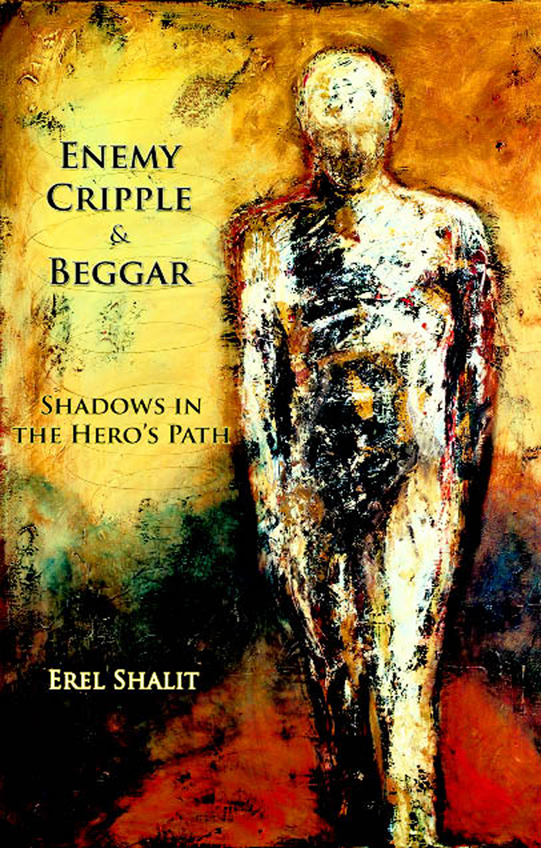
Erel Shalit was instrumental in firmly establishing Fisher King Press as a publisher of Jungian Psychology Books: Publishing Enemy, Cripple, Beggar: Shadows in the Hero’s Path in July of 2007 was the stamp of approval that brought Fisher King Press credibility in the Jungian circles and in turn so many other fine Jungian authors.

Dr. Shalit authored several Fisher King Press publications, including: The Cycle of Life: Themes and Tales of the Journey, Requiem: A Tale of Exile and Return, Enemy, Cripple, Beggar: Shadows in the Hero’s Path, The Hero and His Shadow: Psychopolitical Aspects of Myth and Reality in Israel. With Nancy Swift Furlotti, Erel co-edited, The Dream and its Amplification.

I am grateful to have been a friend of Erel Shalit, grateful to be the publisher of so many of Erel’s books, grateful for all of the love, compassion, and consciousness he has brought to the world.

Mel Mathews
Publisher, Fisher King Press
Fisher King Press publishes an eclectic mix of worthy books including Jungian Psychological Perspectives and a growing list of Cutting-Edge alternative titles. www.fisherkingpress.com

Thursday, July 12, 2018

Remembering Thomas B. Kirsch

Remembering Thomas B. Kirsch
June 10, 1936 – October 22, 2017

From conception on, C.G. Jung, his ideas, and analytical psychology itself was a central thread of Thomas B. Kirsch’s life. His parents, James and Hilde Kirsch, were in analysis with C.G. Jung when Tom was born, and he was imaged to be the product of a successful analysis. At an early age, Dr. Kirsch was introduced to many of the first-generation analysts who surrounded C.G. Jung, and over time became acquainted with them. Later, in his roles with the IAAP, Dr. Kirsch gained a broad knowledge of the developments in analytical psychology, and through both his early family history and in his later professional life, he worked closely with many analysts who were integral in forming the foundations of analytical psychology.

Dr. Kirsch graduated from Yale Medical School in 1961, did his residency in psychiatry in the Department of Psychiatry at Stanford University, and then spent two years with the National Institute of Mental Health in San Francisco. He completed his Jungian training at the C.G. Jung Institute of San Francisco in 1968. In 1976 Dr. Kirsch became president of the Jung institute in San Francisco, and in 1977 he was elected second vice president of the International Association for Analytical Psychology, or IAAP, the professional organization of Jungian analysts around the world. As vice president and then president of the IAAP for eighteen years, he traveled the world and was able to meet Jungian analysts from many different countries. This position allowed him to serve a missionary function of sorts in new areas like China, South Africa, Mexico, Russia, and other former Soviet Eastern Bloc countries. In A Jungian Life, Thomas B. Kirsch reflects upon his entire existence which has been intimately involved with C.G. Jung and analytical psychology.

We are grateful for the generous contributions Thomas B. Kirsch has made to humanity, and we are proud to be the publisher of his memoir: A Jungian Life.

Mel Mathews
Publisher, Fisher King Press
Fisher King Press publishes an eclectic mix of worthy books including Jungian Psychological Perspectives and a growing list of Cutting-Edge alternative titles. www.fisherkingpress.com

Saturday, July 7, 2018

Jungian Child Analysis - News Release


Just Published by Fisher King Press

Jungian Child Analysis

Jungian Child Analysis brings together ten certified Child and Adolescent Analysts (IAAP) to discuss how healing with children occurs within the analytical framework. While the majority of Jung’s corpus centered on the collective aspects of the adult psyche, one can find in Jung’s earliest work clinical observations and ideas that reflect an uncanny prescience of the psychological research that would later emerge regarding the self and the mother-infant relationship. This book discusses and illustrates in very practical ways how one uses an analytical attitude and works with the symbolic: this includes illustrations of analytical play therapy, dream analysis, sandplay, work with special populations and work with the parents and families of the child. Not only will the book capture your interest and further your development in working with children and adolescents, but also will enhance your work with adults.

Jungian Child Analysis, edited by Audrey Punnett; foreword by Wanda Grosso; contributors include Margo M. Leahy, Liza J. Ravitz, Brian Feldman, Lauren Cunningham, Patricia L. Speier, Maria Ellen Chiaia, Audrey Punnett, Susan Williams, Robert Tyminski, and Steve Zemmelman.

Contents:
Preface – Wanda Grosso
Introduction – Audrey Punnett

Chapter 1 – Margo M. Leahy
Jung and the Post-Jungians on the Theory of Jungian Child Analysis

Chapter 2 – Liza J. Ravitz
Child Analysis and the Multilayered Psyche

Chapter 3 – Brian Feldman
The Aesthetic and Spiritual Life of the Infant: Towards a Jungian View of Infant Development

Chapter 4 – Lauren Cunningham
Play, Creation and the Numinous

Chapter 5 – Patricia L. Speier
The Portal of Play Through a Jungian Frame

Chapter 6 – Maria Ellen Chiaia
The Importance of Being: Silence in Child Analysis

Chapter 7 – Audrey Punnett
Children’s Dreams

Chapter 8 – Susan Williams
Awakening to Inter-subjectivity: Working with Autistic Spectrum Disorders

Chapter 9 – Robert Tyminski
Males Coming to Terms with Sexuality in Later Adolescence

Chapter 10 – Steve Zemmelman
Working with Parents in Child Analysis and Psychotherapy: An Integrated Approach


Editor: Audrey Punnett
Paperback: 250 pages
Condition: New
Edition: First
Index, Bibliography
Publisher: Fisher King Press (May 21, 2018)
Language: English
ISBN-10: 1771690380
ISBN-13: 978-1771690386
Fisher King Press publishes an eclectic mix of worthy books including Jungian Psychological Perspectives and a growing list of Cutting-Edge alternative titles. www.fisherkingpress.com

Monday, September 11, 2017

War and The Enemy in the 21st Century

One of the greatest rewards of being a publisher is in reflecting and rejoicing in the many meaningful and timely Fisher King Press publications. It truly is a privilege to be the midwife of these newborns—many of whom arrive far ahead of their time—and to witness their maturing and assimilation into the collective consciousness.

With the wars being fought on many fronts, and with the posturing and possibility of yet more, I reached for Erel Shalit’s Enemy, Cripple, Beggar: Shadows in the Hero’s Path (which we published in 2008) and have been reading from Shalit’s chapter on The Enemy, which in the beginning of the chapter, states:
On [the journey], the hero initially meets the Enemy, because the previously unrealized and unconscious dark side, the shadow, is often first encountered in projection, as carried by the enemy. 
In reference to the First World War, Jung wrote in 1916: "As events in wartime have clearly shown, our mentality is distinguished by the shameless naïveté with which we judge our enemy, and in the judgment we pronounce upon him we unwittingly reveal our own defects: we simply accuse our enemy of our own unadmitted faults." (C.G. Jung, Collected Works 8, 2nd ed., par. 516.)
The realization of the enemy shadow—whether persecuted by it, or when trying to flee or to fight it—provides a possibility of energizing the ego. In the inward process of finding one’s pain and resources, and in order to eventually find one’s way to the inner wounds that unsettle us if we do not attend to them, to find the wounded child in our soul, it is necessary to go through the projections of the shadow . . .
This is just the first few paragraphs of the chapter that explores many facets of the enemy archetype. If you have a copy of Enemy, Cripple, Beggar, I encourage you to revisit this timely publication. If you do not have a copy . . . well, here’s a link to purchase a copy of this rich and worthy book: Enemy, Cripple, Beggar.

As the publisher of Fisher King Press, I would also like to extend a heartfelt thank you to the many readers of our publications, and to our authors who have done the hard work of research, mining the depths of their inner worlds, and for bring back to us these timeless gems.
Fisher King Press publishes an eclectic mix of worthy books including Jungian Psychological Perspectives and a growing list of Cutting-Edge alternative titles. www.fisherkingpress.com

Monday, November 28, 2016

The Rabbi, the Goddess, and Jung

Just Published by Fisher King Press:

The Rabbi, The Goddess, And Jung 
by Naomi Ruth Lowinsky

"The Rabbi, the Goddess, and Jung, a book of essays written in tribute to the depths and the riches of Jungian Psychology—how it helps us get the “word from within”— enters the world at a time when most of us get the word from Facebook, Twitter, Instagram ... when the suck of all those e-mails demands our response before we write down that dream or take time to listen for the still small voice of the soul. As William Giraldi says, we are in thrall to our “illuminated rectangles.” I was moved to read his passionate defense of inwardness. I think it is not only literary art that needs to remain “steadfastly itself,” but Jungian Psychology, which does the subversive work of countering the dominant culture, honoring the “word from within” and the practice of tracking the dream. As Jung tells it in The Red Book, being a slave to “the spirit of the times” can annihilate the soul. A descent to the “the spirit of the depths” can release the spiral serpent of wisdom and creativity." (Naomi Ruth Lowinsky www.thesisterfrombelow.com)

Naomi Ruth Lowinsky creates a sanctuary for the soul in her new book, The Rabbi, the Goddess, and Jung. She shows us the ways in which cultivation of one’s inner life creates sacred space. Admitting that this is not an easy practice in our hectic, fearful times, she demonstrates how the word from within orients—whether it comes as gift or disturbance, guest or ghost, riddle or revelation. It may force a confrontation with one’s worst fears. It may visit in nightmare images, such as . . . Learn More
Fisher King Press publishes an eclectic mix of worthy books including Jungian Psychological Perspectives and a growing list of Cutting-Edge alternative titles. www.fisherkingpress.com

Sunday, February 28, 2016

The Soul of Glacier Country


Fisher King Press author Dennis Merritt will be giving an illustrated talk on “The Soul of Glacier Country” at the Society for the Anthropology of Consciousness (SAC) annual conference in Portland, Oregon on Friday, April 1, 2016. SAC is a branch of the American Anthropological Association. The section Dennis will be speaking in is “Landscapes of Transformation—Encountering the Sacred.” The presentation offers a visual illustration of the glacial history part of his book Land, Weather, Seasons, Insects: An Archetypal View, which is volume 4 of The Dairy Farmer’s Guide to the Universe—Jung, Hermes, and Ecopsychology.

A basic premise of ecopsychology and deep ecology is that a person connected to the land will have a natural desire to protect it. Dreams of landscapes, plants, animals, and natural phenomena like storms can be used to establish a sense of place, especially if these natural elements appear with a numinous or sacred quality in a dream. Dennis Merritt will present his dream of a typical Midwestern landscape that appeared in a sacred light and describe how he used that dream to connect with the soul of glacier country via weekly round-trip bus rides through a notable glacial feature called drumlins. Ten different time frames can be experienced on that journey.

Fisher King Press publishes an eclectic mix of worthy books including Jungian psychological perspectives and a growing list of cutting-edge alternative titles.   

Saturday, January 9, 2016

Guilt with a Twist Good Reads Giveaway


Goodreads Book Giveaway

Guilt with a Twist by Lawrence H. Staples

Guilt with a Twist

by Lawrence H. Staples

Giveaway ends January 27, 2016.
See the giveaway details at Goodreads.
Enter Giveaway

Fisher King Press publishes an eclectic mix of worthy books including 
Jungian Psychological Perspectives, Cutting-Edge Fiction, Poetry, 
and a growing list of alternative titles. 

Sunday, December 6, 2015

A Welcome Contribution to the Mysteries of Advent

Mariann Burke’s Advent and Psychic Birth does true justice to a great tradition. The author describes Advent as a remembrance and ritualistic preparation for the birth of the historical Christ. She notes, however, that if Christmas is solely a revival of an outer event, it will sooner or later loose its inner significance for the soul.

It is not by accident that the birth of Christ is celebrated around the winter solstice. The author draws attention to the historical links between Christmas and the ancient Saturnalian festivals, held in Rome during the second half of December. They can be understood as a revival of yet older traditions that focused on bringing the ailing sun back to life. The people of archaic cultures had no access to modern astronomy and could never be sure if the sun would regain its strength for the coming year. Hence it needed the help of humans to guarantee the continuity of life, as witnessed in Jung’s conversation with Pueblo Indian who claimed that without their religious practice, the sun might never rise again.

It is precisely this uncertainty that provides Advent with a new significance. If we just follow the outer rituals, without ever questioning the meaning of the birth of God in man, our soul will hardly access the full implications of the tradition. The author reminds us that Advent is a time of darkness. Not only the waning sun possesses an ominous significance, but also the first texts of this cycle begin with the destruction from the Great Flood. They also describe cataclysmic events of the future, and advocate us to remain awake during the night, for we do not know when the master will arrive. The liturgy of the second Sunday focuses on liminality, a time of betwixt and betweens. It is devoted to John the Baptist and his time in the wilderness, a psychological space outside of the norms of conventionality. On the third Sunday there are hints of a new baptism, implying a spiritual rebirth destined for humankind. The fourth Sunday celebrates the union of the Holy Spirit with the human Mary, a meeting of heaven and earth, a joining of opposites in preparation for the emergence of a new image of God and man.

With the help of alchemy and convincing case material, Mariann Burke shows us that the symbols and ritual drama of Advent awaken us to our deeper self. We too are exhorted to accept those dark, exiled, repressed components of the psyche. When we immerse ourselves in those ‘dead’ regions of the soul, we might loose our bearing, at least for a while. We begin to confront hidden desires, fears, or anger, but we can also watch out for signs of new symbol. We learn to be open to the creative potential of the unconscious, often manifesting in images of pregnancy, birth, or the appearance of the Divine Child.

This book is a welcome contribution to the mysteries of Advent. It encourages us to participate in the transformative process of death and renewal. It suggests that the soul needs to die and be reborn so that life blossoms in new and surprising ways. Mariann Burke’s book is a testimony to the wonders of revelation, a story that features the ongoing interaction between the human and divine. It can also help us to weave together the broken threads between Christianity and the older nature religions. Advent celebrates a time to anticipate the soul’s striving for wholeness.
 
John Hill, Jungian analyst, author of At Home in the World: Sounds and Symmetries of Belonging
Title:

Title: Advent and Psychic Birth
Author: Mariann Burke
Paperback: 172 pages
Publisher: Fisher King Press (Dec 1, 2014)
Language: English
ISBN-10: 1926715993
ISBN-13: 978-1926715995

Fisher King Press publishes an eclectic mix of worthy books including 
Jungian Psychological Perspectives, Cutting-Edge Fiction, Poetry, 
and a growing list of alternative titles. 

Tuesday, October 13, 2015

The Cycle of Life Goodreads Giveaway


Goodreads Book Giveaway

The Cycle of Life by Erel Shalit

The Cycle of Life

by Erel Shalit

Giveaway ends December 20, 2015.
See the giveaway details at Goodreads.
Enter Giveaway


Fisher King Press publishes an eclectic mix of worthy books including 
Jungian Psychological Perspectives, Cutting-Edge Fiction, Poetry, 
and a growing list of alternative titles. 

Monday, August 31, 2015

The Orphan as Symbol

A review of Audrey Punnett’s The Orphan: A Journey to Wholeness

Review by Dyane Sherwood

Audrey Punnett has brought this powerful topic to our attention in a thoughtful and multifaceted book that is engaging, carefully researched, and clearly written.  As a Jungian analyst, she concerns herself with the effects on individuals of losing a parent in childhood and with the universal questions of the Orphan in each of us—that is, the underdeveloped aspects of our personalities that have lacked the nurturing, structure, and sense of security that they have needed to grow.

In her opening chapters, Dr. Punnett recounts the way the theme of the orphan seemed to find her, rather than her consciously seeking it out, after she had moved alone to Zurich to enter analytic training.  Throughout, one can sense her deep empathy with the loneliness of the parentless child.

Saturday, July 25, 2015

The Life of Buddha and Individuation


"The life of Buddha is an example of individuation. He was privileged and enjoyed every possible means of comfort and pleasure, sheltered from want. What moved him to want to experience the world beyond his palace? He went into the world of ordinary people and found sickness, poverty, and suffering. It seemed he felt his life was not complete until he had experienced the dark and sordid side of life. Only then could he fulfill his destiny as a spiritual sage. His life illustrates the idea that we are not completed by being good or by having what seems like perfection. Individuation as completion means filling out all of our possible conscious experiences and being aware of our potential, the pleasant and unpleasant, good and bad." —Deldon Anne McNeely, Becoming: An Introduction to Jung's Concept of Individuation
Fisher King Press publishes an eclectic mix of worthy books including Jungian Psychological Perspectives, Cutting-Edge Fiction, Poetry, and a growing list of alternative titles. 

Monday, July 20, 2015

Letting Go of the Way We Wish Things Ideally Would Be

There are many worthy arguments for the existence of ideals. These include the role of ideals as an organizing principle around which people with similar values can gather. Like goals, ideals motivate us.

The need to be Jesus can lead to guilt, disillusionment, and dissatisfaction. The need to avoid the painful guilt of failing to achieve ideals often interferes in very practical ways with career development because they can never be satisfied with ordinary jobs. The shortfall from this ideal is predictable. This unconscious need to be great is often expressed by patients as dissatisfaction with their jobs, or as feelings that their work is meaningless or soulless. Sometimes the complaint is stronger; they feel that they are prostituting themselves. They may feel the same about their colleagues and bosses, who think only of profit. They say they want to do something that helps people or helps the environment or helps bring social justice. They often believe there is a job out there that will permit them to use their talents for some greater good or noble purpose.

Letting go of the way we wish things ideally would be can lead to more human development than the ideals themselves.
—Guilt with a Twist: The Promethean Way

article by Lawrence H. Staples

We would have to be blind, however, not to acknowledge their danger. By definition, when ideals are our guide, we strive for perfection that does not exist in the real world. We strive for something that in the long run will frustrate us and depress us because we will fall short. We will experience failure. Goals are different. Having realistically attainable goals can serve us well.

Sunday, July 12, 2015

Good Guilt. . . WHAT IS GOOD GUILT?

Good Guilt is the guilt we incur for the sins we need to commit, if we are to grow and fulfill ourselves. This paradoxical “twist” to the conventional meaning of guilt is the seminal idea behind Guilt with a Twist: The Promethean Way.

In common parlance, the words “good” and “guilt” don’t belong together. They appear to be contradictory. Personal and clinical experience, however, has repeatedly confirmed for me the useful role of sin and guilt in personal and psychological development. I began to notice that there are times in our lives when the experience of guilt actually was a signal of having done something good, even essential to nurture us. While the guilt probably did not feel like “Good Guilt” at the time of transgression, the “sin” that caused the guilt is sometimes viewed in retrospect as having brought something valuable to our life. Examples might include divorces, separations from partners and friends, giving up family-approved or family-dictated careers, or even marriages that are opposed by one’s family on the grounds of race, religion, gender, or social status. It might also include the expression of qualities previously rejected as unacceptable, like selfishness or the contra-sexual sides of ourselves. Later in life we may look at guilt thus incurred in a different light.

Order directly from Fisher King Press by calling +1-831-238-7799

Click the following link to order online Guilt with a Twist

Wednesday, May 27, 2015

Max Zeller and The Dream: The Vision of the Night

front book cover image of The Dream by Max Zeller May 27, 2015 - Press Release

Fisher King Press resurrects another Jungian Classic

A classic in the field of dream analysis, The Dream: The Vision of the Night is a collection of essays, lectures, and vignettes by Max Zeller whose career included a law degree, a brief imprisonment in a Nazi Concentration Camp, study at the Jung Institute in Zurich, Switzerland, and thirty years of in-depth work as a Jungian analyst.

In the eighteen pieces of this collection, Zeller intersperses theoretical writings, compassionate and incisive case studies, and powerful, almost haiku-like reminiscences of certain incidences in his life, from his meetings with C.G. Jung to his impressions of life in pre-war Nazi Germany.

The Dream: The Vision of the Night is the best example of amplification of Jungian principles that can be found. Neither pure research nor pure memoir, the collection is an affective combination of both, and as such best portrays the spirit of its author: always restless and searching, always compassionate and open-minded, and above all, always fascinated by the mystery and power of our dreams.

Saturday, March 21, 2015

Pierre Teilhard de Chardin and Carl Jung


March 21, 2015

Just Published by Fisher King Press

Pierre Teilhard de Chardin and Carl Gustav Jung: Side by Sideedited by Fred Gustafson

Pierre Teilhard de Chardin and C.G. Jung: Side by Side is an anthology written by authors from different backgrounds, sharing how the lives of Pierre Teilhard de Chardin and Carl Gustav Jung impacted them personally and/or how they understand the relevance of these two men for our present times.

Contributors to this fourth volume of the Fisher King Review include: John Dourley, Peter Dunlap, Barbara Faris, Fred R. Gustafson, John Giannini, Richard W. Hanhardt, Robert Henderson, Steven B. Herrmann, Jane A. Kelley, Jon Magnuson, Francisco (Paco) Martorell, Stan V. McDaniel, Dennis L. Merritt, and Laura A. Weber.

Though C.G. Jung and Pierre Teilhard de Chardin never met, their independent intellectual inquiries and courageous researches pushed the personal and collective soul forward and placed both of them at the foreground of needing to understand and integrate on a planetary level the core values of their expansive work.

Thursday, January 15, 2015

Celibacy and Soul: Exploring the Depths of Chastity

Just Published by Fisher King Press

Celibacy and Soul: Exploring the Depths of Chastity

by Susan J. Pollard 

In Celibacy and Soul, Jungian analyst Susan Pollard presents us with a rich and moving reflection on the meaning of a life of spiritual celibacy. Drawing on many sources (psychology, philosophy, mysticism, mythology, poetry) she offers us an encompassing, multicultural perspective on what is nowadays a poorly understood choice of life. An honest, courageous, and deeply helpful book for anyone faced with the challenges of chaste celibacy." — Diane Cousineau Brutsche, Ph.D., Jungian training and supervising analyst, International School for Analytical Psychology Zurich.

 "What wisdom and guidance is needed here! Celibacy and Soul. And here you have it! Good spirituality, good psychology, and lived experience are all growing together in one lovely fi eld of honest and divine love. is book is indeed ‘singular beauty’ and a gift to our humanity!" —Richard Rohr, O.F.M., author of Immortal Diamond: The Search for Our True Self.

"Dr. Susan Pollard offers something very special with this work. At a time when spiritually-focused celibacy is so little understood she brings an exceptional depth of focus and understanding to what can, indeed, be an immensely positive, life-affirming choice. Her skills as a Jungian analyst, and the depth of her own journey as a religious sister and as a Christian scholar, come together superbly here to make a book that will be widely and perhaps surprisingly relevant both within Christian circles and beyond them." — Stephanie Dowrick, Ph.D., author of Seeking the Sacred and In the Company of Rilke.

Monday, July 14, 2014

John Hill on The Orphan: A Journey to Wholeness


by John Hill, from the preface of
The Orphan: A Journey to Wholeness

The Orphan addresses loneliness and the feeling of being alone in the world, two distinct characteristics that mark the life of an orphan. Regardless if we have grown up with or without parents, we are all too likely to meet such experiences in ourselves and our daily encounters with others. Our technological age has enabled us to create networks with many people, but these relationships often fail to meet the need to belong to someone, some place or something in a world that suffers from “spiritual depletion, emotional alienation, and personal isolation.” With numerous case examples, Dr. Punnett describes how loneliness and the feeling of being alone tend to be repeated in later relationships, especially when the earlier attachment patterns have been insecure, disruptive, or intrusive and can eventually lead to pathological states of anxiety and depression.

In an historical survey, Dr. Punnett outlines some of the appalling conditions that parentless children have suffered. One just has to think of 19th century England, as described in the novels of Dickens or the Dying rooms of Asia. Despite Biblical exhortation to care for the homeless and the gradual increased social empathy for orphans, as witnessed in the creation of orphanages and their gradual replacement through foster families, improved outer circumstances fail to bring the kind of healing that makes such devastating experiences meaningful.

A main purpose of this book is not just to stay within the context of the literal orphan, but also to explore its symbolic dimensions, for the author believes that symbols provide meaning to the diverse experiences of feeling alone in the world. Regardless if a child is brought up by parents or not, the orphan complex can be constellated, especially if attachment patterns have been problematic. In order not to remain limited by a purely biographical approach to the psychological orphan, Dr. Punnett elaborates on the archetypal foundations of this complex. She notes that many heroes have suffered abandonment in childhood. Their birth and early development, usually emerging from miraculous circumstances, bear the characteristics of a Divine Child, symbolizing hope and renewal for the individual, for society, and for our culture.

The constellation of this archetype in dreams, fantasy, and sandplay can act as an inspiration and bring transformation to those who have endured the sufferings of an orphan. With the help of amplification and case material, the author shows in a convincing way how the constellation of the orphan archetype with its accompanying feelings of isolation, anguish, and despair can act as a catalyst for the individuation process. Inspired by Jung’s creation of the Orphan Stone in Bollingen, Dr. Punnett’s book has placed the orphan at the center rather than at the periphery of human concern and invites us to explore the creative potential in feeling alone in oneself and the world. This is a remarkable book on a subject that tends to be viewed with attitudes that are too narrow and restrictive. The author concludes that in accepting the orphan within, we begin to take responsibility for our own unique life journey, an attitude that also celebrates authentic relationship with the other.

John Hill
Zurich, Switzerland

Fisher King Press publishes an eclectic mix of worthy books including 
Jungian Psychological Perspectives, Cutting-Edge Fiction, Poetry, 
and a growing list of alternative titles. 

Saturday, July 5, 2014

On Keeping your Friends Close - Your Enemies Closer


by Erel Shalit

On his way, the hero initially meets the Enemy, because the previously unrealized and unconscious dark side, the shadow, is often first encountered in projection, as carried by the enemy.

In reference to the First World War, Jung wrote in 1916:
As events in wartime have clearly shown, our mentality is distinguished by the shameless naïveté with which we judge our enemy, and in the judgment we pronounce upon him we unwittingly reveal our own defects: we simply accuse our enemy of our own unadmitted faults. (C.G. Jung, CW 8,  quoted in Shalit's, Enemy, Cripple, Beggar)
The realization of the enemy shadow—whether persecuted by it, or when trying to flee or to fight it—provides a possibility of energizing the ego. In the inward process of finding one’s pain and resources, and in order to eventually find one’s way to the inner wounds that unsettle us if we do not attend to them, to find the wounded child in our soul, it is necessary to go through the projections of the shadow, as for instance in the following dream:
I am persecuted by a group of young children. I am really afraid, and run as quickly as I can. I then discover that I have found refuge in what looks like a concentration camp. I see that the commander is an Arab, in Nazi uniform. I try to escape, and finally I find a way out. I am really very frightened. I cross a field and come to a small village. Initially it looks friendly, but then I discover that I have been taken prisoner-of-war. Even though I am the prisoner, I am asked to treat a wounded child. The child looks angry, and I am scared, but I know this child is in pain, so I am determined to treat it.
In the following dream, which I have discussed elsewhere, the dreamer is painfully shown that there can be no ego without a shadow. Furthermore, it demonstrates how we are often awoken to encounter what lingers in the shadow, as it is projected onto the awesome enemy:
I see a small Arab boy crawling on his knees in the street, screaming in despair, ‘My hand is cut off.’ It is in the grass, some meters away from where he is crawling. At the crossroad of the street are four cut-off hands, reaching up through the asphalt. The sight is too frightening for me to approach. I don’t dare reach out a helping hand to bring his hand back to him, to the Arab boy. On the opposite side of the crossroad there is an overturned van. Underneath it, also on his knees, there is a Jewish man, dressed in a blue overall. His hands are tied together, and bandaged. It is Intifada. (Shalit, The Hero and His Shadow, p. 119.)
While the Arab boy initially is identified as the enemy, he is then recognized as the wounded one. Later the dreamer realizes that it is by this frightening encounter that he comes to see the struggling Self, the awesome sight of the four cut-off hands in the center of the crossroads.

Fisher King Press publishes an eclectic mix of worthy books including 
Jungian Psychological Perspectives, Cutting-Edge Fiction, Poetry, 
and a growing list of alternative titles. 

Tuesday, July 1, 2014

News Release: Just Published - Shared Realities


June 1, 2014 - Press Release

Shared Realities: Participation Mystique and Beyond
[The Fisher King Review Volume 3]
edited by Mark Winborn

Cover image, 'This Longing,' is from an original oil on panel painting by Susan Bostrom-Wong

Shared Realities: Participation Mystique and Beyond brings together Jungian analysts and psychoanalysts from across the United States, the United Kingdom, and France. Carl Jung’s concept of participation mystique is used as a starting point for an in depth exploration of ‘shared realities’ in the analytic setting and beyond. The clinical, narrative, and theoretical discussions move through such related areas as: projective identification, negative coniunctio, reverie, intersubjectivity, the interactive field, phenomenology, neuroscience, the transferential chimera, shamanism, shared reality of place, borderland consciousness, and mystical participation. This unique collection of essays bridges theoretical orientations and includes some of the most original analytic writers of our time. An essential read for psychoanalysts, Jungian analysts, psychotherapists, and analytic candidates.

Section I – Clinical Applications
1 Negative Coniunctio: Envy and Sadomasochism in Analysis by Pamela Power
2 Trauma, Participation Mystique, Projective Identification and Analytic Attitude by Marcus West
3 Watching Clouds Together: Analytic Reverie and Participation Mystique by Mark Winborn
4 Modern Kleinian Therapy, Jung’s Participation Mystique, and the Projective Identification Process by Robert Waska

Section II – Experiential Narratives
5 Songs Never Heard Before: Listening and Living Differently In Shared Realities by Dianne Braden
6 Variants of Mystical Participation by Michael Eigen
7 Participation Mystique in Peruvian Shamanism by Deborah Bryon

Section III – Theoretical Discussions
8 Healing Our Split: Participation Mystique and C. G. Jung by Jerome Bernstein
9 The Transferential Chimera and Neuroscience by François Martin-Vallas
10 Toward a Phenomenology of Participation Mystique and a Reformulation of Jungian Philosophical Anthropology by John White

Product Details
Paperback: 270 pages (Large Page Format 9.25" x 7.5")
Publisher: Fisher King Press; 1st edition (June 1, 2014)
Weight: 1.3 lbs
Language: English
ISBN-10: 1771690097
ISBN-13: 9781771690096

Fisher King Press publishes an eclectic mix of worthy books including 
Jungian Psychological Perspectives, Cutting-Edge Fiction, Poetry, 
and a growing list of alternative titles.