Showing posts with label Enemy. Show all posts

Monday, September 11, 2017

War and The Enemy in the 21st Century

One of the greatest rewards of being a publisher is in reflecting and rejoicing in the many meaningful and timely Fisher King Press publications. It truly is a privilege to be the midwife of these newborns—many of whom arrive far ahead of their time—and to witness their maturing and assimilation into the collective consciousness.

With the wars being fought on many fronts, and with the posturing and possibility of yet more, I reached for Erel Shalit’s Enemy, Cripple, Beggar: Shadows in the Hero’s Path (which we published in 2008) and have been reading from Shalit’s chapter on The Enemy, which in the beginning of the chapter, states:
On [the journey], the hero initially meets the Enemy, because the previously unrealized and unconscious dark side, the shadow, is often first encountered in projection, as carried by the enemy. 
In reference to the First World War, Jung wrote in 1916: "As events in wartime have clearly shown, our mentality is distinguished by the shameless naïveté with which we judge our enemy, and in the judgment we pronounce upon him we unwittingly reveal our own defects: we simply accuse our enemy of our own unadmitted faults." (C.G. Jung, Collected Works 8, 2nd ed., par. 516.)
The realization of the enemy shadow—whether persecuted by it, or when trying to flee or to fight it—provides a possibility of energizing the ego. In the inward process of finding one’s pain and resources, and in order to eventually find one’s way to the inner wounds that unsettle us if we do not attend to them, to find the wounded child in our soul, it is necessary to go through the projections of the shadow . . .
This is just the first few paragraphs of the chapter that explores many facets of the enemy archetype. If you have a copy of Enemy, Cripple, Beggar, I encourage you to revisit this timely publication. If you do not have a copy . . . well, here’s a link to purchase a copy of this rich and worthy book: Enemy, Cripple, Beggar.

As the publisher of Fisher King Press, I would also like to extend a heartfelt thank you to the many readers of our publications, and to our authors who have done the hard work of research, mining the depths of their inner worlds, and for bring back to us these timeless gems.
Fisher King Press publishes an eclectic mix of worthy books including Jungian Psychological Perspectives and a growing list of Cutting-Edge alternative titles. www.fisherkingpress.com

Saturday, July 5, 2014

On Keeping your Friends Close - Your Enemies Closer


by Erel Shalit

On his way, the hero initially meets the Enemy, because the previously unrealized and unconscious dark side, the shadow, is often first encountered in projection, as carried by the enemy.

In reference to the First World War, Jung wrote in 1916:
As events in wartime have clearly shown, our mentality is distinguished by the shameless naïveté with which we judge our enemy, and in the judgment we pronounce upon him we unwittingly reveal our own defects: we simply accuse our enemy of our own unadmitted faults. (C.G. Jung, CW 8,  quoted in Shalit's, Enemy, Cripple, Beggar)
The realization of the enemy shadow—whether persecuted by it, or when trying to flee or to fight it—provides a possibility of energizing the ego. In the inward process of finding one’s pain and resources, and in order to eventually find one’s way to the inner wounds that unsettle us if we do not attend to them, to find the wounded child in our soul, it is necessary to go through the projections of the shadow, as for instance in the following dream:
I am persecuted by a group of young children. I am really afraid, and run as quickly as I can. I then discover that I have found refuge in what looks like a concentration camp. I see that the commander is an Arab, in Nazi uniform. I try to escape, and finally I find a way out. I am really very frightened. I cross a field and come to a small village. Initially it looks friendly, but then I discover that I have been taken prisoner-of-war. Even though I am the prisoner, I am asked to treat a wounded child. The child looks angry, and I am scared, but I know this child is in pain, so I am determined to treat it.
In the following dream, which I have discussed elsewhere, the dreamer is painfully shown that there can be no ego without a shadow. Furthermore, it demonstrates how we are often awoken to encounter what lingers in the shadow, as it is projected onto the awesome enemy:
I see a small Arab boy crawling on his knees in the street, screaming in despair, ‘My hand is cut off.’ It is in the grass, some meters away from where he is crawling. At the crossroad of the street are four cut-off hands, reaching up through the asphalt. The sight is too frightening for me to approach. I don’t dare reach out a helping hand to bring his hand back to him, to the Arab boy. On the opposite side of the crossroad there is an overturned van. Underneath it, also on his knees, there is a Jewish man, dressed in a blue overall. His hands are tied together, and bandaged. It is Intifada. (Shalit, The Hero and His Shadow, p. 119.)
While the Arab boy initially is identified as the enemy, he is then recognized as the wounded one. Later the dreamer realizes that it is by this frightening encounter that he comes to see the struggling Self, the awesome sight of the four cut-off hands in the center of the crossroads.

Fisher King Press publishes an eclectic mix of worthy books including 
Jungian Psychological Perspectives, Cutting-Edge Fiction, Poetry, 
and a growing list of alternative titles. 

Friday, December 2, 2011

A Cyclic Perspective

In his “Commentary on The Secret of the Golden Flower,” Jung writes, “Everything of which we are conscious is an image, and that image is psyche.” He then continues, “the psyche is a world in which the ego is contained.”

This statement reflects Jung’s cyclic perspective, as well as the centrality of the image in Analytical Psychology. It is not an ego-psychology; the world of the psyche does not reside in the ego; rather, what we call ego is contained in a world we call psyche. The Jungian approach to man’s psyche is situated at the edge between consciousness and the unconscious—never fully established on the empirical ground of ego-reality, its natural habitat is on mountainous myths, or wandering off into fairy tale forests.

For the same reason, Jungian psychoanalysis has many names, reflecting Hermetic movement rather than Apollonian authority, and the elusive images of the soul take the place of the well-defined mechanisms of the mind.

The hero serves as an image of that aspect of our ego that ventures into the unknown land of shadows, for instance in our dreams at night, to trace its treasures and bring them home to consciousness.

The images of enemy, cripple, and beggar, convey three essential layers of the shadow–the image that Jung chose to describe the unconscious, repressed or unrecognized aspects of the personality, or, as he distinctly defined the shadow, “the thing a person has no wish to be.”

These images are primarily intended to reflect the matter and fluidity of soul, rather than providing empirical structures and systematic definitions; I hope they facilitate weaving the story of the hero’s journey into the soul and the shadow.

As we follow in the footsteps of the hero on his (or her) path or way, we shall meet the shadows that the hero (whether in masculine or feminine dress) necessarily encounters.(1)

Were the hero to believe he already knows all there is to know, and if he would insist on standing on the firm ground of principles and conventions, he would seldom bother to respond to the call to adventure.(2) Our hero would remain at home, seated like Archie Bunker in the confined and drowsy embrace of the armchair-ego. He would stay away from the unknown, unaware of moonlit nights, and intolerant of the shadow-carrying Other. “The usual person is more than content, he is even proud, to remain within the indicated bounds…,” says Campbell.(3) “The hero,” says Jung beautifully, “is the symbolical exponent of the movement of libido.”(4)

The hero who searches for new paths in his heart and soul often lets hints and hunches guide him forward. Yet, he also needs to be equipped with courage to search beyond the boundaries of common ground and with humbleness towards the unknown that lies ahead of him. He must also carry a bagful of questions and concerns, curiosity and conflict, doubt and fear; “Every man hath the right to doubt his task, and to forsake it from time to time; but what he must not do is forget it.”(5)

The hero ventures into the shadow-land, far away from home, beyond the familiar security of ego-boundaries. Or perhaps the shadow is not a land, but an entire continent, with many different landscapes—fields and valleys, seas and forests, some quite recognizable, others remote and mysterious, some seemingly friendly and embracing, others hostile and intimidating. The forests may become increasingly dense and dark, the sea so wild and stormy that it carries one away, “far from native lands,” to the point where one may contemplate “whether to cast myself out of the ship into the sea and perish there, or ... to endure and bide among the living.”(6) Some of those in shadow-land are easily recognized as foes we loathe. Yet, often envy, pride, greed, anger, and lust are found in friends whom we’d never believe could possess such qualities—or even more, we discover these universal patterns, those “deadly sins” within ourselves. There are also warriors and cripples, the homeless and vagabonds, and some of awe-inspiring stature. 

The land of shadows holds both the chains and the treasure-house of our ancestors, as well as the prospects and the promises, the fears, anxieties and uncertainty about our offspring. It pertains to the shadows we cast onto our enemy so that we may fight him—yes, usually him—in order to gain a sense of a free and secure personal identity. And it is the crippling sense of complexes that we may try to dump on the dunghill, outside and away from the central city square and the walls of our ‘ego-state,’ only to be terrified as they stare back at us when we try to gain a moment’s rest. And there, further down the murky path, stands the beggar as if faceless, without the social mask of the persona, lurking in the misty shadow at the gateway to the Self. 

This articles is from the introduction Enemy, Cripple, Beggar by Erel Shalit

In addition to Erel Shalit's most recent publication: The Cycle of Life: Themes and Tales of the Journey, his popular book Enemy, Cripple, Beggar: Shadows in the Hero’s Path, are available in both printed and eBook editions and can be ordered from the Fisher King Press Online Bookstore and from a host of international booksellers, including Amazon (.com, .ca, co.uk, .fr, .de) in printed and kindle editions), Barnes & Noble (printed and nook editions), and all international Apple iBookstores.


Fisher King Press publishes an eclectic mix of worthy books including Jungian Psychological Perspectives, Cutting-Edge Fiction, and a growing list of alternative titles.

Wednesday, March 16, 2011

Enemy, Cripple, Beggar - A Treasure for Our Times


an in-depth review by Joe Madia, New Mystics

Enemy, Cripple, Beggar is a treasure for our times. Vital and applicable to both lay people and experts, the book flows seamlessly and spirally from scholarship, to textual interpretation, to case studies, and the analysis of dreams. Shalit draws on an impressive breadth of scholarship and myths/fairy tales, looking at both history (e.g., the Crusades or Masada) and story.
The book first discusses the key aspects of the Hero, considering Byron, the work of Robert Graves and Robert Bosnak, the Bible, and Joseph Campbell’s The Hero with a Thousand Faces, among many other sources.

I take as my starting point the condition of mythlessness in the modern world, as expressed by Jung and reinforced by Campbell and how it is limiting our vision and ability to cure an ailing world rife with war and economic/environmental woes.

If ever we needed to consider the role of the Hero, it is now.

Consider the mistaken mythologizing of the death and wounding, respectively, of Pat Tillman and Jessica Lynch. While both are certainly heroes, the government’s and media’s manipulation of their circumstances (used to try and justify an unjustifiable war) bring to mind David Mamet’s Wag the Dog, the 1997 film adaptation of Larry Beinhart's novel, American Hero.

The people love their heroes and their construction for societal consumption by the government and the media has become no less than a High Art.

Shalit says, on p. 24: “In society, the hero may be the messenger of hope who lights the torch of democracy. Sometimes it is amazing how, at the right moment in history, the heroism of a nation, spurting forth through layers of oppression, creates dramatic changes and overthrows worn-out regimes.”

Might this apply to U.S. president-elect Barak Obama? Many people think so, and many more find themselves hoping so. Then again, there are many who see him as the shadow, using the term antichrist, and finding similarities between he and Nicolae Carpathia in the Left Behind series.
If ever we needed to consider the role of the Hero, it is now.

Consider the current fascination with Superheroes in the age of CGI and comic book cinema. Just last night I watched Christopher Nolan’s record-shattering The Dark Knight, which takes as its thesis the complicated interrelationship of the hero and the shadow. Given the death of Heath Ledger, who played the Joker, the notions of the Hero are expanded to the realm of the Artist and his or her relationship with Pain.

When Shalit writes, on p. 95, “…life thrives in the shadow; in our detested weaknesses, complex inferiorities and repressed instincts there is more life and inspiration than in the well-adjusted compliance of the persona,” I think that his words bring Ledger’s death into sharp relief. As an acting teacher who works almost exclusively with teens, many of which see Ledger’s “dying for his art” as a form of heroism (an interpretation with which I disagree; it discounts the necessity of craft in preventing such tragedies), I think it is more important than ever to examine carefully the Hero’s role and relationship to the shadow.

The shadow is Jung’s term for the unconscious, the “thing a person has no wish to be” (p. ix). His early experience of his own shadow is, to me, some of the most compelling and useful text in his Memories, Dreams, and Reflections.

The hero must go into the shadow (the forest, the depth of the sea, the desert, the cave­—Plato’s or the Celtic Bard’s) to retrieve his soul. The shadow is a place of misery, calling to mind Schopenhauer’s ideas about life being mostly pain and sorrow and Campbell’s advice to “follow your bliss” [sat chit ananda].

Much of what Shalit centers on as aspects of the Hero are present in the shaman, who also has “one foot in divinity, one in the world of mortals” (p. 33). The journey into the netherworld (often to retrieve or heal the soul), the returning with precious gifts of knowledge, the responsibility of re-integration into the community (see Mircea Eliade’s comprehensive works on shamanism), all parallel the hero’s journey. The modes of the vision quest and the alchemical transformation are, further, symbolically manifested in the landscape of the fairy tale.

Pursuing this idea, Shalit, in the tradition of Robert Bly’s Iron John or Bruno Bettelheim’s Uses of Enchantment, ably presents and dissects a number of fairy tales, myths, and Biblical stories in the course of the book.

“Nixie of the Millpond” is presented without commentary. The myth of Perseus, however, is told with commentary from a wide variety of sources mixed in. It would be valuable to watch Clash of the Titans (1981) after reading this section, as it brings Shalit’s analysis visually to life. Page 47 lists eight traits of the hero myth to guide the interpretation. I would add a ninth—the use of magical items (such as Athena’s shield, Hermes’ sword, and the three gifts of the Stygian nymphs, all of which are given to Perseus to defeat the Medusa).

I have used these same basic elements of the hero myth for the past decade in my theatre workshops with youth and in my books on using drama in the classroom.

If our youth are to break the limiting conventions of societal and governmental structures that have put the planet and its inhabitants in a place of crisis, they—and those who guide and educate them—must understand the Hero and Shadow both.

On p. 65 Shalit writes, “Collective consciousness constitutes a threat by its demand on compliance with rules, roles and regulations.” The mythological fighting of dragons and monsters by the Hero is most clearly articulated to me by Joseph Campbell, when, in various books and interviews, he talked about Nietzsche describing the cycle of life as beginning as a camel loaded down with the requirements of parents and society. The camel then goes into the desert (one of the hero landscapes I mentioned earlier) to become the lion, who must slay the dragon whose scales all say "Thou Shalt." This dragonslaying, certainly a noble and necessary undertaking, situates the Hero as the classic warrior, akin to Michael the Archangel and St. George, but when the fighting is done, the warrior must put down the sword. Whether we speak of the Vulcans comprising the Bush administration (as author James Mann terms them) or an abused child who grows up to wage ongoing battles even on a landscape of peace in a more stable family situation, this is a notion well worth focusing on. I think of the Roman general Cincinnatus, who moved back and forth between sword and plow and the dwarves of the novels of Dan Parkinson, who switch the hammer from one hand to the other as necessary in times of peace and war.

The hero struggling with the shadow often projects onto a demonized Other because, as Shalit reminds us, “Since shadows easily lend themselves to projection [see pgs. 97–101 for the three types identified by Jung], they are discovered so much more easily in the other than oneself” (p. 84). This is, of course, the source of most of the ugliness in the history of Humankind.

The Biblical explorations/interpretations presented are a high point of the book (see, for example, p. 63 on the Virgin Mary) and begin in earnest with the section on the shadow. The etymology of both biblical and mythological names given throughout add much to the discussion.

Shalit uses Oscar Wilde’s “doppelganger novel,” Picture of Dorian Gray, to explore the notion of shadow in terms of our duality, as Dorian is projecting his shadow onto the canvas. Duality—war/peace, animus/anima, masculine/feminine, dark/light—is prevalent throughout the book.

The second half of the book deals with the Enemy, Cripple, and Beggar of the title. The Enemy (the projection onto the Other that is really the shadow in oneself) is explored through such Biblical figures as Amalek, Samson, Jacob, and the key figures in the trial of Jesus. The section on the Fathers and the Collective Consciousness, dealing with Caiaphas, the Sanhedrin, Barabbas, and Judas, is fascinating reading. The connection of the father and the son resounds on many levels, including the relationship of Jesus/Judas as being nearly inseparable.

The Cripple (one’s weaknesses and inner wounds) is explored through mythological/fictional figures such as Hephaestus, Ptah, Oedipus, Quasimodo, and the child in Hans Christian Andersen’s “The Cripple.” There are case studies here that serve many of the same functions as the analyses of the myths and fairy tales, and will appeal to those interested in the dynamics of Jungian analysis. Certain aspects of the second case study reminded me of Don Juan DeMarco (1995), the film starring Marlon Brando and Johnny Depp, especially considering that love (Eros) is the means to heal the Cripple, as articulated so well in this book.

The final section deals with the Beggar (the “door that leads to the passageway of the Self,” p. 225), which is the Inner Voice or Daemon. Shalit deals here with the notions of alchemy that so fascinated Jung. I was intrigued by the story of King Solomon as the wandering beggar and Shalit’s exploration of the life of the prophet Elijah.

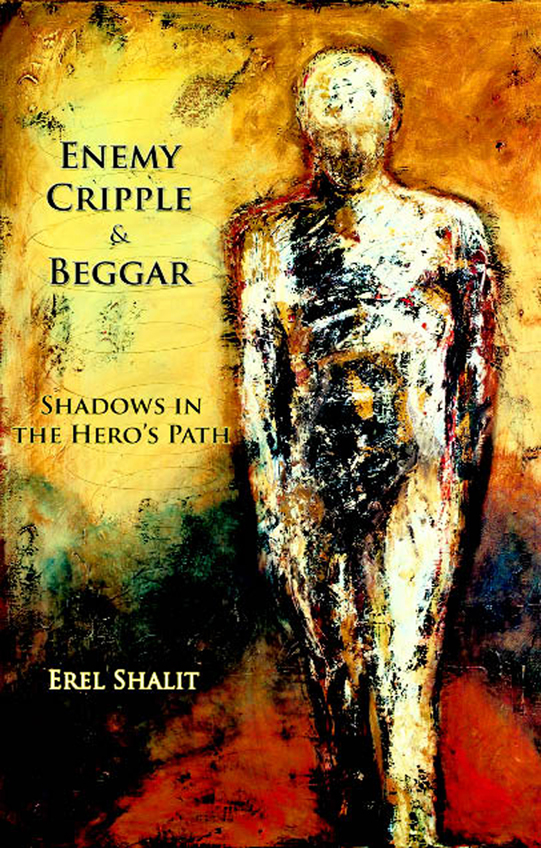
In closing, I want to mention the cover art, a painting titled “Emerging” by Susan Bostrom-Wong, an artist and Jungian analyst. Shalit asks the reader to examine the images embedded in the human figure. It is well worth the time to do so. Like the book itself, the longer you look, the more you will see.

I urge educators, artists, and those in search of new paths toward a life well-lived to buy this book. I know that one of my own heroes, Joseph Campbell, certainly would.

Enemy, Cripple, Beggar: Shadows in the Hero's Path and Erel Shalit's many other publications can be purchased at the Fisher King Press Online Bookstore.

This review of Erel Shalit’s Enemy, Cripple, Beggar: Shadows in the Hero’s Path was written by Joey Madia of New Mystics. New Mystics is an online Arts community founded in 2002 by Joey Madia, playwright, poet, novelist, actor, director, artist, musician, and teacher who promotes the work of a group of cutting edge writers and artists. To learn more about New Mystics, Joey Madia, and his most recent publication Jester-Knight visit www.newmystics.com.

Fisher King Press publishes an eclectic mix of worthy books including Jungian Psychological Perspectives, Cutting Edge Fiction, and a growing list of alternative titles. 
  • International Shipping. 
  • Credit Cards Accepted. 
  • Phone Orders Welcomed: +1-831-238-7799 skype: fisher_king_press

Friday, February 18, 2011

"Enemy, Cripple and Beggar is an intensely moving book that speaks deeply to the psyche."


Enemy, Cripple and Beggar is an intensely moving book that speaks deeply to the psyche." Ann Walker, Ph.D., published in Psychological Perspectives, volume 53, issue 2, 2010. Read the Review

Fisher King Press publishes an eclectic mix of worthy books including Jungian Psychological Perspectives, Cutting Edge Fiction, and a growing list of alternative titles.

International Shipping - Credit Cards Accepted.
Phone Orders Welcomed: +1-831-238-7799
skype: fisher_king_press

Wednesday, July 16, 2008

Press Release: Enemy, Cripple & Beggar by Erel Shalit

Press Release  

Fisher King Press announced:

Available July 15th, 2008

Enemy, Cripple, Beggar: Shadows in the Hero’s Path
By Erel Shalit

In Enemy, Cripple, Beggar, Erel Shalit provides new thoughts and views on the concepts of Hero and Shadow. From a Jungian perspective, this Fisher King Press publication elaborates on mythological and psychological images. Myths and fairy tales explored include Perseus and Andersen’s ‘The Cripple.’ You’ll also enjoy the psychological deciphering of Biblical stories such as Amalek—The Wicked Warrior, Samson—The Impoverished Sun, and Jacob & the Divine Adversary. With the recent discovery of The Gospel of Judas, Dr. Shalit also delves into the symbolic relationship between Jesus and Judas Iscariot to illustrate the hero-function’s inevitable need of a shadow. Clinical material concerning a case of a powerful erotic counter-transference is also an integral part of this deeply insightful body of work.

The Hero is that aspect of our psyche, or in society, who dares to venture into the unknown, into the shadow of the unconscious, bringing us in touch with the darker aspects in our soul and in the world. In fact, it is the hero whom we send each night into the land of dreams to bring home the treasures of the unconscious. He, or no less she, will have to struggle with the Enemy that so often is mis-projected onto the detested Other, learn to care and attend to the Cripple who carries our crippling complexes and weaknesses, and develop respect for the shabby Beggar to whom we so often turn our backs—for it is the ‘beggar in need’ who holds the key to our inner Self.

In Enemy, Cripple & Beggar: Shadows in the Hero’s Path, as with Erel Shalit’s previous book, The Complex: Path of Transformation from Archetype to Ego, alternative comprehensive views of the Shadow and the Hero images are provided and theory further explored. In addition to analysts and Jungian oriented psychotherapists and clinicians, Enemy, Cripple & Beggar can be comfortably read by an informed lay public interested in Analytical Psychology and by those interested in the interface between psychology and mythology, and psychology and religion.

Erel Shalit is a Jungian psychoanalyst in Ra’anana, Israel. He is a training and supervising analyst, and past president of the Israel Society of Analytical Psychology. He is the author of several publications, including The Hero and His Shadow: Psychopolitical Aspects of Myth and Reality in Israel and The Complex: Path of Transformation from Archetype to Ego. Articles of his have appeared in journals such as Quadrant, The Jung Journal, Spring Journal, Political Psychology, Clinical Supervisor, Round Table Review, Jung Page, Midstream and he has entries in The Encyclopedia of Psychology and Religion. Dr. Shalit lectures at professional institutes, universities and cultural forums in Israel, Europe and the United States.

Enemy, Cripple & Beggar
ISBN 978-0-9776076-7-9
Order directly from Fisher King Press