Showing posts with label Erel Shalit. Show all posts

Friday, July 10, 2015

More Praise for Shared Realities: Participation Mystique and Beyond

"Shared Realities, edited by Mark Winborn, is a beautiful in-depth study of Jung's (and Levy-Bruhl's) concept of Participation Mystique. It is an important contribution to t.he understanding of a significant and intriguing concept, here presented in its diversity, linking theory with clinical praxis. It is highly recommended and will be an important textbook on the subject.” Dr. Erel Shalit – Jungian Analyst
Author (most recently The Cycle of Life)
Ra’anana, Israel

“Beautifully written and poignantly described, Shared Realities offers the reader diverse, contemporary, and in-depth perspectives on the mystery of the psyche's participation in the analytic relationship. Its richness reaches beyond its relevance and usefulness in the professional/clinical relationship and invites us, also, to wonder about and reflect on the shared realities of personal relationships. This book is an important contribution to analytic work. I felt enriched professionally and personally by it.”
Marilyn Marshall, MA, LPC
Faculty - New Orleans Jungian Seminar
Jungian Analyst

Thursday, December 22, 2011

The Definitive Journey

From Enemy, Cripple, Beggar

The hero who searches for new paths in his heart and soul often lets hints and hunches guide him forward. Yet, he also needs to be equipped with courage to search beyond the boundaries of common ground and with humbleness towards the unknown that lies ahead of him. He must also carry a bagful of questions and concerns, curiosity and conflict, doubt and fear; “Every man hath the right to doubt his task, and to forsake it from time to time; but what he must not do is forget it.” Paulo Coelho, The Fifth Mountain, p. 53.

Erel Shalit titles are on Sale now at the Fisher King Press online bookstore.

Fisher King Press publishes an eclectic mix of worthy books including 
Jungian Psychological Perspectives, Cutting-Edge Fiction, Poetry, 
and a growing list of alternative titles. 

Wednesday, March 16, 2011

Enemy, Cripple, Beggar - A Treasure for Our Times


an in-depth review by Joe Madia, New Mystics

Enemy, Cripple, Beggar is a treasure for our times. Vital and applicable to both lay people and experts, the book flows seamlessly and spirally from scholarship, to textual interpretation, to case studies, and the analysis of dreams. Shalit draws on an impressive breadth of scholarship and myths/fairy tales, looking at both history (e.g., the Crusades or Masada) and story.
The book first discusses the key aspects of the Hero, considering Byron, the work of Robert Graves and Robert Bosnak, the Bible, and Joseph Campbell’s The Hero with a Thousand Faces, among many other sources.

I take as my starting point the condition of mythlessness in the modern world, as expressed by Jung and reinforced by Campbell and how it is limiting our vision and ability to cure an ailing world rife with war and economic/environmental woes.

If ever we needed to consider the role of the Hero, it is now.

Consider the mistaken mythologizing of the death and wounding, respectively, of Pat Tillman and Jessica Lynch. While both are certainly heroes, the government’s and media’s manipulation of their circumstances (used to try and justify an unjustifiable war) bring to mind David Mamet’s Wag the Dog, the 1997 film adaptation of Larry Beinhart's novel, American Hero.

The people love their heroes and their construction for societal consumption by the government and the media has become no less than a High Art.

Shalit says, on p. 24: “In society, the hero may be the messenger of hope who lights the torch of democracy. Sometimes it is amazing how, at the right moment in history, the heroism of a nation, spurting forth through layers of oppression, creates dramatic changes and overthrows worn-out regimes.”

Might this apply to U.S. president-elect Barak Obama? Many people think so, and many more find themselves hoping so. Then again, there are many who see him as the shadow, using the term antichrist, and finding similarities between he and Nicolae Carpathia in the Left Behind series.
If ever we needed to consider the role of the Hero, it is now.

Consider the current fascination with Superheroes in the age of CGI and comic book cinema. Just last night I watched Christopher Nolan’s record-shattering The Dark Knight, which takes as its thesis the complicated interrelationship of the hero and the shadow. Given the death of Heath Ledger, who played the Joker, the notions of the Hero are expanded to the realm of the Artist and his or her relationship with Pain.

When Shalit writes, on p. 95, “…life thrives in the shadow; in our detested weaknesses, complex inferiorities and repressed instincts there is more life and inspiration than in the well-adjusted compliance of the persona,” I think that his words bring Ledger’s death into sharp relief. As an acting teacher who works almost exclusively with teens, many of which see Ledger’s “dying for his art” as a form of heroism (an interpretation with which I disagree; it discounts the necessity of craft in preventing such tragedies), I think it is more important than ever to examine carefully the Hero’s role and relationship to the shadow.

The shadow is Jung’s term for the unconscious, the “thing a person has no wish to be” (p. ix). His early experience of his own shadow is, to me, some of the most compelling and useful text in his Memories, Dreams, and Reflections.

The hero must go into the shadow (the forest, the depth of the sea, the desert, the cave­—Plato’s or the Celtic Bard’s) to retrieve his soul. The shadow is a place of misery, calling to mind Schopenhauer’s ideas about life being mostly pain and sorrow and Campbell’s advice to “follow your bliss” [sat chit ananda].

Much of what Shalit centers on as aspects of the Hero are present in the shaman, who also has “one foot in divinity, one in the world of mortals” (p. 33). The journey into the netherworld (often to retrieve or heal the soul), the returning with precious gifts of knowledge, the responsibility of re-integration into the community (see Mircea Eliade’s comprehensive works on shamanism), all parallel the hero’s journey. The modes of the vision quest and the alchemical transformation are, further, symbolically manifested in the landscape of the fairy tale.

Pursuing this idea, Shalit, in the tradition of Robert Bly’s Iron John or Bruno Bettelheim’s Uses of Enchantment, ably presents and dissects a number of fairy tales, myths, and Biblical stories in the course of the book.

“Nixie of the Millpond” is presented without commentary. The myth of Perseus, however, is told with commentary from a wide variety of sources mixed in. It would be valuable to watch Clash of the Titans (1981) after reading this section, as it brings Shalit’s analysis visually to life. Page 47 lists eight traits of the hero myth to guide the interpretation. I would add a ninth—the use of magical items (such as Athena’s shield, Hermes’ sword, and the three gifts of the Stygian nymphs, all of which are given to Perseus to defeat the Medusa).

I have used these same basic elements of the hero myth for the past decade in my theatre workshops with youth and in my books on using drama in the classroom.

If our youth are to break the limiting conventions of societal and governmental structures that have put the planet and its inhabitants in a place of crisis, they—and those who guide and educate them—must understand the Hero and Shadow both.

On p. 65 Shalit writes, “Collective consciousness constitutes a threat by its demand on compliance with rules, roles and regulations.” The mythological fighting of dragons and monsters by the Hero is most clearly articulated to me by Joseph Campbell, when, in various books and interviews, he talked about Nietzsche describing the cycle of life as beginning as a camel loaded down with the requirements of parents and society. The camel then goes into the desert (one of the hero landscapes I mentioned earlier) to become the lion, who must slay the dragon whose scales all say "Thou Shalt." This dragonslaying, certainly a noble and necessary undertaking, situates the Hero as the classic warrior, akin to Michael the Archangel and St. George, but when the fighting is done, the warrior must put down the sword. Whether we speak of the Vulcans comprising the Bush administration (as author James Mann terms them) or an abused child who grows up to wage ongoing battles even on a landscape of peace in a more stable family situation, this is a notion well worth focusing on. I think of the Roman general Cincinnatus, who moved back and forth between sword and plow and the dwarves of the novels of Dan Parkinson, who switch the hammer from one hand to the other as necessary in times of peace and war.

The hero struggling with the shadow often projects onto a demonized Other because, as Shalit reminds us, “Since shadows easily lend themselves to projection [see pgs. 97–101 for the three types identified by Jung], they are discovered so much more easily in the other than oneself” (p. 84). This is, of course, the source of most of the ugliness in the history of Humankind.

The Biblical explorations/interpretations presented are a high point of the book (see, for example, p. 63 on the Virgin Mary) and begin in earnest with the section on the shadow. The etymology of both biblical and mythological names given throughout add much to the discussion.

Shalit uses Oscar Wilde’s “doppelganger novel,” Picture of Dorian Gray, to explore the notion of shadow in terms of our duality, as Dorian is projecting his shadow onto the canvas. Duality—war/peace, animus/anima, masculine/feminine, dark/light—is prevalent throughout the book.

The second half of the book deals with the Enemy, Cripple, and Beggar of the title. The Enemy (the projection onto the Other that is really the shadow in oneself) is explored through such Biblical figures as Amalek, Samson, Jacob, and the key figures in the trial of Jesus. The section on the Fathers and the Collective Consciousness, dealing with Caiaphas, the Sanhedrin, Barabbas, and Judas, is fascinating reading. The connection of the father and the son resounds on many levels, including the relationship of Jesus/Judas as being nearly inseparable.

The Cripple (one’s weaknesses and inner wounds) is explored through mythological/fictional figures such as Hephaestus, Ptah, Oedipus, Quasimodo, and the child in Hans Christian Andersen’s “The Cripple.” There are case studies here that serve many of the same functions as the analyses of the myths and fairy tales, and will appeal to those interested in the dynamics of Jungian analysis. Certain aspects of the second case study reminded me of Don Juan DeMarco (1995), the film starring Marlon Brando and Johnny Depp, especially considering that love (Eros) is the means to heal the Cripple, as articulated so well in this book.

The final section deals with the Beggar (the “door that leads to the passageway of the Self,” p. 225), which is the Inner Voice or Daemon. Shalit deals here with the notions of alchemy that so fascinated Jung. I was intrigued by the story of King Solomon as the wandering beggar and Shalit’s exploration of the life of the prophet Elijah.

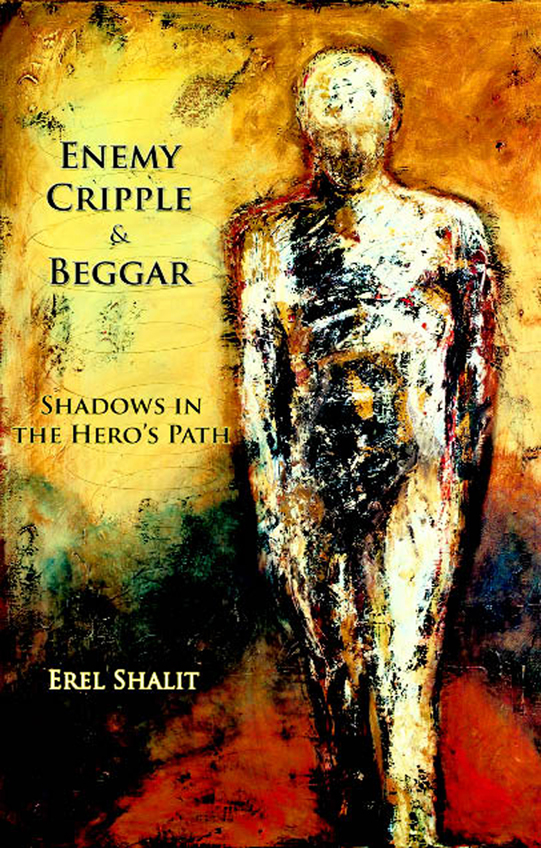
In closing, I want to mention the cover art, a painting titled “Emerging” by Susan Bostrom-Wong, an artist and Jungian analyst. Shalit asks the reader to examine the images embedded in the human figure. It is well worth the time to do so. Like the book itself, the longer you look, the more you will see.

I urge educators, artists, and those in search of new paths toward a life well-lived to buy this book. I know that one of my own heroes, Joseph Campbell, certainly would.

Enemy, Cripple, Beggar: Shadows in the Hero's Path and Erel Shalit's many other publications can be purchased at the Fisher King Press Online Bookstore.

This review of Erel Shalit’s Enemy, Cripple, Beggar: Shadows in the Hero’s Path was written by Joey Madia of New Mystics. New Mystics is an online Arts community founded in 2002 by Joey Madia, playwright, poet, novelist, actor, director, artist, musician, and teacher who promotes the work of a group of cutting edge writers and artists. To learn more about New Mystics, Joey Madia, and his most recent publication Jester-Knight visit www.newmystics.com.

Fisher King Press publishes an eclectic mix of worthy books including Jungian Psychological Perspectives, Cutting Edge Fiction, and a growing list of alternative titles. 
  • International Shipping. 
  • Credit Cards Accepted. 
  • Phone Orders Welcomed: +1-831-238-7799 skype: fisher_king_press

Thursday, March 3, 2011

Being on the Way—A Way of Being

Fisher King Press to publish 
by Erel Shalit

“The art of life is the most distinguished and rarest of all the arts.”   
 - C.G. Jung, CW 8, par. 789.

In the first half of life, the task of the young traveler is to depart from home, to step out into the world in search for his or her adventure, to find his or her own individual path. However, in the second half, we find ourselves on what often amounts to a very long journey in search of Home. In many a tale, the hero, for instance Gilgamesh, sets off on his road to find life’s elixir, while other stories, such as the Odyssey, revolve around the hero’s long and arduous journey home.

This archetypal journey of life is constantly repeated along the never-ending process of individuation. We find ourselves returning to this venture repeatedly, every night, as we set out on our nightly voyage into the landscape of our unconscious. Many dreams begin by being on the way, for instance, “I am on my way to …,” I am driving on a road that leads into the desert …,” I am walking through one room after the other in a long corridor-like building …,” “I am walking towards my office, but it looks different than in reality,” “I walk on the pavement and on the opposite side of the street someone seems to follow me …,” “I go down into an underground parking…,” “I am in my car, but someone I don’t know is driving,” or, “I have to go to the place from where I came ...”

Prominently, we are familiar with the journey of Dante, who at the very beginning of his Divine Comedy finds himself “Midway along the journey of our life.”


A partial list of topics explored in The Cycle of Life include:

I. The Journey
   Stages and Seasons
   Jung’s Stages of Life
   All the World’s a Stage, and a Stage of Life
   Being on the Way—A Way of Being
   Hermes and the Journey: Being on the Way
   Backward and Forward
   The Crossroads
   + more
II. The Child
   The Child in the Mirror
   Psychotherapy and Childhood
   The Divine Child
   From Divine to Human
   Eros, Psyche and Pleasure
   + more
III. The Puer and the Puella
   Between Shame and Fear
   Wine, Spirit and Fire
   Prometheus—the Thoughtful Thief
   + more
IV. The Adult
   King on Earth
   Boundaries of Reality
   Celestial Jerusalem—Terrestrial Jerusalem
   The King who Refuses to Die
   The Dried-up Earth
   The Limping Ego
   The Empty Shell
   + more
V. i. The Senex
V. ii. Homage to Sophocles
V. iii. The Last Chapter: Self and Meaning
   Ancestral Roots
   An Oak and an Acorn
   We Are All Beggars, Are We Not?
  + more
    Fisher King Press publishes an eclectic mix of worthy books including Jungian Psychological Perspectives, Cutting Edge Fiction, and a growing list of alternative titles.
      • We Ship Worldwide.
      • Credit Cards Accepted.
      • Phone Orders Welcomed: +1-831-238-7799 skype: fisher_king_press

      Monday, February 21, 2011

      A History of the Dream

      A History of the Dream: Fate and Destiny from Gilgamesh to Jung

      The President’s Lecture Series

      As part of the C. G. Jung Foundation's initiative to reach out to the many Jungian communities worldwide to share information and build community, we are presenting a new program, entitled The President's Lecture Series.

      By sharing information among the various Jungian communities, we can draw together in our work to enlarge analytical psychology to its fullest capacity, benefiting a new audience of people in their quest for greater consciousness.

      Date: Tuesday, March 22, 2011, 7:00 – 8:30 pm
      Location: Jung Center, 28 East 39th Street, New York City
      Speaker: Erel Shalit, PhD

      A History of the Dream: Fate and Destiny from Gilgamesh to Jung

      The dream is a muthos, a mouth that gives expression to the voice of fate and destiny. A story of the dream is told from the ancient dreams of Gilgamesh and Nebuchadnezzar to the Greek discourse; from Freud and Dora on to Jung's final dream.

      By tracing the dream and the image, we follow man's grand opus of turning pre-destined fate into prospective destiny, until hubris may again endanger the future.

      Dr. Erel Shalit is a Jungian psychoanalyst in Ra'anana, Israel. He is a training and supervising analyst, and past President of the Israel Society of Analytical Psychology. He has served as liaison person of the International Association of Analytical Psychology (IAAP) with the Jung Society of Bulgaria. He is a past Director of the Shamai Davidson Community Mental Health Clinic, at the Shalvata Psychiatric Centre in Israel. Erel Shalit has served as officer in the IDF Medical Corps, and is a member of The Council for Peace and Security. He is Academic Director of the 'Jung's Analytical Psychology' program at Bar Ilan University. He is the author of Requiem: A Tale of Exile and Return (Fisher King Press 2010),  Enemy, Cripple, Beggar: Shadows in the Hero's Path (Fisher King Press 2008; the book was a nominee for the 2009 Gradiva Award for Best Theoretical Book, National Association for the Advancement of Psychoanalysis), The Hero and His Shadow: Psychopolitical Aspects of Myth and Reality in Israel (2004), The Complex: Path of Transformation from Archetype to Ego (2002), and Archetypal Images of the Life Cycle (forthcoming 2011). Dr. Shalit lectures at professional institutes, universities, and cultural forums in Israel, Europe and the United States.

      Tickets: $20.00 C.G. Jung Foundation Members; $25.00 General Public.
      Tickets should be purchased in advance by mail, by phone or fax with credit card (Visa or MasterCard), or in person Monday — Thursday, 10:00 a.m. – 5:00 p.m. For further information, please call the C. G. Jung Foundation of New York at 212-697-6430, or FAX 212-953-3989. You can also email your questions to info@cgjungny.org.
      Fisher King Press publishes an eclectic mix of worthy books including Jungian Psychological Perspectives, Cutting Edge Fiction, and a growing list of alternative titles.
        • We Ship Worldwide.
        • Credit Cards Accepted.
        • Phone Orders Welcomed: +1-831-238-7799 skype: fisher_king_press

        Friday, February 18, 2011

        "Enemy, Cripple and Beggar is an intensely moving book that speaks deeply to the psyche."


        Enemy, Cripple and Beggar is an intensely moving book that speaks deeply to the psyche." Ann Walker, Ph.D., published in Psychological Perspectives, volume 53, issue 2, 2010. Read the Review

        Fisher King Press publishes an eclectic mix of worthy books including Jungian Psychological Perspectives, Cutting Edge Fiction, and a growing list of alternative titles.

        International Shipping - Credit Cards Accepted.
        Phone Orders Welcomed: +1-831-238-7799
        skype: fisher_king_press

        Friday, February 11, 2011

        Press Release: Will Fishes Fly

        Feb 1, 2011

        Fisher King Press is pleased to present:

        Will Fishes Fly in Aquarius
        or Will They Drown in the Bucket?

        Jung’s book Aion serves as point of departure for this publication. The transition of the aeons from Pisces to Aquarius reflects decisive changes in the relationship between man and image – the image which is at the center of what Jung calls psychization, the process of reflection whereby consciousness is enhanced. At the daybreak of history, man extracted the image from the divine waters. Then, the craftsman whom God warned should not make graven images, came to replicate the divine on earth. By means of image and reflection, dream and dreaming, man becomes human, in the sense of not only partaking in events, but able to relate to experience. In Aquarius, images have been rounded up, and man now holds the bucket.

        “God’s powers have passed into our hands,” says Jung, which forces man to consider the shadow of unreflective progress, such as the transient as-if personality and soullessness. The legend of the golem serves to illustrate the condition of man, who has become master of the images that may either create or destroy our future.

        Erel Shalit is a Jungian psychoanalyst in Ra’anana, Israel. He is a training and supervising analyst, and past president of the Israel Society of Analytical Psychology (ISAP). He is the author of several publications, including Enemy, Cripple, Beggar: Shadows in the Hero's Path, Requiem: A Tale of Exile and Return, The Hero and His Shadow: Psychopolitical Aspects of Myth and Reality in Israel and The Complex: Path of Transformation from Archetype to Ego. Articles of his have have appeared in Quadrant, The Jung Journal, Spring Journal, Political Psychology, Clinical Supervisor, Round Table Review, Jung Page, Midstream, and he has entries in The Encyclopedia of Psychology and Religion. Dr. Shalit lectures at professional institutes, universities and cultural forums in Israel, Europe and the United States.

        Cover painting, The Fifth Day, from the 'Genesis series' by Mira Raman

        Will Fishes Fly in Aquarius -- available as an eBook edition and available from:

          Fisher King Press publishes an eclectic mix of worthy books including Jungian Psychological Perspectives, Cutting Edge Fiction, and a growing list of alternative titles.

            International Shipping - Credit Cards Accepted.
            Phone Orders Welcomed: +1-831-238-7799 skype: fisher_king_press

            Sunday, February 6, 2011

            Requiem on the Nile

            Article by Erel Shalit

            The fire and the flames of revolt sweep across the Arab Crescent. Does the unrest herald the requiem of the Arab Kings? Perhaps these are the torches of democracy that are lit by the oppressed, the banners of freedom that defy non-elected rulers and dictators. Perhaps this proclaims the dawn of a new era, echoing the prospects and possibilities of change in the Middle East.

            Or do darker forces linger in the shadow of hope and freedom, hiding behind the veils, holding their horses behind the courageous, ready to ride forth on the waves of uprising, when the time is ripe?

            In Tunisia, Zine Ben Ali was ousted, but it seems the old guard and the army generals still hold on to power. The January Jasmine revolution simply led to a coup from within, likely generating reforms, but not necessarily a change of power or structure of the authoritarian regime. In Lebanon, the Hezbollah staged a coup, the Syrians threatened the Druze leader, and the Prime Minster was quickly ousted, replaced by a puppet in the hands of Iranian-directed Hezbollah, who now holds political and military power in the country.

            In Egypt we witness the clash of major opposing forces:

            From a Western perspective, democratic forces have risen against the dictatorial regime. Toward the end of his 30-year autocratic rule, Mubarak offers reforms, and cynically one may wonder, why did he not implement those suggested reforms during the decades he had the exclusive power to do so.

            But no less perplexing, where were the voices of protest against Mubarak’s regime and its oppression of human and civil rights until now? Is it perhaps indicative that Egypt for decades was a member of the UN Human Rights Commission and its successor the Human Rights Council? Never did any of these bodies investigate or report on human rights violations in Egypt, while half of the Council’s critical decisions and resolutions on specific states’ human right’s records have been about Israel.

            While Mubarak retained a cold peace with Israel, he not only refrained from visiting (except for the funeral of Itzhak Rabin), but did nothing to prevent hatred, or promote education toward peace – unfortunately similar to the Palestinian Authority.

            From an Iranian perspective, this is the beginning of an Islamic renaissance in the Middle East, a movement toward removing the West’s autocratic puppet regimes.

            And for a brief moment, Mohamed ElBaradei has returned to Egypt to play the temporary façade and front, the marionette of the different forces that believe that his Janus-face serve their interests, prominently so the Muslim Brotherhood, themselves speaking in different tongues. Only innocent desire, naïve hope and the blindness of denial award him a Nobel Peace Prize, until his persona of deceit, particularly as regards Iran's true intentions, was torn off by his successor at the International Atomic Energy Agency.

            Egypt seems to reflect the forces that are played out across the Middle East: the people against the autocrats; army vs. Islamic fundamentalism. Also the Islamic revolution in Iran was initially an uprising against the oppressive regime of the Shah, until it became a revival of Islam. However, in spite of the similarity, there is a difference between Shia Iran and Sunni Egypt.

            Democracy is more than elections. Yasser Arafat was elected, but never felt a need to stand for re-election. And following the West’s insisting on Palestinian elections, the result has been two governments and a military coup. Free elections are a manifestation, a symptom of democracy. Democracy is a state of mind, which evolves through the establishment of democratic institutions, parties, free press, and education. The transition to democracy can be sudden, since freedom is an archetypal need, just like the development of consciousness. But it requires a balance of forces. Democracy requires more than “one person, one vote, one time,” which may be the result of elections when non-democratic forces exploit a situation of confusion, depression and despair, as has happened in history, such as but not only Germany in the 1930s.

            How will the present changes affect Israel? Geo-politically, it will likely not be easier. The cold yet strategically vital peace with Egypt, and the formal agreement between the countries may be in danger. Israel is likely to become even more alienated in the area, possibly emphasizing its identity as a Mediterranean country rather than a nation in the Middle East. The right in Israel will conclude that there really is no one to make peace with, and sigh in relief. The left, on the other hand, will claim the necessity and urge to move ahead toward agreements with the Palestinians.

            Can similar uprisings to the ones in Tunisia and Egypt (and prior to that, the 2009 election protests in Iran, unfortunately much more weakly supported by the West), take place in Israel? Yes and no. (This is, in fact, part of the story line of Requiem: A Tale of Exile and Return. No, because Israel is a democracy, with freedom of expression, protest and free elections.

            Yes, because democracy in Israel is a vulnerable balance between powerful forces. There is increasing reluctance of the majority to carry the extra-ordinary military and financial burdens of political stalemate and orthodox religious draining of state resources , enabled by a weak government paying for power (by giving in to corrupt coalition demands, rather than preserving integrity - leading to attempts to burden the majority with even heavier taxes).

            Primarily, the Arab minority in Israel proper is torn between the benefits, in spite of longtime negligence, of living in Israel, and their identity as Palestinians. If major efforts are not made to bring greater equality and integration of the Arab minority, unrest seems inevitable.

            And if Israel does not withdraw and define its borders in such a way that the Palestinians can establish a viable state based primarily in the West Bank, the country will find itself in a condition of permanent unrest and conflict between Jews and Arabs, lose its democratic basis and deteriorate internally and internationally.

            The present government may turn its weakness into an asset, by considerably revising its policies, opening up toward sincere negotiations. The leaks from the previous government's negotiations with the Palestinian leadership simultaneously demonstrate the possibility of progress, and the difficulty finalizing an agreement. But stalemate will bring an end to the present government, since clearly these are times of change.

            Erel Shalit is a Jungian psychoanalyst in Ra’anana, Israel. He is a training and supervising analyst, and past president of the Israel Society of Analytical Psychology (ISAP). He is the author of several publications, including Enemy, Cripple, Beggar: Shadows in the Hero's Path, Requiem: A Tale of Exile and Return, The Hero and His Shadow: Psychopolitical Aspects of Myth and Reality in Israel and The Complex: Path of Transformation from Archetype to Ego.

            Fisher King Press publishes an eclectic mix of worthy books including Jungian Psychological Perspectives, Cutting Edge Fiction, and a growing list of alternative titles.
              • International Shipping.
              • Credit Cards Accepted.
              • Phone Orders Welcomed: +1-831-238-7799 skype: fisher_king_press

              Sunday, August 1, 2010

              The Archetypal Beggar

              The Beggar
              by Erel Shalit
              Rainer Maria Rilke: The Song of the Beggar

              I am always going from door to door,
              whether in rain or heat,
              and sometimes I will lay my right ear in
              the palm of my right hand.
              And as I speak my voice seems strange as if
              it were alien to me,

              for I’m not certain whose voice is crying:
              mine or someone else’s.
              I cry for a pittance to sustain me.
              The poets cry for more.

              In the end I conceal my entire face
              and cover both my eyes;
              there it lies in my hands with all its weight
              and looks as if at rest,
              so no one may think I had no place where-
              upon to lay my head. (1)
              Faceless Interiority
              Far away in the shadow, behind the persona and one’s face of appearance, stands the beggar. He has no social face; he plays no game. Pretension is an aspect of the persona, though not every persona that we wear is necessarily either false or pretentious. Persona pertains to the social adaptation of our conscious identity. It takes courage, honesty and compassion to transcend one’s conscious experience of identity. On the road, one is forced to overcome obstacles and struggle with adversaries. Then, as well, one will have to bend down low and care for the wounded, embracing the weak. And traveling on, one will have to see without eyes, touch with empty hands, hear the unspoken words, and sense the sameness, identitas, in anonymity. A forty-five-year-old extraverted man, professionally successful and generally concerned with labels of accessories, dreamed:
              I am in a very elegant house. It’s my house, and I’m having a party. Everyone “who’s-who” is there. Suddenly a bitchy old woman comes down the stairs, tells me that the house is hers, I have only rented it, and I have to leave. It is very embarrassing, I’m being thrown out, from what I thought was my house. Out there in the street I meet a beggar. He is homeless, crazy, doesn’t really know how to speak, and doesn’t know who he is – he is without identity. It’s frightening.
              As a negative of our ego-ideal and the socially adjusted persona, the shadowy image of the beggar abides in our soul, as if without identity. Without a persona, there can be no pretension—which comes from Latin’s praetendere, to extend in front. We need to ‘extend in front’ of ourselves, to reach out and forwards. Thereby, some degree of falseness and pretension are inevitable and undeniable. In contrast to the persona, the beggar “huddle[s] in the shadows,” and unmasks those who come his way,(2) that is, everyone who ventures far away from the royal court of unquestioned convictions. Without the protection of a social façade, the image of the beggar expresses the Inner Voice or the Daemon. The beggar becomes the genuine persona, that is, he is an image of the means by which the Voice comes across; persona, per sonare, by means of voice. But since he lacks the appearance of an external persona, he is not easily seen and attended to, but must be heard and listened to, for us to grasp the meaning of his words.(4) In Dr. D’s dream (page 176), he attends to the voice of the old, shabby, hardly visible, wise man.

              The image of the beggar entails a reversal of our attitude in consciousness. We may believe that we give him something, that we may contribute to his welfare. But the essence of his being is that he holds something for us to receive. He may hold in his hand, and whisper through his mouth, a wisdom free from conventional ethics, transcending our conscious distinction of good and evil.(4) Beyond the blushing face of shame, the beggar’s hand is full of emptiness—he holds nothing in his hand.

              The beggar does not do, and we may so easily pass by without noticing him. Only by stopping for a moment may we see what he can give—an opportunity to feel and hear, to reflect and forget myself (my ego), and to know what not to forgo:
              The crippled beggar cries.
              His weeping masks the sun’s eye,
              hides the flowers.
              His weeping–
              a smoldering barrier
              between me and God.
              The crippled beggar demands
              that I thrust my whole life
              into his hand–
              that which is revealed
              and that which is hidden,
              all that could have happened
              and all that yet will happen.
              The crippled beggar demands
              that I let him eat
              from the Carmel in my soul
              and from the sea,
              from the risings of the sun
              and from the depths within me.
              The crippled beggar spits in my face
              because I have not forgotten myself,
              because I have not died.
              His scorn is right.
              To the quiet, inner core
              that exists even in the heart of the lost,
              to the axis of immortality
              that exists even in the heart of the insane,
              I have not given over
              my whole self.
              I have almost forgotten
              that he, too, the impoverished one,
              is a child of the sun,
              that his soul, too,
              will turn into a rose at twilight.(5)
              When Gandhi after more than twenty years in South Africa stepped ashore in India, he spent a year of wandering, “his ears open but his mouth shut.” The notable poet Tagore called him “The Great Soul in Beggar’s Garb.” Soul is a perspective, perspective, by means of spection, looking, introspective and extraspective, which enables us not to just act and do. It is reflective between us and events, and makes us relate to our deeds,(6) thereby inducing what we do with life, with inspiration. Without soul we may constantly fight wars with an ever-more evil enemy, or we may fall into paralyzing crippleness. The voice that speaks through the image of the beggar is not formulated by his words, but by our listening in spite of there being nothing to see. The soul that the beggar brings is one of pure interiority, which brings life only if attended to. At the end of the Grimm brothers’ tale of The Golden Bird, for instance, the king’s (in some versions the gardener’s) youngest son arrives secretly at the king’s court, dressed in a poor man’s ragged clothes. As he arrives, scarcely within the doors, the horse began to eat, and the bird to sing, and the princess left off weeping. The soul appears in the least of garments, secretly, invisibly, without known identity. The following was the final dream that a fifty-five-year-old man brought at the end of a seven-year analysis:
              I am walking with a group of people in a field. It is rather dark. It is like walking along a wadi [dry river valley] at the slopes of a gray mountain. From somewhere high up I hear a voice telling me – and it seems he is calling just me – I have to get up on top of the mountain and read prayers from a book.

              I then stand on a cliff high up on the mountain, with the man who had called me. He doesn’t look like the kind of prophet you would imagine – or perhaps you would! He is very unimpressive, small, ugly, hunchback, disgusting! No, sorry, not disgusting, but you’d hardly notice him, or, rather, if you met him in real life, one would try to avoid him, like those poor sick beggars you see more and more in the city.

              He just hands me the book. Looks like a bunch of old papers. The prayers are a combination of Jewish and alchemical texts or prayers. I have to do this, supposedly because I am accused of some crime, possibly having assassinated someone. But before climbing higher on up the mountain, I go into a cave, supposedly my cave, where there are lots of wine glasses, kind of grails, some in glass, others in metals, that I have to serve to people, though I don’t really see the people; they will arrive later. The wine glasses are placed on an old wooden table, and the tin cups on an even more antique wooden table. Everything is semi-dark. I don’t know what kind of mixture or drink is in the glasses, especially in the tin cups – probably some alchemical tincture – just joking! But it has that kind of flavor, so I guess I have to accept that! Then the man, the beggar/prophet or whatever, his daughter comes running. She has been running very quickly, and I meet her at the entrance of the cave as I am on my way to depart to ascend the mountain. She is clearly taken by her long and quick run, breathes visibly, tells me that the whole accusation against me is a mistake. I feel relieved. I know that you [the analyst] won’t die from me leaving, even if you’ll be somewhat sad, just like I will be as well, but I still know that I have to carry out the task, even if you can’t help me any further, and I must go ahead and do it alone.
              This man knew he had further work to do, but also felt that there always would be, and at some stage he needed to take it on himself. The need of a soulful attitude in this man’s further undertakings was unmistakable. His tendency not to remain serious, but to dismiss the hard work by joke and avoidance, had been prominent. A sense of lack of meaning in life had been the reason to come for analysis.

              In his associations to the dream he said he had come to understand there were “layers of meaning” to “that Jungian stuff and all that alchemy,” using “alchemy” as a code word for his ambivalence to the process, but thereby for its potency as well.

              The word alchemy had most likely not been mentioned during the years of analysis, but the meaning of the word warrants a brief comment: as is well known, Jung concluded that the alchemical process reflects the soul’s transformative journey through the shadow to the Self, from base metal to refined gold. There are various assumptions as to the etymological origin of the word alchemy. One possible origin is from the Greek chumeia, to pour together, to cast together, clearly reflecting the process of bringing seemingly opposite elements together. In this sense, alchemy replicates the process of the Self; symbolos, symbol-formation as a healing process that brings the opposites together (syn- together, ballein- to throw)—in contrast to the consciousness-raising process of diabolos (to throw apart).

              Another possible origin is from the Arabic al-khimiya, where Khemia was an ancient name for Egypt, meaning ‘the land of the black earth,’ because of the mud that brought fertility to the land of the Nile. Most transformative activity in the alchemical laboratory of therapy and analysis probably takes place in the land of the black earth, the shadowy matter of the process.

              Gershom Scholem writes, “Even more remarkable is the derivation of the word kimiya (chemistry) from the Hebrew, which carried over from Arabic sources.” He quotes several older Arabic and Jewish sources, and says, “The word for chemistry comes from ki miya,”(7) i.e., alchemy would mean for it is of God. It seems we might need to hear the voice of all three possible etymologies in order to appreciate the journey of the soul.

              The previous article is an excerpt from Erel Shalit’s
              Enemy, Cripple, Beggar: Shadows in the Hero’s Path
              (Fisher King Press 2008)

              International Shipping - Phone Orders Welcomed,
              Credit Cards Accepted: +1-831-238-7799

              1.Selected Poems, Translated by Albert Ernest Flemming, p. 78.
              2. Elie Wiesel, A Beggar in Jerusalem, p. 3
              3. It is noteworthy that the root of the Hebrew word for meaning, maSHMAot, means to hear. Martin Buber claimed the Jews were inherently a people of the “ear,” “summoned to ‘hear,’ as in ‘Hear, Oh Israel’ ” (Elon, The Pity of it All, p. 262.)
              4. Cf. Depth Psychology and a New Ethic, p. 39; The Hero and His Shadow, p. xvi
              5. “The Crippled Beggar,” from The Spectacular Difference: Selected Poems of Zelda, p. 39-41. Translated, with an Introduction and Notes, by Marcia Falk (Hebrew Union College Press, 2004). Copyright (c) 2004 by Marcia Lee Falk. Used by permission of the translator
              6. James Hillman, Archetypal Psychology: A Brief Account, pp. 6-10; Andrew Samuels, Jung and the Post-Jungians, p. 244.
              7. Gershom Scholem, Alchemy and Kabbalah, p. 16f.

              Friday, June 4, 2010

              The Sun and the Sword, The Moon and the Mirror

              The Sun and the Sword,
              The Moon and the Mirror

              article by Erel Shalit

              Besides the more commonly accounted for masculine, solar aspect of the hero’s journey, we may refer to a feminine, lunar attribute as well. They represent different attitudes vis-à-vis the unconscious.

              The sun-hero has a dual relationship to the Great Mother, as exemplified by Heracles; his name means Glory of Hera, yet the goddess drives him to madness. He sets out on the mission to break free from the bonds of the Great Mother, to face her magnitude, ready to draw his sword in combat with her however awesome she seems to be, and to enhance his ego-consciousness. The sun-hero, while not always able to fulfill the entire mission of his journey, works towards replacing id and the unconscious with ego. He must abandon the comfort and the security of the kingdom of childhood, about which Jung writes:
              For him who looks backwards the whole world, even the starry sky, becomes the mother who bends over him and enfolds him on all sides ... As such a condition must be terminated, and as it is at the same time an object of regressive longing, it must be sacrificed in order that discriminated entities - i.e., conscious contents - may come into being.(1)
              On his way to consciousness the hero encounters monstrous and malicious obstacles that, as Jung says, rise in his path and hamper his ascent, wearing “the shadowy features of the Terrible Mother, who saps his strength with the poison of secret doubt and retrospective longing.”(2) He risks being devoured by the Earth Mother, destroyed by the gods, to burn in the flames of passion set afire by the nymphs, or die in battle with his competing Martian warriors. His world is patriarchal, goal-directed and lawful, thus he may lose direction and plunge into unconsciousness, teased and tantalized by the feminine seductress intruding from afar, as became the tragic fate of Samson.

              It is the sun-hero’s undertaking to break away, to free himself from the archetypal world. Simultaneously, as part of his mission, he must gather the strength required to bring the very same archetypal energy into the ego and human consciousness. Thus, the hero has one foot in divinity, one in the world of mortals. It is the hero’s task to dismember the archetypal energies and transpose them as increasingly human complexes into the personal world and the realm of the ego. This is what Prometheus does when he brings fire to man. His name means forethinker; the Promethean fire is the capacity to plan the use of that natural transformative energy, fire, for the benefit of mankind, to create consciousness and acculturation, heating and cooking, creating new materials and fresh ideas.(3) But also when the complex has become autonomous, split-off from consciousness and detracting energy from the ego, the hero is called for. The man who compulsively clung to a job far below his capabilities because of his fear of losing it was constantly threatened by dismissal until he gathered his strength to fight the complex that nearly destroyed him.

              The sun-hero may be the obstinate two-year-old who repeatedly says no and no to being dressed, “I dress.” Or the five-year-old who pulls the hero’s phallic sword with which he fights the beasts within—as they are projected upon the little kindergarten-brutes of the real world without. The sun-hero is unmistakably masculine, a He, whether a boy or a girl.

              The solar hero brings something new, something formerly unknown into the consciousness of the individual or that of society. By means of the adventures of the sun-hero, man has, for instance, accomplished scientific achievements and expanded geographical boundaries. The solar aspect of the hero pertains to patriarchal consciousness. With his sword, the hero cuts and divides, which is structurally essential for the establishment and expansion of consciousness.

              But there is a lunar aspect or phase of the hero’s journey as well, which may likewise unfold when the hero abandons the conventions of the royal throne and the safe rule of ego, when he stands up against and turns away from collective consciousness. This is the case, for instance, with Buddha, whose way is enlightened by reflection rather than by the splendor of the sword. It pertains to conceiving, rather than “deliberate doing,” and, says Neumann, “time must ripen, and with it, like the seeds sown in the earth, knowledge matures.”(4)

              This is the moon-hero. He, or in fact She, because it pertains rather to the feminine, whether in man or woman, ventures into the dangerous paths, the forests and the rivers, the hills and the valleys, the labyrinths and the netherworlds, the pandemonium, the chaos and the torment outside the boundaries of collective consciousness, beyond norms and conventions. She is maybe not the skillful goal-directed archer Apollo, but rather his twin sister Artemis, the hunter goddess roaming in the wilderness and the forest, armed with silver bow and arrows. This may be the sense of drifting around the outskirts of town, sneaking into backyards, to hike around in foreign places in the geography of the world or in the psychography of the soul, learning “how to observe nature, the way it grows and changes.”(5) It is dangerous; as happens to Artemis, by mistake, you may kill your loved one, or if you come too close you may be transformed into a stag, because it is an oscillating journey between death and rebirth, waxing and waning, appearance and disappearance, love and disaster, reflection and deflection, healing and wounding. The ground easily quakes, and on winding roads and behind thorny bushes the forces of love and madness, pain and desire, despair and anticipation struggle with savage ferocity. The lunar hero pertains to relationship and unification, but breakup and falling apart, as well.

              The hero’s lunar quality refers to the mirror and reflection, rather than the sword and division. As we shall see later, Perseus is equipped with both.

              In its lunar aspect, the hero does not attack the unconscious. It entails a conscious turning towards the unconscious, quietly and humbly awaiting what in the course of time arises and unfolds in the hero’s reflective mirror. As Campbell says:
              The mirror, reflecting the goddess and drawing her forth from the august repose of her divine non-manifestation, is symbolic of the world, the field of the reflected image. Therein divinity is pleased to regard its own glory, and this pleasure is itself inducement to the act of manifestation or “creation.”(6)
              The following is the dream of a sixty-year-old man, slowly finding his way home to himself after having “been away” for a long time, during an extraverted career:
              I feel an urge to return home. I have been away for a long time. As I get home, I see that a man sits on a chair in the attic, watching the dark sky through a telescope—there is a big opening in the roof. He calls me to look, and I try to look carefully through the telescope, but I see nothing. I turn and turn the telescope, yet, I can’t see anything. He shouts and yells at me and I feel very embarrassed, and he tells me angrily to go and sit and wait next to a little girl who sits on a bench. She looks like she is in a dream state, just looking up at the sky. First I look at her, and then I lose the focus, and like her I just look at the dark sky, and then, suddenly, a very bright star shines far far away but very very clearly, and then I see the moon, so close, almost as if I could touch it.
              Naturally, the lunar aspect of the hero is closely related to matriarchal consciousness, as elaborated in depth by Erich Neumann.(7) Queen Jocasta, Shining Moon, as representative of the feminine side of consciousness, has been discussed elsewhere.(8) However, Neumann is mainly concerned with matriarchal or moon-consciousness as something preceding patriarchal consciousness, pertaining to “enchantment and magic, ... inspiration and prophecy” rather than “its recurrence in the psychology of individuation, which is a reappearance at a higher level, as is always the case where, in the course of normal development, we again encounter something already experienced.”(9) I believe the lunar and the solar elements constitute complementary aspects of the hero and his/her journey, even if the one may precede or dominate the other.

              In fact, as regards the lunar aspect of the hero’s journey, he naturally ventures into darkness only as the sun sets, rather than at dawn. Yet, the hero needs to be equipped with some of the day’s light to withstand the night’s depressive darkness, and with summer’s warmth for the cold loneliness of winter not to overwhelm him.

              He travels at night-time, west to east, in the reflective light of the moon rather than in the unambiguous light of day. “The alchemical work starts with the descent into darkness (nigredo), i.e., the unconscious” says Jung.(10) Only thereafter “one arrives at the east and the newborn sun,” says Edinger.(11) Ayala, a forty-year-old woman, dreams:
              It is midnight, midsummer night. I am barefoot, walking from the sea eastward, on a thorny field. My feet hurt, I am bleeding. Then, suddenly, a path opens up, crossing the field in the centre, dividing it in two, lit up by the light of the moon. As I walk along, still feeling the pain in my feet, a man suddenly appears from the dark and blocks my way. He is religious, completely shrouded in his Tallith [the prayer shawl], even his head is covered. He barely notices me, and he does not move to let me pass. I have to stop and wait, and listen to him reciting a prayer. I look at him as he prays, and very quietly he looks at me, in a warm and kind way. I feel his quiet prayer fills me up within, and he then blows the shofar [the ram’s horn], and I feel a wave of excitement.
              While the dream was experienced during an afternoon nap, it takes place during summer’s brief night. The dreamer is guided along her path by the moon. The peripeteia occurs when her road is blocked, but she need not actively struggle with her adversary. Rather, this woman, who had experienced a deep narcissistic wound due to lack of adequate mirroring in early childhood, allows herself in the dream to be mirrored by the religious man’s chanting prayer. Jung says:
              Christ, or the self, is a “mirror”: on the one hand it reflects the subjective consciousness of the disciple, making it visible to him, and on the other hand it “knows” Christ, that is to say it does not merely reflect the empirical man, it also shows him as a (transcendental) whole.(12)
              The dream-ego, the I in our dreams, is our recurrent nightly hero, our messenger who ventures into dreamland, and returns home with a letter from the Self.(13) In the above dream, Ayala encounters her adversary who emerges from the shadow, not as an enemy to be fought, but as a mirroring or reflecting other. This is the hero’s lunar rather than solar attribute. It may even be that the dream ego will not really bring anything new into consciousness, but her soul becomes inspired and excited, i.e., setting the breath of life in motion. From the lunar perspective, the event, such as in this dream, needs less to be interpreted, but rather be libidinized by the moisture of the Self.

              (1) C.G. Jung, CW 5, par. 646.
              (2)“The Dual Mother,” CW 5, par. 611.
              (3) Shalit, The Hero and His Shadow, p. 151.
              (4) Erich Neumann, The Fear of the Feminine, pp. 92, 94.
              (5) Verena Kast, The Mermaid in the Pond, p. 55.
              (6) The Hero with a Thousand Faces, p. 213.
              (7) ‘The Moon and Matriarchal Consciousness,’ in The Fear of the Feminine, pp. 64-118.
              (8) Shalit, The Complex, p. 55.
              (9) The Fear of the Feminine, pp. 74, 92.
              (10) CW 9ii., par. 231.
              (11) Edward Edinger, The Aion Lectures, p. 116.
              (12) CW 11, par. 427.
              (13) The Talmudic dictum says: “A dream not interpreted is like a letter not read.”

              This article by Erel Shalit is an excerpt from Enemy, Cripple, Beggar: Shadows in the Hero’s Path.

              Erel Shalit is a Jungian psychoanalyst in Ra'anana, Israel. He is a training and supervising analyst, and past president of the Israel Society of Analytical Psychology (ISAP). He is the author of the recently published novella, Requiem: A Tale of Exile and Return, and several other publications, including The Hero and His Shadow: Psychopolitical Aspects of Myth and Reality in Israel and The Complex: Path of Transformation from Archetype to Ego.

              Phone orders welcomed, Credit Cards accepted: +1-831-238-7799.

              Friday, December 4, 2009

              Press Release - Requiem: A Tale of Exile and Return

              a novella by Erel Shalit
              ISBN 9781926715032
              Just published by Fisher King Press:

              Requiem: A Tale of Exile and Return
              a novella by Erel Shalit

              Requiem returns us to an eternal theme, a dialogue with Soul, and we know quite well what happens when one dialogues with Soul—we change, consciousness is enlarged, the impossible becomes possible and we no longer are compelled to blindly follow in the deathly path of our forefathers.

              Requiem is a fictitious account of a scenario played out in the mind of many Israelis, pertaining to existential reflections and apocalyptic fears, but then, as well, the hope and commitment that arise from the abyss of trepidation. While set in Israel sometime in the present, it is a story that reaches into the timelessness of history, weaving discussions with Heine and Kafka into a tale of universal implications.

              Erel Shalit is a Jungian psychoanalyst in Ra’anana, Israel. He is a training and supervising analyst, and past president of the Israel Society of Analytical Psychology. He is the author of several publications, including Enemy, Cripple, Beggar: Shadows in the Hero’s Path.

              Dr. Shalit lectures at professional institutes, universities, and cultural forums in Israel, Europe, and the United States. One of his popular lectures includes Requiem and is the basis for Requiem: A Tale of Exile and Return.

              Friday, September 4, 2009

              Enemy, Cripple, Beggar: Finalist of NAAP Gradiva® Award

              Enemy, Cripple, Beggar: 
              Shadows in the Hero’s Path
              is 1 of 3 finalists for the Theoretical category of the NAAP Gradiva® Award.

              In Enemy, Cripple, Beggar: Shadows in the Hero's Path, Erel Shalit provides new thoughts and views on the concepts of Hero and Shadow. From a Jungian perspective, this Fisher King Press publication elaborates on mythological and psychological images. Myths and fairy tales explored include Perseus and Andersen's The Cripple. You'll also enjoy the psychological deciphering of Biblical stories such as Amalek - The Wicked Warrior, Samson - The Impoverished Sun, and Jacob & the Divine Adversary. With the recent discovery of The Gospel of Judas, Dr. Shalit also delves into the symbolic relationship between Jesus and Judas Iscariot to illustrate the hero-function's inevitable need of a shadow.

              About the Author
              Erel Shalit is a Jungian psychoanalyst in Ra'anana, Israel. He is a training and supervising analyst, and past president of the Israel Society of Analytical Psychology (ISAP). He is the author of several publications, including The Hero and His Shadow: Psychopolitical Aspects of Myth and Reality in Israel and The Complex: Path of Transformation from Archetype to Ego. Articles of his have appeared in Quadrant, The Jung Journal, Spring Journal, Political Psychology, Clinical Supervisor, Round Table Review, Jung Page, Midstream, and he has entries in The Encyclopedia of Psychology and Religion. Dr. Shalit lectures at professional institutes, universities, and cultural forums in Israel, Europe, and the United States.

              Order your copy Enemy, Cripple, Beggar from Fisher King Press.
              Phone orders welcomed, Credit Cards accepted: +1-831-238-7799.

              Be kept up to date on many new publications at www.fisherkingreview.com

              Thursday, July 16, 2009

              Enemy, Cripple, Beggar - A Treasure for Our Times

              an in-depth review by Joe Madia

              Written by Erel Shalit, a noted and extensively published Jungian psychoanalyst practicing in Ra’anana, Israel, Enemy, Cripple, Beggar is a treasure for our times. Vital and applicable to both lay people and experts, the book flows seamlessly and spirally from scholarship, to textual interpretation, to case studies, and the analysis of dreams. Shalit draws on an impressive breadth of scholarship and myths/fairy tales, looking at both history (e.g., the Crusades or Masada) and story.

              The book first discusses the key aspects of the Hero, considering Byron, the work of Robert Graves and Robert Bosnak, the Bible, and Joseph Campbell’s The Hero with a Thousand Faces, among many other sources.

              I take as my starting point the condition of mythlessness in the modern world, as expressed by Jung and reinforced by Campbell and how it is limiting our vision and ability to cure an ailing world rife with war and economic/environmental woes.

              If ever we needed to consider the role of the Hero, it is now.

              Consider the mistaken mythologizing of the death and wounding, respectively, of Pat Tillman and Jessica Lynch. While both are certainly heroes, the government’s and media’s manipulation of their circumstances (used to try and justify an unjustifiable war) bring to mind David Mamet’s Wag the Dog, the 1997 film adaptation of Larry Beinhart's novel, American Hero.

              The people love their heroes and their construction for societal consumption by the government and the media has become no less than a High Art.

              Shalit says, on p. 24: “In society, the hero may be the messenger of hope who lights the torch of democracy. Sometimes it is amazing how, at the right moment in history, the heroism of a nation, spurting forth through layers of oppression, creates dramatic changes and overthrows worn-out regimes.”

              Might this apply to U.S. president-elect Barak Obama? Many people think so, and many more find themselves hoping so. Then again, there are many who see him as the shadow, using the term antichrist, and finding similarities between he and Nicolae Carpathia in the Left Behind series.
              If ever we needed to consider the role of the Hero, it is now.

              Consider the current fascination with Superheroes in the age of CGI and comic book cinema. Just last night I watched Christopher Nolan’s record-shattering The Dark Knight, which takes as its thesis the complicated interrelationship of the hero and the shadow. Given the death of Heath Ledger, who played the Joker, the notions of the Hero are expanded to the realm of the Artist and his or her relationship with Pain.

              When Shalit writes, on p. 95, “…life thrives in the shadow; in our detested weaknesses, complex inferiorities and repressed instincts there is more life and inspiration than in the well-adjusted compliance of the persona,” I think that his words bring Ledger’s death into sharp relief. As an acting teacher who works almost exclusively with teens, many of which see Ledger’s “dying for his art” as a form of heroism (an interpretation with which I disagree; it discounts the necessity of craft in preventing such tragedies), I think it is more important than ever to examine carefully the Hero’s role and relationship to the shadow.

              The shadow is Jung’s term for the unconscious, the “thing a person has no wish to be” (p. ix). His early experience of his own shadow is, to me, some of the most compelling and useful text in his Memories, Dreams, and Reflections.

              The hero must go into the shadow (the forest, the depth of the sea, the desert, the cave­—Plato’s or the Celtic Bard’s) to retrieve his soul. The shadow is a place of misery, calling to mind Schopenhauer’s ideas about life being mostly pain and sorrow and Campbell’s advice to “follow your bliss” [sat chit ananda].

              Much of what Shalit centers on as aspects of the Hero are present in the shaman, who also has “one foot in divinity, one in the world of mortals” (p. 33). The journey into the netherworld (often to retrieve or heal the soul), the returning with precious gifts of knowledge, the responsibility of re-integration into the community (see Mircea Eliade’s comprehensive works on shamanism), all parallel the hero’s journey. The modes of the vision quest and the alchemical transformation are, further, symbolically manifested in the landscape of the fairy tale.

              Pursuing this idea, Shalit, in the tradition of Robert Bly’s Iron John or Bruno Bettelheim’s Uses of Enchantment, ably presents and dissects a number of fairy tales, myths, and Biblical stories in the course of the book.

              “Nixie of the Millpond” is presented without commentary. The myth of Perseus, however, is told with commentary from a wide variety of sources mixed in. It would be valuable to watch Clash of the Titans (1981) after reading this section, as it brings Shalit’s analysis visually to life. Page 47 lists eight traits of the hero myth to guide the interpretation. I would add a ninth—the use of magical items (such as Athena’s shield, Hermes’ sword, and the three gifts of the Stygian nymphs, all of which are given to Perseus to defeat the Medusa).

              I have used these same basic elements of the hero myth for the past decade in my theatre workshops with youth and in my books on using drama in the classroom.

              If our youth are to break the limiting conventions of societal and governmental structures that have put the planet and its inhabitants in a place of crisis, they—and those who guide and educate them—must understand the Hero and Shadow both.

              On p. 65 Shalit writes, “Collective consciousness constitutes a threat by its demand on compliance with rules, roles and regulations.” The mythological fighting of dragons and monsters by the Hero is most clearly articulated to me by Joseph Campbell, when, in various books and interviews, he talked about Nietzsche describing the cycle of life as beginning as a camel loaded down with the requirements of parents and society. The camel then goes into the desert (one of the hero landscapes I mentioned earlier) to become the lion, who must slay the dragon whose scales all say "Thou Shalt." This dragonslaying, certainly a noble and necessary undertaking, situates the Hero as the classic warrior, akin to Michael the Archangel and St. George, but when the fighting is done, the warrior must put down the sword. Whether we speak of the Vulcans comprising the Bush administration (as author James Mann terms them) or an abused child who grows up to wage ongoing battles even on a landscape of peace in a more stable family situation, this is a notion well worth focusing on. I think of the Roman general Cincinnatus, who moved back and forth between sword and plow and the dwarves of the novels of Dan Parkinson, who switch the hammer from one hand to the other as necessary in times of peace and war.

              The hero struggling with the shadow often projects onto a demonized Other because, as Shalit reminds us, “Since shadows easily lend themselves to projection [see pgs. 97–101 for the three types identified by Jung], they are discovered so much more easily in the other than oneself” (p. 84). This is, of course, the source of most of the ugliness in the history of Humankind.

              The Biblical explorations/interpretations presented are a high point of the book (see, for example, p. 63 on the Virgin Mary) and begin in earnest with the section on the shadow. The etymology of both biblical and mythological names given throughout add much to the discussion.

              Shalit uses Oscar Wilde’s “doppelganger novel,” Picture of Dorian Gray, to explore the notion of shadow in terms of our duality, as Dorian is projecting his shadow onto the canvas. Duality—war/peace, animus/anima, masculine/feminine, dark/light—is prevalent throughout the book.

              The second half of the book deals with the Enemy, Cripple, Beggar of the title. The Enemy (the projection onto the Other that is really the shadow in oneself) is explored through such Biblical figures as Amalek, Samson, Jacob, and the key figures in the trial of Jesus. The section on the Fathers and the Collective Consciousness, dealing with Caiaphas, the Sanhedrin, Barabbas, and Judas, is fascinating reading. The connection of the father and the son resounds on many levels, including the relationship of Jesus/Judas as being nearly inseparable.

              The Cripple (one’s weaknesses and inner wounds) is explored through mythological/fictional figures such as Hephaestus, Ptah, Oedipus, Quasimodo, and the child in Hans Christian Andersen’s “The Cripple.” There are case studies here that serve many of the same functions as the analyses of the myths and fairy tales, and will appeal to those interested in the dynamics of Jungian analysis. Certain aspects of the second case study reminded me of Don Juan DeMarco (1995), the film starring Marlon Brando and Johnny Depp, especially considering that love (Eros) is the means to heal the Cripple, as articulated so well in this book.

              The final section deals with the Beggar (the “door that leads to the passageway of the Self,” p. 225), which is the Inner Voice or Daemon. Shalit deals here with the notions of alchemy that so fascinated Jung. I was intrigued by the story of King Solomon as the wandering beggar and Shalit’s exploration of the life of the prophet Elijah.

              In closing, I want to mention the cover art, a painting titled “Emerging” by Susan Bostrom-Wong, an artist and Jungian analyst. Shalit asks the reader to examine the images embedded in the human figure. It is well worth the time to do so. Like the book itself, the longer you look, the more you will see.

              I urge educators, artists, and those in search of new paths toward a life well-lived to buy this book. I know that one of my own heroes, Joseph Campbell, certainly would.

              Enemy, Cripple, Beggar: Shadows in the Hero's Path and Erel Shalit's many other publications can be purchased by phoning Fisher King Press +1-831-238-7799 or skype: fisher_king_press.

              This review of Erel Shalit’s Enemy, Cripple, Beggar: Shadows in the Hero’s Path was written by Joey Madia of New Mystics. New Mystics is an online Arts community founded in 2002 by Joey Madia, playwright, poet, novelist, actor, director, artist, musician, and teacher who promotes the work of a group of cutting edge writers and artists. To learn more about New Mystics, Joey Madia, and his most recent publication Jester-Knight visit www.newmystics.com.