Showing posts with label Gospel of Judas. Show all posts

Friday, February 18, 2011

"Enemy, Cripple and Beggar is an intensely moving book that speaks deeply to the psyche."


Enemy, Cripple and Beggar is an intensely moving book that speaks deeply to the psyche." Ann Walker, Ph.D., published in Psychological Perspectives, volume 53, issue 2, 2010. Read the Review

Fisher King Press publishes an eclectic mix of worthy books including Jungian Psychological Perspectives, Cutting Edge Fiction, and a growing list of alternative titles.

International Shipping - Credit Cards Accepted.
Phone Orders Welcomed: +1-831-238-7799
skype: fisher_king_press

Monday, September 8, 2008

Oedipus Denied . . . not so fast!


by Mel Mathews

Whether we know it, or not, whether we care to or are able to admit it, every human being is influenced by psychological ‘complexes’. In The Complex: Path of Transformation from Archetype to Ego, Erel Shalit explains the difference between an ‘autonomous complex’ and an integrated complex. Shalit explains, “The fundamental task of the complex is to serve as a vehicle and vessel of transformation…” In other words, psychological complexes are not to be gotten rid of. Quite the contrary, complexes are necessary aspects of our being and when we are able to recognize and develop a dialogue or an ongoing conscious relationship with these complexes, these aspects of our humanity can be expressed and honored in a healthy and often creative manner.

A complex becomes troublesome when it is denied and splits off from our greater whole, as is the case with the Oedipus myth. In studying and deciphering the symbolic meaning of the Oedipus myth, Erel Shalit explains how a complex that has the potential to bring us into living a fuller, more conscious existence, is often denied and splits off into an ‘autonomous’ complex. Denying a complex, an aspect of who we are, does not cause this entity to go away. Instead, the denied castaway becomes ‘autonomous’ energy and unconsciously continues to live a life of its own, often wreaking havoc that is acted out in a host of neurotic symptoms.

In recognizing and welcoming home these prodigal complexes, vital pieces of our beings, we are able to reclaim lost aspects of our souls, and in turn unblock the stymied flow of psychological and creative energy that often gets dammed up and diverted into neurotic symptoms and suffering.

This publication addresses far more than just the Oedipal Complex. Dr. Shalit also delves into the Father Complex and the Mother Complex in both negative and positive forms. Client’s dreams and case studies are also discussed to bring theory into more concrete and practical terms.

For those interested in psychology, myth, religion, and philosophy, but even more so to those who might be suffering from a host of neurotic symptoms, including addictions or obsessive compulsive tendencies, I highly recommend The Complex: Path of Transformation from Archetype to Ego (ISBN 978-0919123991) as well as Erel Shalit’s most recently published book Enemy, Cripple, Beggar: Shadows in the Hero’s Path (ISBN 978-0977607679).

Mel Mathews' book reviews have been published in USA Today and many other notable publications. He is the author of The Chronicles of a Wandering Soul series. His books are available directly from his website at: www.melmathews.com 

© 2008 Mel Mathews - permission to reprint this article is granted

Wednesday, July 16, 2008

Press Release: Enemy, Cripple & Beggar by Erel Shalit

Press Release  

Fisher King Press announced:

Available July 15th, 2008

Enemy, Cripple, Beggar: Shadows in the Hero’s Path
By Erel Shalit

In Enemy, Cripple, Beggar, Erel Shalit provides new thoughts and views on the concepts of Hero and Shadow. From a Jungian perspective, this Fisher King Press publication elaborates on mythological and psychological images. Myths and fairy tales explored include Perseus and Andersen’s ‘The Cripple.’ You’ll also enjoy the psychological deciphering of Biblical stories such as Amalek—The Wicked Warrior, Samson—The Impoverished Sun, and Jacob & the Divine Adversary. With the recent discovery of The Gospel of Judas, Dr. Shalit also delves into the symbolic relationship between Jesus and Judas Iscariot to illustrate the hero-function’s inevitable need of a shadow. Clinical material concerning a case of a powerful erotic counter-transference is also an integral part of this deeply insightful body of work.

The Hero is that aspect of our psyche, or in society, who dares to venture into the unknown, into the shadow of the unconscious, bringing us in touch with the darker aspects in our soul and in the world. In fact, it is the hero whom we send each night into the land of dreams to bring home the treasures of the unconscious. He, or no less she, will have to struggle with the Enemy that so often is mis-projected onto the detested Other, learn to care and attend to the Cripple who carries our crippling complexes and weaknesses, and develop respect for the shabby Beggar to whom we so often turn our backs—for it is the ‘beggar in need’ who holds the key to our inner Self.

In Enemy, Cripple & Beggar: Shadows in the Hero’s Path, as with Erel Shalit’s previous book, The Complex: Path of Transformation from Archetype to Ego, alternative comprehensive views of the Shadow and the Hero images are provided and theory further explored. In addition to analysts and Jungian oriented psychotherapists and clinicians, Enemy, Cripple & Beggar can be comfortably read by an informed lay public interested in Analytical Psychology and by those interested in the interface between psychology and mythology, and psychology and religion.

Erel Shalit is a Jungian psychoanalyst in Ra’anana, Israel. He is a training and supervising analyst, and past president of the Israel Society of Analytical Psychology. He is the author of several publications, including The Hero and His Shadow: Psychopolitical Aspects of Myth and Reality in Israel and The Complex: Path of Transformation from Archetype to Ego. Articles of his have appeared in journals such as Quadrant, The Jung Journal, Spring Journal, Political Psychology, Clinical Supervisor, Round Table Review, Jung Page, Midstream and he has entries in The Encyclopedia of Psychology and Religion. Dr. Shalit lectures at professional institutes, universities and cultural forums in Israel, Europe and the United States.

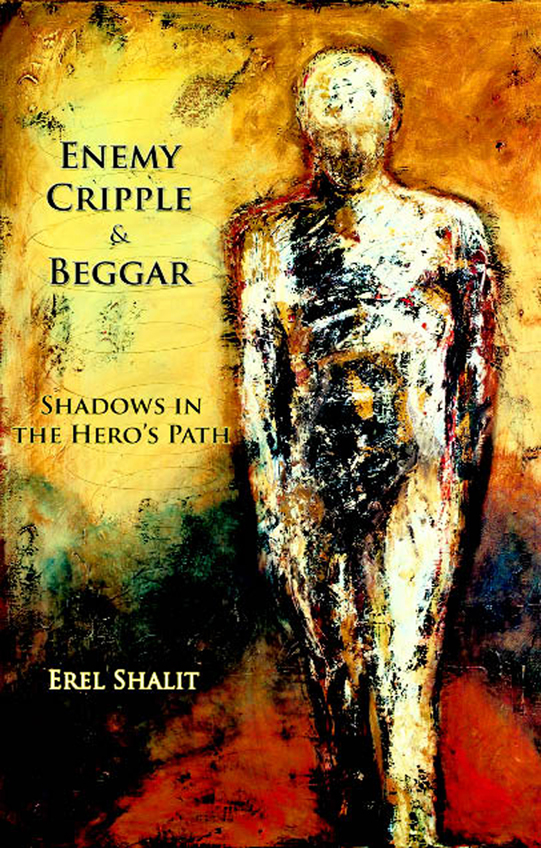
Enemy, Cripple & Beggar
ISBN 978-0-9776076-7-9
Order directly from Fisher King Press

Tuesday, January 1, 2008

Fisher King to publish 'Enemy, Cripple & Beggar' by Erel Shalit

With Great Pleasure Fisher King Press announced today:

Available August 2008 from Fisher King Press:

Enemy, Cripple, Beggar: Shadows in the Hero’s Path
by Erel Shalit

In Enemy, Cripple, Beggar: Shadows in the Hero’s Path, Erel Shalit provides new thoughts and views on the concepts of Hero and Shadow. From a Jungian perspective, this forthcoming Fisher King Press publication will elaborate on mythological and psychological images. Myths and fairy tales explored include Perseus and Andersen’s The Cripple. You’ll also enjoy the psychological deciphering of Biblical stories such as Amalek—The Wicked Warrior, Samson—The Impoverished Sun, and Jacob & the Divine Adversary. With the recent discovery of The Gospel of Judas, Dr. Shalit also delves into the symbolic relationship between Jesus and Judas Iscariot to illustrate the hero-function’s inevitable need of a shadow. Clinical material concerning a case of a powerful erotic counter-transference is also an integral part of this deeply insightful body of work.

The Hero is that aspect of our psyche, or in society, who dares to venture into the unknown, into the shadow of the unconscious, bringing us in touch with the darker aspects in our soul and in the world. In fact, it is the hero whom we send each night into the land of dreams to bring home the treasures of the unconscious. He, or no less she, will have to struggle with the Enemy that so often is mis-projected onto the detested Other, learn to care and attend to the Cripple who carries our crippling complexes and weaknesses, and develop respect for the shabby Beggar to whom we so often turn our backs—for it is the 'beggar in need' who holds the key to our inner Self.

As with Erel Shalit’s previously published book The Complex: Path of Transformation from Archetype to Ego, comprehensive views of the concepts and images of the Shadow and the Hero are provided and theory further explored. While directed toward an audience of analysts and Jungian oriented psychotherapists and clinicians, Enemy, Cripple, & Beggar: Shadows in the Hero’s Path can be comfortably read as well by an informed lay public interested in Analytical Psychology and Psychoanalysis, and by those interested in the interface between psychology and mythology, and psychology and religion.

Erel Shalit is a Jungian psychoanalyst in Ra'anna, Israel. He is a training and supervising analyst, and past president of the Israel Society of Analytical Psychology (ISAP). He is the author of several publications, including The Hero and His Shadow: Psychopolitical Aspects of Myth and Reality in Israel and The Complex: Path of Transformation from Archetype to EgoSeveral of his Articles have appeared in Quadrant, The Jung Journal, Spring Journal, Political Psychology, Clinical Supervisor, Round Table Review, Jung Page, Midstream, and he has entries in The Encyclopedia of Psychology and Religion. Dr. Shalit has taught at the Department of Psychotherapy, Tel Aviv University Medical School, and lectures at professional institutes, universities, and cultural forums in Israel, Europe, and the United States.

Order directly from Fisher King Press or call +1-831-238-7799