Showing posts with label poetry. Show all posts

Wednesday, March 21, 2018

Emily Dickinson: A Medicine Woman for Our Times

Just Published by Fisher King Press

Emily Dickinson: A Medicine Woman for Our Times
by Steven Herrmann

Among the 19th century poets, Emily Dickinson is by far the most scientifically minded. Science is the voice that summoned Dickinson at Mount Holyoke Female Seminary and gave her unique distinction as a poetess of botanical and entomological and astronomical classifications. Like no other 19th century poet she forms an integration between science and spirituality. She studied at Holyoke at the exact historical moment of the first Seneca Falls Women’s Rights Convention in 1848. This, therefore, is a feminist book. It speaks up for the Divine Feminine. On the front cover purple-white rosemary blossoms are exploding with color. Emily Dickinson’s garden was a place where butterflies, bees, and hummingbirds drank up the radiance of flowers. Rosemary in particular was one of her favorite healing herbs. C.G. Jung mentions the antitoxin of rosemary flowers as a synonym for the Self, the total personality. When Steven Herrmann refers to Emily Dickinson as a Medicine Woman, he is speaking of an archetype of healing within all humans. Her poems are enduring imprints of the Medicine Woman archetype. It is by access to the Medicine Woman archetype that she’s able to espouse a democracy of equality that the world needs right now. She advises women to cherish “Power” and take heed from the Serpent. We need a Medicine Woman to balance things out. In a democratic sense, she’s a fierce and uncompromising spokeswoman for Liberty. Emily Dickinson is a dispenser of a new American myth for our times.

About the author
Recognized internationally, Steven Herrmann is the author of William Everson: The Shaman’s Call, Walt Whitman: Shamanism, Spiritual Democracy, and the World Soul, and Spiritual Democracy: The Wisdom of Early American Visionaries for the Journey Forward. In 2015 his chapter “C.G. Jung and Teilhard de Chardin: Peacemakers in an Age of Spiritual Democracy” was published in Pierre Teilhard de Chardin and Carl Gustav Jung Side by Side. He has taught on the subjects of Jung, Whitman, and Melville at the C.G. Jung Institutes of San Francisco, Chicago, and Zürich, UC Berkeley and UC Santa Cruz, and on Jung and James at Yale University. Herrmann’s expertise in Jungian Literary Criticism makes him one of the seminal thinkers in the international field, and a foremost authority on Whitman, Melville, and now Dickinson in post-Jungian studies.

Emily Dickinson: A Medicine Woman for Our Times
Paperback: 298 pages, Index, Bibliography
Publisher: Fisher King Press
1st edition
Official Publication date: March 21, 2018
Language: English
ISBN 10: 1771690410
ISBN-13: 9781771690416
Fisher King Press publishes an eclectic mix of worthy books including Jungian Psychological Perspectives and a growing list of Cutting-Edge alternative titles. www.fisherkingpress.com

Friday, May 19, 2017

Love Poems and Other Terrible Problems

Just Published by il piccolo editions

Love Poems and Other Terrible Problems
by Charles Zeiders

Charles Zeiders has given us a great gift; a poet, healer, and lover, he shares with fearless eloquence his heart, his mordant wit, and his empathic depth. Most of all, however, he inspires hope, hope in the human soul. I am captivated by his words and reading him I can feel my soul's enthusiastic approbation. You must give your soul the same pleasure. -Dr. Stephen Martin, Jungian Analyst and President Emeritus of the Philemon Foundation

Love Poems and Other Terrible Problems teems with psychic and spiritual energy. It’s like a Hieronymus Bosch painting that includes the Marx Brothers and splotches of transcendent gold. - Peter Devlin, from the Introduction

Zeiders’ love poems depict the paradoxes of a Christ-redeemed eros . . . But the volume explores the insane side of love…Like Dante’s Virgil, Zeiders navigates us through an earthly Inferno of malignant narcissists, charlatans, and pedophiles…Thankfully, the poet brings us safely to the other side . . . Just as the Christian vision of the universe begins and ends with Love, so Love Poems and Other Terrible Problems provides hope.  -Joseph Walls, from Kiss Epiphany: A Spiritual Critique of Love Poems and Other Terrible Problems

From the exploration of the transfigured state found in the “Love Poems” we turn to the “Other Terrible Problems” . . . Nietzschean nihilism presses upon us. So does war and gore…Psychopaths head our institutions . . . we cannot find a way to offer our eros in the mad contexts they create . . . yet, the lesson is that within the container of love . . . one’s entire humanity can be accepted. -Margaret Connolly, from the Editor’s Afterword

About the author
Charles Zeiders is a clinical and forensic psychologist. His books include The Clinical Christ and Wall Street Revolution and Other Poems.

Love Poems and Other Terrible Problems
Paperback: 104 pages
Publisher: il piccolo editions
1st edition
Official Publication date: May 19, 2017
Language: English
ISBN 10: 1771690445
ISBN-13: 9781771690447
Fisher King Press publishes an eclectic mix of worthy books including Jungian Psychological Perspectives and a growing list of Cutting-Edge alternative titles. www.fisherkingpress.com

Tuesday, February 28, 2017

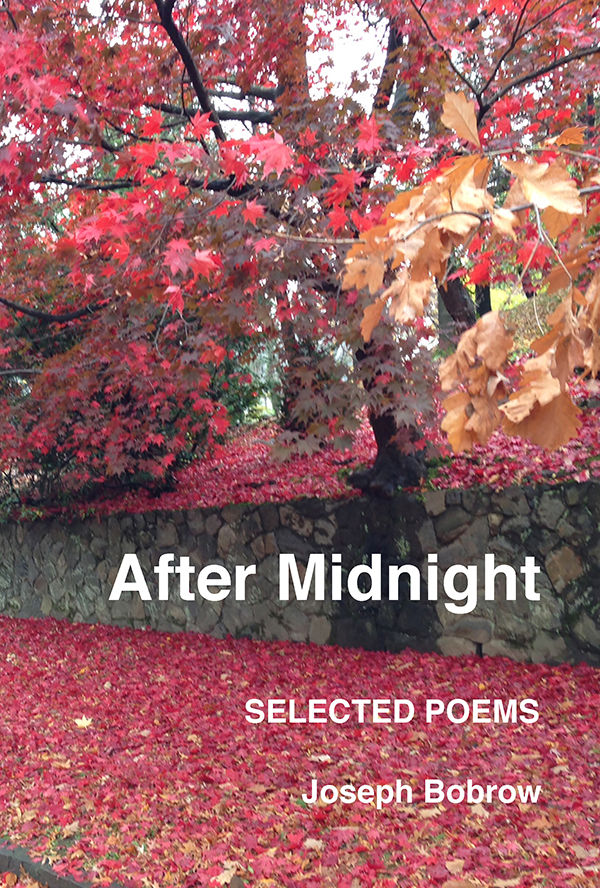
After Midnight: Selected Poems

Just Published by il piccolo editions

After Midnight: Selected Poems
by Joseph Bobrow

"Joseph Bobrow’s poems are prayers for safe haven. They are sutras for life, for the protection of soldiers, children, mothers, fathers, everyone. We can take refuge in our relationships with one another, and in the beauty of the world." —Maxine Hong Kingston, author, activist, and the recipient of the National Medal of Art from President Barack Obama.

"Joseph Bobrow’s poems know that every day we are dying and that every one of those dying days we are also fully alive. He writes that “memory and inclination are subject to conditions on the ground,” and so they are in these moving poems which are the gift of seeing and of the ability to respond to tragedy and delight in equal measure while weaving them into the fabric of a life fully realized." —Dan Gerber, author of Sailing through Cassiopeia, 2013 Book of the Year Award in Poetry from The Society of Midland Authors.

"Joseph Bobrow’s poems are down-to-earth meditations on the poignant mysteries of life, love, and loss. Not one is abstract or philosophical; every one is a Dharma talk with heart. I kept touching into moments of Bobrow’s experience that mirrored—and enriched—my own. Bows!" —David Richo, author of You Are Not What You Think: The Egoless Path to Self-Esteem and Generous Love. 

"Reading Joe Bobrow’s poetry makes me want to live more wildly, more fully. His poems live in an irresistible arc between the raw and vivid details of his precious life and a sense of vastness, of spaciousness, of universality. I want to return to these poems again and again. His voice makes me want to reply with my own poetry, and to touch his voice in the darkness." —Stephen Cope, best-selling author of The Great Work of Your Life and Yoga and the Quest for the True Self

"In the dense moments of Bobrow’s writing intensity hovers, swells. Pain and bliss rise, fall, rise again. Which will it be moment to moment? Where can we go when it is happening? Seek refuge in a poem? These poems accost us with more of how it feels to be alive. Be ready. —Michael Eigen, Author of Under the Totem: In Search of a Path

About the Author 
Joseph Bobrow is the author of Waking Up From War: A Better Way Home for Veterans and Nations (foreword by His Holiness the Dalai Lama), Zen And Psychotherapy: Partners in Liberation (comments by Ven. Thich Nhat Hanh), and the co-translator of Thich Nhat Hanh’s Guide To Walking Meditation. After Midnight: Selected Poems is his first collection of poems.

Joseph is a Zen master and Roshi of Deep Streams Zen Institute in Santa Barbara, which offers Zen Buddhist practice, interdisciplinary education, and peace-building programs that implement new integrative models of transforming suffering. For ten years, Coming Home Project, a community service of Deep Streams Zen Institute, helped thousands of post-9/11 service members, veterans, families, and caregivers transform the unseen injuries of war. A retired psychoanalyst, Joseph now serves on the faculty of Pacifica Graduate Institute and teaches widely.

Title: After Midnight: Selected Poems
Author: Joseph Bobrow
Paperback: 60 pages
Condition: New
Publisher: il piccolo editions (Feb 28, 2017)
Language: English
ISBN-10: 1771690429
ISBN-13: 978-1771690423
Fisher King Press publishes an eclectic mix of worthy books including Jungian Psychological Perspectives and a growing list of Cutting-Edge alternative titles. www.fisherkingpress.com

Tuesday, April 21, 2015

Watsky's Walk-Up Music by il piccolo editions

Press Release - April 21, 2015

Just published by il piccolo editions:

Walk-Up Music
by Paul Watsky

Watsky does the work of 10 poets in this excellent, slim collection. An avid baseball fan, Watsky writes gorgeously of his passion for America’s pastime. To borrow a term from the sport: he’s a utility player. Watsky handles multiple positions with equal dexterity and skill. In fact, there’s not much he can’t do. Verse about Jungian archetypes? He’s got it: “Yes!! shouts Shadow, straight to hell! / Be nice, admonishes Persona. / Partially disrobed, Anima at the mirror peekaboos her hair / first across one breast then the other.” (Watsky is a trained clinical psychologist.) Verse about the Japanese poet Santoka? That’s here too: “Sake / his favorite koan got him / into trouble and then got / him out before the bent / nail of his personality / was pounded / flat.” How about a poem, out by out, of San Francisco Giant Matt Cain’s perfect game? “June 13, 2012, a Wednesday night against / the Astros, we’re down for one of Matt’s trade- / mark gems, especially Houston being nearly / impotent on the road—not that we’re entitled / to point fingers.” And it’s all good. Though he can ably write in a variety of forms, Watsky’s favorite weapon is a sort of prose poem divided cunningly into sharp, un-rhyming couplets. One particularly effective example is “Squaw Valley Pan Shot”: “white pine that nips / the heels of retreating / glaciers a mere ten / millennia ago this summer. God / knows, my timing / can be rotten but I haven’t bought any / ski areas lately.” In this form, the line breaks do the work; “God” is left out on a limb, separated from the knowing he will eventually do. Thus does an approachable meditation on a winter landscape become subtle, incisive theology. As if Watsky didn’t already have enough on his plate. Refreshing poetry that has a little something for everybody. —Kirkus Review

Friday, March 21, 2014

Just Published - Feathered Ladder

March 21, 2014 - Just Published by il piccolo editions

Feathered Ladder
Selected Poems

by Brian Landis and Dennis Patrick Slattery

Two volumes of poetry have been combined in this special edition il piccolo publication.

“Brian Landis is a master storyteller; Dennis Patrick Slattery a master teacher in the art of writing myth. Both are skillful poets who have teamed to produce this refined volume of poetry. Feathered Ladder speaks brilliantly to me.” —From the Foreword by Stephanie Pope, Cultural Mythologer and poet — mythopoetry.com

Brian Landis, MA Economics, Denver University, MA Depth Psychology, Pacifica Graduate Institute, is a psychotherapist in private practice in San Luis Obispo, California. His writing has been published internationally, most recently “Duet For Marimba” in Mythopoetry Scholar; and a review of The Beauty Between Words, in Psychological Perspectives. He has been nominated multiple times for the Pushcart Prize in poetry.

Dennis Patrick Slattery, Ph.D. has been teaching for 44 years, the last 20 at Pacifica Graduate Institute in Carpinteria, California. He is the author, co-author, editor or co-editor of 20 volumes, including four volumes of poetry: Casting the Shadows: Selected Poems; Just Below the Water Line: Selected Poems; Twisted Sky: Selected Poems; and The Beauty Between Words with Chris Paris. He has co-authored one novel, Simon’s Crossing with Charles Asher. His more recent books includeDay-to-Day Dante: Exploring Personal Myth Through the Divine Comedy; Riting Myth, Mythic Writing: Plotting Your Personal Story; The Soul Does Not Specialize: Revaluing the Humanities and the Polyvalent Imagination with Jennifer Selig. His new book, Creases in Culture: Essays Towards a Poetics of Depth was published by Fisher King Press in January 2014. He is completing a work on Herman Melville’s Moby-Dick for publication in 2014. He offers riting retreats on exploring one’s personal myth through the works of Joseph Campbell in the United States and Europe.

Product Details
Feathered Ladder: Selected Poems
Paperback: 230 pages
Publisher: il piccolo editions; 1st edition (March 21, 2014)
Language: English
ISBN 10: 1771690127
ISBN 13: 9781771690126
Fisher King Press publishes an eclectic mix of worthy books including 
Jungian Psychological Perspectives, Cutting-Edge Fiction, Poetry, 
and a growing list of alternative titles. 

Just Published - A Cast of Coins

March 21, 2014

Just Published by il piccolo editions

A Cast of Coins
Poems by Phyllis Stowell

A Cast of Coins derives from contemplation of the language and images encountered in the I CHING, an ancient Chinese text used for divination. Those who are unfamiliar with the I CHING (or Yi Jing) The Book of Changes, will be able to read the poems as poems without referring to it. However, some knowledge of this text would add a dimension to the reader’s experience. At the core lies an interchange between concept and image taken from nature as well as cultural, social and religious life. A Cast of Coins is a book about messages.

Phyllis Stowell has a PhD in Depth Psychology and Poetry and currently is Co-chair of Friends of the C. G. Jung Institute, San Francisco. She was a founding member of the Saint Mary’s College MFA where she was elected Professor Emerita. She is the author of six volumes of poetry, including Sundered, the bilingual art/poetry book Shield/Bouclier with art by Pacia Sallomi, and co-editor of Appetite: Food as Metaphor: An Anthology of Women Poets.

Product Details
A Cast of Coins
Paperback: 80 pages
Publisher: il piccolo editions; 1st edition (March 21, 2014)
Language: English
ISBN 10: 1771690119
ISBN 13: 9781771690119

Fisher King Press publishes an eclectic mix of worthy books including 
Jungian Psychological Perspectives, Cutting-Edge Fiction, Poetry, 
and a growing list of alternative titles. 

Monday, November 11, 2013

News Release: Wall Street Revolution


November 11, 2013

Fisher King Press and il piccolo editions are pleased to announce another new publication:

Wall Street Revolution and Other Poems
by Charles Zeiders

Wall Street Revolution and Other Poems draws on the perennial wisdom of the Western religious tradition to treat the disease of 21st century nihilism. These poems are at once comical, candid, prophetic, and even healing to the wound in the Western mind. The collection takes the reader on a journey through the Faustian bargains and idolatries that have defined the postwar and postmodern years. Like Dante, the poet shows that only Love and love can satisfy the needs of the individual and collective soul.  In terms of the spiritual poetry addressing the madness of the postmodern moment, this work is unique and enlightening.

News Release: Dark Healing


November 11, 2013

Fisher King Press and il piccolo editions are pleased to announce another new publication:

Dark Healing
by Richard E. Messer

These poems, written from lived experience, speak for the survivors of personal violence. The pain inflicted on so many families in our violent age has seldom been faced with such unflinching determination to depict it honestly and wrest from it an acceptance of suffering based on a full, active and meaningful view of life. Does anyone escape suffering? No, that is why those who survive and go on to a new acceptance of life, reach out to those who are for the present victims. Tragedy teaches what intuition always whispers: there is a realm in which we are all present to each other; we are One in the deep heart’s core. We mourn those who die, and we move on through the knowledge that what has happened to them, no matter how brutal or tragic, does not define them—or us. Our spirits and our souls tell us who we are and give our lives their meaning.

Wednesday, April 10, 2013

What Became of Our Fierce Flowering?


April 10, 2013 - Just published by il piccolo editions

The Faust Woman Poems
by Naomi Ruth Lowinsky

What became of our fierce flowering?

In the 1960s and '70s the long forgotten and forbidden Great Goddess roused herself from millennia of slumber and took possession of young women’s imaginations. That cast out She offered a Faustian bargain—She would rip you out of your narrow domesticated self image, thrust you into the wilds of sex, power and creativity, initiate you into the mysteries of Earth and Starry Heaven, but you would owe Her your soul. A generation of women followed Her. Some knew her as Feminism, some knew her as the Deep Feminine, many as both.

The Faust Woman Poems trace one woman’s Faustian adventures through that time. Most of a lifetime later the Great Goddess returns to the poet.  As oceans rise and species die She demands Her due.

About the Author:
Naomi Ruth Lowinsky lives at the confluence of the River Psyche and the Deep River of poetry. The Sister from Below: When the Muse Gets Her Way tells stories of her pushy muse. She is the co-editor, with Patricia Damery, of the new collection Marked by Fire: Stories of the Jungian Way. In addition to the Faust Woman Poems, Naomi is also the author of three books of poetry, including the recently published Adagio & Lamentation. Her poetry has been widely published and she is the winner of the Obama Millennium Award. She is a member of the San Francisco Institute and has for years led a writing circle there, called Deep River.

Cover image Papilla Estelar is a painting by Remedios Varo, used with permission from the Varo Estate, © 2013 Artists Rights Society (ARS), New York / VEGAP, Madrid.

Product Details
The Faust Woman Poems
Paperback: 90 pages
Publisher: il piccolo editions; 1st edition (April 10, 2013)
Language: English
ISBN: 978-1926715971
Fisher King Press publishes an eclectic mix of worthy books including 
Jungian Psychological Perspectives, Cutting-Edge Fiction, Poetry, 
and a growing list of alternative titles. 

Saturday, December 8, 2012

Fisher King publishes another Master: Alvaro Cardona-Hine

the song less/on

A book of poetry by Alvaro Cardona-Hine

“Some of the best ever written . . .” 

--Tom McGrath in The National Guardian 

reviewing the haiku in The Gathering Wave.

“Cardona-Hine is far more tuned to silence than Eliot; there are no phases to his theology. He offers no disciplines, nor even Zen vacancies; he offers arrivals . . . This gentle poet has little to do with the hysterical attenuated surrealism which has in recent years dominated the better little magazines. Or with archetypes of the Great Mother or other theorizing . . . It is understandable that poets want to move out into the universe, to dream of being moles, to sink into mineral veins, to make wild dissociated images that dissolve the self. But Cardona-Hine preserves the sense of human self-hood, human wonder, adventure.”
–Benjamin Saltzman in Kayak 
reviewing Words On Paper.

Alvaro Cardona-Hine was born in Costa Rica in 1926 and was brought to the United States by his parents in 1939. By 1945 he was writing poetry then went on to translate Cesar Vallejo, write novels, make a living as a painter, and compose music which has been performed in various parts of the country. He is the recipient of an NEA grant, a Bush Foundation Fellowship and a Minnesota State Arts Board grant. He lives with his wife, the poet and painter Barbara McCauley, in the small village of Truchas, in New Mexico, where the two manage their own gallery.

Product Details
* Paperback: 170 pages
* Publisher: il piccolo editions; First edition (Jan 1, 2013)
* Language: English
* ISBN-13: 978-1926715889
* www.fisherkingpress.com

Fisher King Press publishes an eclectic mix of worthy books including 
Jungian Psychological Perspectives, Cutting-Edge Fiction, Poetry, 
and a growing list of alternative titles. 

Sunday, November 11, 2012

News Release - Just Published - The Book of Now


The Book of Now: 
Poetry for the Rising Tide

edited by Leah Shelleda

It is an honor to be the publisher of The Book of Now: Poetry for the Rising Tide. To Anita Endrezze, Crystal Good, Dunya Mikhail, Frances Hatfield, Jane Downs, Leah Shelleda, and Naomi Ruth Lowinsky, I would like to express my sincere gratitude, for allowing Fisher King Press to publish poets of such venerated caliber. It is my hope that your mighty voices encompass the entire world and your messages reach and touch the hearts of humanity as a whole. It is my hope that your most worthy offerings are genuinely received and deeply understood.
-- Mel Mathews, Publisher, Fisher King Press

Seven lyrical women poets, each accompanied by a study of their work, navigate our contemporary world. They travel to the depths of the psyche, experience exile, rhapsodize on the beauty of our planet, lament loss and celebrate renewal. These poets write courageously on what threatens us: climate change, war, mountain-top removal, loss of species, environmental damage, the scourge of cancer. They are witnesses, ‘Couriers’ who bring us their visions. As the tide rises they reach out to us in deeply personal and clear voices, each providing a unique experience in contemporary poetry.

* The Book of Now: Poetry for the Rising Tide
* Paperback: 110 pages
* Publisher: il piccolo editions; First edition (Nov 1, 2012)
* Language: English
* ISBN-10: 192671590X
* ISBN-13: 978-1926715902

Fisher King Press publishes an eclectic mix of worthy books including 
Jungian Psychological Perspectives, Cutting-Edge Fiction, Poetry, 
and a growing list of alternative titles. 

Tuesday, April 17, 2012

News Release - Sundered


April 17, 2012

Just Published

Sundered

poems by Phyllis Stowell

“This is not what is true, merely true.” Images of intrusion, aggression, martyrdom, achievement, pilgrimage move in and out of these poems as they move in and out of our dreams, their relation to the lived life real but imponderable. Phyllis Stowell’s writing seems to acquire a new clarity and strength of purpose, paradoxically, as it plunges into the mysterious. For me this stands with Arc of Grief at the top of her work.
—Alan Williamson

Phyllis Stowell is Professor Emerita and Founding Member of Saint Mary’s College of California MFA. Her poems have appeared in over forty traditional and avant-garde reviews. In addition to Sundered, she is the author of several other poetry collections. She is co-editor of Appetite: Food as Metaphor: An Anthology of Women Poets. Phyllis lives in Berkeley, California.
Fisher King Press publishes an eclectic mix of worthy books including 
Jungian Psychological Perspectives, Cutting-Edge Fiction, Poetry, 
and a growing list of alternative titles. 

Saturday, February 11, 2012

She’s certainly not about the ordinary business of life . . .


The Sister from Below:
When the Muse Gets Her Way

a Jungian Perspective by Naomi Ruth Lowinsky

The Sister speaks to all those who want to cultivate an unlived promise—those on a spiritual path, those who are filled with the urgency of poems that have to be written, paintings that must be painted, journeys that yearn to be taken…

Who is She, this Sister from Below? She’s certainly not about the ordinary business of life: work, shopping, making dinner. She speaks from other realms. If you’ll allow, She’ll whisper in your ear, lead your thoughts astray, fill you with strange yearnings, get you hot and bothered, send you off on some wild goose chase of a daydream, eat up hours of your time. She’s a siren, a seductress, a shape-shifter . . . Why listen to such a troublemaker? Because She is essential to the creative process: She holds the keys to the doors of our imaginations and deeper life—the evolution of Soul.

The Sister emerges out of reverie, dream, a fleeting memory, a difficult emotion—she is the moment of inspiration—the muse. Naomi Ruth Lowinsky writes of nine manifestations in which the muse visits her, stirring up creative ferment, filling her with ghosts, mysteries, erotic teachings, the old religion—bringing forth her voice as a poet. Among these forms of the muse are the “Sister from Below,” the inner poet who has spoken for the soul since language began. The muse also appears as the ghost of a grandmother Naomi never met, who died in the Shoah—a grandmother with ‘unfinished business.’ She visits in the form of Old Mother India, whose culture Naomi visited as a young woman. She cracks open her Western mind, flooding her with many gods and goddesses. She appears as Sappho, the great lyric poet of the ancient world, who engages her in a lovely midlife fantasy. She comes as “Die Ür Naomi,” an old woman from the biblical story for which Naomi was named, who insists on telling Her version of the Book of Ruth. And in the end, surprisingly, the muse appears in the form of a man, a long dead poet whom Naomi loved in her youth.

The Sister from Below is a personal story, yet universal, of giving up a creative calling because of life’s obligations, and being called back to it in later life. This forthcoming Fisher King Press publication describes the intricate patterns of a rich inner life; it is a traveler’s memoir, with outer journeys to Italy, India and a Neolithic cave in Bulgaria, and inward journeys to biblical Canaan and Sappho’s Greece; it is filled with mythic experience, a poet’s story told. The Sister conveys the lived experience of the creative life, a life in which active imagination—the Jungian technique of engaging with inner figures—is an essential practice.

eBook, Paperback, Download a Free PDF Sample at the Fisher King Press Online Bookstore.

Naomi Ruth Lowinsky is the author of The Motherline: Every Woman’s Journey to Find Her Female Roots (2008) and numerous prose essays, many of which have been published in Psychological Perspectives and The Jung Journal. She has had poetry published in many literary magazines and anthologies, among them After Shocks: The Poetry of Recovery, Weber Studies, Rattle, Atlanta Review, Tiferet and Asheville Poetry Review. Naomi has three published poetry collections, Adagio and Lamentation, red clay is talking (2000) and crimes of the dreamer. She has been nominated for a Pushcart Prize three times. Naomi is a Jungian analyst in private practice, poetry and fiction editor of Psychological Perspectives, and a grandmother many times over.

The cover image "Phases of the Moon" is an oil painting by Bianca Daalder-van Iersel, an artist and Jungian analyst practicing in Los Angeles, California. You can learn more about the artist and her work at www.bdaalder.com.

The Sister from Below : When the Muse Gets Her Way
—by Naomi Ruth Lowinsky
ISBN 978-0-9810344-2-3

Tuesday, January 10, 2012

Animus, O Animus!

by Deldon Anne McNeely

Animus, O Animus, wherefore art thou, Animus? Please step forward out of the shadows, out from behind the dark foliage which camouflages you, into the moonlight, and show yourself to be a true, substantial bridegroom.

Or must I play this scene alone, foolish in my belief that this soliloquy finds an audience? Alas, who speaks? Is it I or you? Aren’t you the Word? The one who insists on clarity? So why am l out here alone on this balcony and you invisible? True, I’m the one who wants togetherness; perhaps by withholding yourself you flush me out so you can see me clearly. How do I get what I need from you? How do I even know what I need from you? You’re supposed to be the assertive one. Am I at your mercy, waiting to be overtaken? And if you come, who in me stands up to you? Can you bear to look me in the eye, or must I feign indifference? Do you respond to honesty, or only to coyness, or, worse yet, must I treat you sadistically to reassure you that you’re dispensable, in order to keep your attention?

Are you loyal? Will you lead me to the true center, or mislead me into folly? Will you fructify me or leave me alone and barren? How can I know your voice? Will I find you in the world, or only through renouncing the world? What, of me, are you? Where, in me, are you? Do you exist outside of the imaginative schemas of nineteenthcentury men?

My confusion about you stems partly from the fact that your functions, as supposed by analytical psychology, sound mightily like “ego,” as we have generally come to define it in heroic terms. Come to think of it, you sound quite a bit like “God,” when It is Whom the patriarchal worlds describe as He. If you are Logos, whose voice speaks you? The voice of reason? The voice of conscience? The voice of the Holy Spirit? The voice of We, the People? The voice of one crying in the desert, “Prepare ye the way of the Lord”? All of the above? Does the heroine exist who is not under your spell? How can you connect me to my Deity, the One who is both male and female, creator and destroyer, now and forever, indivisible?

In trying to understand where the animus lives in the psyche of a woman, it may be helpful first of all to place it in relationship to ego. In Jung’s schema, the ego consists of all we are conscious of being. That which we exclude is defined as shadow. Anima and animus are subsumed under the shadow in early life, and are gradually brought into conscious focus through experience and introspection. At first we cannot differentiate these structures of the psyche, nor can we tell which is functioning through our outward behavior.
A generation ago this sexist little rhyme didn’t raise an eyebrow:
What are little girls made of? What are little girls made of? 
Sugar and spice and everything nice, that’s what little girls aremade of. 
What are little boys made of? What are little boys made of? 
Snakes and snails and puppy dog tails, that’s what little boys are made of.
Many children today would consider it strange. As one thoughtful child said to me, “It sounds very stereotypical.” It is an extreme form of stereotyping, but subtle variations of this sort of thing continue to subliminally teach that “boys will be boys” and girls will not. By such conditioning girls and boys gradually form egos that accept certain characteristics as their own and eliminate others. At first what is deemed unacceptable is not only different, but bad. Only with experience do the qualities of the opposite sex which we find within become tolerable as something potentially valuable.

Animus is the archetypal masculine principle as it exists in a woman. When Jung conceived the term, the stereotyping of females and males into consistent gender roles and characteristics made the masculine principle as it exists in a woman easier to define than it is today. Jung assumed that the consciousness of a woman is identified by her biological sexual being; having the external genitalia of a female automatically meant having the ego of a female. Anima was who you were, and animus was who you eliminated from your self-definition. In that case, the experience of the unconscious would be perceived by the female in terms of otherness, and this otherness would be masculine.

The animus, an archetype unknowable in itself, manifests in three ways: through cultural expression, through biological influence, and through recurrent events in the history of the individual. While the biological influences on maleness and femaleness have not changed to any obvious degree since Jung’s time, enormous cultural changes are occurring in the perception of the sexes.

Think about how our culture has presented the concept of what is “masculine” over the past hundred years. Many of our notions of masculine values remain unchanged. We admire strength of character and physical prowess in men. Yet many men today are not afraid of appearing vulnerable, of cultivating emotional intimacy in relationships with both men and women, of being present to birth and nurture children, of questioning traditional macho social forms, of grooming and dressing themselves in ways once reserved for women. Occupations formerly considered masculine-senior management, the judiciary, clergy and military, to name but a few-are no longer the prerogative of men.

Think about the great differences in the personal history of many women today, compared to women of a hundred years ago: exposure to many more men, and to different types of men; greater intimacy and communications with men; greater access to education and jobs; many more opportunities fostering independence; more support for self-assertion and creative expression.

Cultural changes in the past century have led to further differentiation of the issues surrounding sexual identity. It is now popularly held that biological sexual identity consists of factors beyond those that produce the external genitalia, that hormonal influences of both sexes exist in all humans, and that the external genitalia do not in every instance mirror the dominance of the sexual hormones. It is possible to be male or female genitally while having a range of contrasexual physiological characteristics (breast size, facial hair, voice timbre, muscular apportionment, etc.).

Complicating this is the fact that cultural conditioning has a strong influence on how biological males and females experience their masculinity and femininity. A hundred years ago the cultural factors were so strong that biological preferences were overridden by gender expectations. Choices that we have come to take for granted in the expression of gender roles were not possible. Jane Wheelwright, taught and analyzed by Jung, commented on this cultural change:
Women of the educated younger generations on the whole are independent, energetic, up-front, experimental. They handle their legitimate anger, assert their honest opinions and make necessary objections. In my day, a woman behaving in this way would have been condemned as an animus hound and indeed would have been acting and speaking out of society’s collective animus. When caught by that collective pressure, ie., when she expressed female potential that society had arbitrarily dumped into the animus category, woman would be forced to function from out of the animus complex, doing its bidding, instead of doing the bidding of her own biological ego. Her good qualities, when commandeered and distorted by the animus complex would have made her unrelated instead of independent; compulsive instead of energetic. She would have been devious, not upfront, fearful instead of experimental, hostile but not legitimately angry, opinionated rather than presenting her viewpoint. To put it bluntly she would have been objectionable instead of objecting. The primary business of the animus is to be a creative tool. Its secondary role is to give the necessary stamina to all endeavors. When the animus is overloaded with what does not belong to it, it takes on a negative stance, spilling over and destroying relationships. For this reason I feel knowledge of the animus is important today for women of all ages. (For Women Growing Older, pp. 52-53.)
Previously men strived to live up to society’s expectation that they become husbands, fathers, aggressors, even though they might have no inclination or ability to do so. Women with no desire for motherhood were forced to live out their lives feeling like failures or withdrawing, usually in some noncreative way. There were courageous or accidental exceptions, but few people of either sex could find realistic models for nonconventional identities. There are always people with a seemingly innate talent for individuation who are able to go their own staunch way without obvious models or support, although on close examination there usually exists in their history a very strong, supportive parent who imbues a healthy spirit of conviction and high self-esteem. Such individuals live by their dreams and instincts without collective encouragement, and they forge new routes for all of us.

There were, therefore, women who not only survived but excelled in masculine fields of interest during Jung’s day, even though they probably met with disapproval or animosity; and there were men who lived productive lives out of the anima. But on the whole, most men and women at least put forth the appearance of living up to the expectations set upon them by society, or they withdrew. This meant that Jung was accurate in observing that the unconscious personality of a woman was represented by the masculine principle, which combined all those qualities we associate with yang and Logos.

Today, many of those qualities—assertiveness, clarity of ideation, logical intellect, articulateness of mental processes, drive, etc.—are modeled for women by individuals of either sex. These psychological capacities include mental and emotional factors that were once ascribed to males exclusively, and when these ego-strengths became obvious in women, women often denied or hid them. Men, meanwhile, denied or hid their capacities for fantasy, receptivity, contemplation and other qualities which in some circles were considered sissified, but which today we see as particular strengths of the yin ego, whether in man or woman.

These cultural changes complicate the task of understanding what the female biological ego really is, and what the animus, as “other,” is. Theoretically, the animus is a psychological function mediating between a woman’s ego and the unconscious. In Jung’s model of the psyche, the persona mediates between the ego and the outer world, while the contrasexual archetypes, anima and animus, are essentially guides to the inner world. On the journey of individuation, one must come to terms with the shadow before being able to relate in a conscious way to the anima and animus.

As archetypal feminine and masculine principles, anima and animus have a timeless place in every human psyche. The dominant archetype does not always match a person’s biological sex. Anima values usually dominate the conscious psyche of a woman, but not in every woman, and not in every life situation. To illustrate the complexity of this, here is a description of three women, all in their twenties, who do not fit the usual picture.

Becky, a young woman from a large family, has had problems relating to her alcoholic mother all her life. Her father is a likable but ineffectual man. When Becky entered therapy she was depressed and anxious. She worked as a teacher and had just been through her first relationship with a man, which had ended in her being rejected.

Becky repeatedly dreamed of herself as a male, usually in the role of rescuing a female. The recurrence of the masculine dream ego suggested that Becky identified with men, and indeed, she had been a tomboy, had not dated at all until recently and had never had a satisfying sexual relationship. The recurrent theme of rescue suggested a repressed feminine side that called out for recognition.

She had not been in therapy for long when she met and fell in love with a young man. They were immediately compatible sexually and in every other way, and after a year of courtship they married and moved away. I do not have information about her dreams since then. I do know that after several years she was still happily married. Her identification on some level with men did not prevent Becky from making a conventional adjustment as a woman. She had not been in therapy long enough to assume that this was due to therapy. One can only surmise that when the conditions were favorable and she felt supported and safe, her feminine ego was accessible for a mature relationship.

Dana, in contrast, always a tomboy also, remembered having excited feelings about girls from the time she began school. She adamantly refused to wear dresses from an early age, and after a few years of high school dating which she found distasteful, declared herself a lesbian.

Dana’s dreams in the early stage of therapy often presented her as a person harassed and persecuted by unsavory women. It seemed as if her conscious ego was male, so that even though her dream ego pictured her in a female body, she saw the “other” as women aggressors. The opposite sex, still fused with a persecutory shadow, was female. Dana’s relationship with her mother appeared to be positive; however, her early life was fraught with chaotic changes through divorces, marriages, moves, and animosity between her several sets of parents.

Marie, like Becky, was one of many children of a domineering mother. She earned attention from her powerful and often absent father by excelling in sports. Although she was very attracted to men and boys as a young girl, she fell in love with a female celebrity and entered into a long-term relationship with her. Defining herself as lesbian, she was later surprised to find herself attracted to strong men and frequently propositioned by authority figures. She entered therapy, confused and anxious, after several relationships with men had come close to being consummated. She repeatedly dreamed about figures entering her bedroom, which frightened her and woke her before they could be identified. She found herself attracted to both men and women; she was afraid of being intimate with men, though in fantasy this excited her.

These examples, typical of issues raised by patients today, reflect changing roles and values, and changing images of the structure of the psyche. Psychology does not dictate normality, it studies the data presented by life. Today’s women are vibrant though confused, open and questioning, unwilling to have answers foisted upon them.

It has been the special talent of women historically to follow and discriminate between the nuances and important details of relatedness. Forced into positions of waiting, of observing cyclical patterns of nature in their own physiological and emotional movements, and of remaining centered in the face of demands of children and men, women have had opportunities to observe these nuances for ages. Now they have more opportunities to express those observations.

Rachel Eliza Mann, for instance, a bright and creative graduate student in her twenties, struggles for integrity and awareness in her relationships with family, friends and romantic partners. The following poem explores aspects of dream figures and herself, including her masculine side. The kind of differentiation in fantasy represented here pays off in encounters in the outer world by preparing the ego for the tasks of sorting, unraveling, spinning and weaving that take place in the psyche during the course of a relationship.
The lynx paces within its cage,
The lunatic waits outside the door.
Who is kept outside, who kept in?
The second man makes love to one woman.
Hands and lips wander like a meandering ant,
an answering, a needing, a waiting. 
The first man’s right hand opens up the door.
So invited, the lunatic comes in.
The lynx leaps, quivering and ready.
She is opened up, the second man enters in.
She dives alone into the Blue Hole,
only her left hand keeping hold. 
The lynx dissolves into leaves.
The lunatic crosses the river into the hall.
The first man serves him porcupine stew.
The second man plunges to her roots.
The ant finds its queen.
She takes hold and enters him. 
“Two Loves, an Ant, a Lynx, and a Lunatic” (unpublished).
Confusion about what is animus and what is ego occurs because ego-functions as defined by psychologists are subject to the bias of male dominance. I have come to use the terms “yin-ego” and “yang-ego” to emphasize the fact that because the ego has struggled to differentiate itself from the unconscious does not mean that all ego functions must be heroic. In fact, such an ego would be maladaptive and self-destructive over time.

Energy itself cannot be identified as masculine. The uroboros may seem feminine to the male, but as the Great Spirit/Matter, it is androgynous, the organizing Self that drives the ego, as Dylan Thomas’s “force that through the green fuse drives the flower.” To view the ego’s creation from the unconscious as an image of birth from a mother, one would have to note that the creative phallus of the father was an essential aspect of the unconscious fruition, and that the fetus not only initiates but also passively receives the process. Ego is not, then, necessarily yang; it has feminine characteristics from the beginning. Though the yin-ego is by definition passive, passivity is not without energy. Yin qualities enable the ego to reflect, image, contain, generalize and empathize, and to embrace one’s frailty.

So entwined have the characteristics of animus and ego become that many psychologists define ego strength entirely in terms of masculine adjectives. What women perceive as strength has at times been considered weakness when judged by male values. Indeed, people of both sexes have been hospitalized as severely disturbed for behavior that could be judged as heroic from the standpoint of the yin-ego. A contemplative lifestyle, for instance, unless practiced under the aegis of a religious institution, would be considered abnormal by some psychologists’ standards. A religious attitude in itself has been criticized as a form of weakness, a delusional system to avoid the pain of mortality, according to those who define “normality” as extroverted and rational. Yin ego-consciousness seems to be imaginal and synthesizing, and yang ego-consciousness factual and analytical.

Good parenting requires much yin energy. Young children need waiting for, not hurrying; to have all their feelings held, not judged; to be contained, not driven. Yang-consciousness, oriented toward the future and efficiency, has difficulty here. I have found it easiest to catch my negative animus when I have been hurrying--then I have been most unkind and unconnected to my children. Our schools often reward only the yang ego, and the child who reflects yin experience is misplaced. A bright, introverted child of ten told me she found school going too quickly for her. “When the teacher says something that reminds me of something else, my mind wants to think of it; but if I do, then I find the rest of the class goes on to something else and I am lost.” That is how the creative thought process becomes discouraged. Parents often judge themselves harshly for lacking patience. It is understandable, for yin-consciousness has been poorly modeled and unsupported, except in rare subcultures.

A brilliant woman told me she was considered retarded by her early teachers, not an unusual situation. Neglected, unkempt, the child of alcoholic parents, she was noticed, tested (IQ, 70), tolernted, but never touched until her second-grade teacher bothered to sit close to her and teach her to read with their fingers touching the book. This was all it took for the awakening to happen. Because that teacher shared a moment of grace with her, enabling her to feel received and not judged, her intellect was able to flourish.
I have learned to fail. And I have had my say.
Yet shall I sing until my voice crack (this being my leisure, this my holiday)
That man was a special thing and no commodity, a thing improper to be sold.
Edna St. Vincent Millay, from “Lines Written in Recapitulation,” Collected Poems, p. 384.
The confusion caused by the defining of ego in predominantly masculine terms has led some psychologists to wonder whether the term “ego” is useful at all, and whether the psyche can be conceived of as egoless, without a “monotheism of consciousness.” (See James Hillman, Anima: An Anatomy of a Personified Notion, pp. 177-181.)
My own practice is to think of ego as representing yin/yang features, because phenomenologically we are so accustomed to the experience of a central, organized aspect of the personality which can contain awareness of many parts, that it is difficult to imagine an egoless personality structure maneuvering its way between polarities.

Every woman contains within her psyche the masculine principle, though it may be very repressed. The better the relationship to the masculine principle, the more the woman is able to use animus qualities in appropriate ways throughout her life, and the less conflict she has about doing so. This means that in most women the masculine principle will be experienced as “other,” but the relationship to that “other” may be quite positive.

When the principle of the opposite sex is dominant and unconscious, it obliterates the functioning of the ego and results in problems, especially in close relationships. But the more experience the ego has in dialogue with the contrasexual principle, the more egosyntonic the relationship with the contrasexual partner becomes and the more choices one has in one’s repertoire of conscious behavior. This is why male-female relationships in the outer world promote the blending of yin-yang qualities in the personalities of both men and women. Without the opportunity for positive outer experiences, one has to work harder to come to good terms with the inner partner.

It is still possible, however, to have a good relationship with the contrasexual archetype without much contact with outer-world partners, if one is aware of the capacity to use information from the unconscious to understand this powerful inner partner.

It has been said of Emily Dickinson that she, with Walt Whitman, “all but invented American poetry.” (Ellman and O’Clair, Norton Anthology, p. 33.) She was, in her “strange, explosive ponderings,” prolific, but during her lifetime of reticence and obscurity, only eight of her 1800 poems were published. She said of her awesome father—a lawyer, congressman, treasurer of Amherst College—”His heart was pure and terrible, and I think no other like it exists.” She could not bear to attend his funeral; she listened to it alone in an upstairs bedroom. Her mother, kind, patient, pious and sickly, evoked condescension and even contempt from Emily, who hated the social duties of housekeeping and sewing imposed on women.

Dickinson left home at seventeen to attend Mt. Holyoke, a few miles away, but returned home, never to leave, before the year was up.

We know of two men with whom Emily Dickenson corresponded, but, like her sister, she never married. Some cataclysm occurred in her inner life around 1861, an event only indirectly referred to in her poetry but probably having to do with an experience of unrequited love. From that time on, her poetry changed. She seemed to have been transformed from girl to woman. In spite of a seemingly uneventful life on the surface, she left a treasure of inner riches. . .

You have just read an excerpt from Animus Aeternus by Deldon Anne McNeely

Using some of the more enigmatic poems of the 20th century as guideposts, Deldon Anne McNeely explores the poetry of Sylvia Plath, Adrienne Rich, Teresa of Avila, Emily Dickinson, Mary Oliver, Edna St. Vincent Millay, Anna Akhmatova, and others whose works have had an indelible impact on the evolving world soul. This is literary criticism taken to another level--the level of psyche. Once again, with her hard-won wisdom deeply rooted in soul, Jungian analyst Deldon Anne McNeely delivers -- embedded within the stories of this finely crafted book, one finds redemption and liberation. Some will mirror your own story--other tales will be about those you love. Animus Aeternus is a worthy companion for any modern-day woman.


Fisher King Press publishes an eclectic mix of worthy books including 
Jungian Psychological Perspectives, Cutting-Edge Fiction, Poetry, 
and a growing list of alternative titles. 

Wednesday, November 2, 2011

Drawing a Line in the Sand

Drawing a Line in the Sand and 
Cultivating the Unlived Promise 
of Your Creativity . . .


Listen to Bonnie Bright Interview Naomi Ruth Lowinsky

Bonnie Bright is the founder of Depth Psychology Alliance, a central gathering place, a global village for academic discussion, research, and development of Depth Psychology ideas and views as well as a place to connect with like-minded colleagues, old and new. As the first online community of its kind, it is quickly building a powerful collection of content and methods, enabling Depth Psychology to emerge more fully into the everyday world.

Naomi Ruth Lowinsky is a Jungian analyst and the author of several books, including The Sister From Below: When the Muse Gets Her Way, and her latest poetry collection Adagio & Lamentation. Visit Naomi's blog at www.sisterfrombelow.com and read about the many forms of the muse.
Fisher King Press publishes an eclectic mix of worthy books including Jungian Psychological Perspectives, Cutting-Edge Fiction, and a growing list of alternative titles.
    • International Shipping.
    • Credit Cards Accepted.
    • Phone Orders Welcomed: +1-831-238-7799 skype: fisher_king_press

    Sunday, August 14, 2011

    News Release: Telling the Difference goes viral!

    Paul Watsky's Telling the Difference has gone Viral. We sold out of a healthy inventory in one day. More books are on the way. In the mean time, Amazon.com has inventory
    Fisher King Press publishes an eclectic mix of worthy books including Jungian Psychological Perspectives, Cutting-Edge Fiction, and a growing list of alternative titles.
      International Shipping.

      Credit Cards Accepted.

      Phone Orders Welcomed: +1-831-238-7799 skype: fisher_king_press

      Monday, May 2, 2011

      Mother's “Hallelujah Violin”

      by Naomi Ruth Lowinsky

      A Mother’s Day Offering
      I am losing my mother in little flakes of peeling off memories. Sometimes, during our Sunday morning phone conversations, she tells me she wakes up and doesn’t know where she is. Sometimes she doesn’t know who she is.

      My mother is in Chicago, in a beautiful retirement community by the lake. I am in Northern California. She forgets this. She also forgets where my children and grandchildren live. “You’re so lucky!” she exclaims, each time we have this conversation, “They’re all near you! You can see them whenever you like.” I get her meaning. It’s not easy for her that I’m so far away. It’s not easy for me.

      My mother is a fine musician—a violinist and violist. She still plays chamber music regularly. “What did you play?” I wonder. “Oh, I can’t remember” she says. “But it was fun.”

      I remember, just a few years ago, when my mother was in her eighties, she’d tell me proudly about her Christmas time ”gigs,” playing Handel’s Messiah in Black churches all over Chicago. I wrote a poem about how our family identified with African-American culture, “Your People Are My People.” My mother and her “Hallelujah violin” make an appearance in the poem, which was recently published in New Millennium Writings.

      So mother, here’s my poem as a Mother’s Day offering to you, who have taught me so much about aging with grace and with passion for what you love. It’s dedicated to Al Young, whose poetry inspired my poem.


      YOUR PEOPLE ARE MY PEOPLE
      for Al Young

      My people are the people of the pianoforte and the violin
      Mozart people Bach people Hallelujah people
      my people are the Requiem people Winterreise people Messiah people
      who crossed the red sea Pharoah’s dogs at our heels

      Your people are the drum beat people the field holler people the conjure people
      Blues people Jubilee people people who talk straight to God
      Your people are the Old Man River people the Drinking Gourd people
      singing the Lord’s songs in a strange land

      My family had a Sabbath ritual
      We lit the candles sang Go Down Moses sang Swing Low Sweet Chariot
      sang slave music freedom music secret signals in the night music
      my father said you never know
      when Pharoah will be back

      i was young
      i was American i thought
      my people were the Beatles the Lovin’ Spoonful the Jefferson Airplane
      singing Alice and her White Rabbit through all
      those changes my parents did not understand

      That didn’t last
      That was leaving home music magic mushroom music
      Puff the Dragon music floating off to Never Never land
      now heard in elevators in the pyramids of finance

      but Old Man River still rolls through my fields
      Bessie Smith still sweetens my bowl
      Ma Rainey appears in the inner sanctum
      of the CG Jung Institute flaunting her deep black bottom

      My father’s long gone over Jordan
      and I’d hate for him to see
      how right he was about Pharoah

      but I want you to know Al

      every Christmas
      in black churches all over Chicago
      the Messiah shows up
      accompanied by my mother’s
      Hallelujah violin

      (Published in New Millennium Writings)

      You can learn more about my mother’s life, and about the power of the mother archetype in all our lives, in my book: The Motherline: Every Woman’s Journey to Find Her Female Roots. By the way, it makes a great Mother’s Day gift.
      My mother and her “Hallelujah violin.”
      Photo by Joan David, 2007
      Fisher King Press publishes an eclectic mix of worthy books including Jungian Psychological Perspectives, Cutting Edge Fiction, and a growing list of alternative titles.
        • We Ship Worldwide.
        • Credit Cards Accepted.
        • Phone Orders Welcomed: +1-831-238-7799 skype: fisher_king_press

        Wednesday, October 27, 2010

        Cumbersome


        To quote Norman O. Brown quoting Euripedes, “God made an opening for the unexpected,” and at long last we have what many of us have greatly desired: a collection of poems by Paul Watsky. His is a singular voice in contemporary poetry, with a range that encompasses the wry, the mordant, the laugh-out-loud funny and the deeply moving, often within the same poem. One of Ovid’s earliest critics complained that he did not know when to leave well enough alone. In this he resembles the eponymous hero of Watsky’s “The Magnificent Goldstein,” and, come to think of it, Watsky himself, for which we have cause to rejoice. —Charles Martin

        We meet an observant poet telling a story, his story: wryly perceived incidents of family and history—all given with elegance, wit, and intimacy. A concise, carefully crafted, timely view of the world. —Joanne Kyger
        Order Telling the Difference by Paul Watsky

        A native of New York City, Paul Watsky moved to California during the late 1960’s, where, after teaching for five years in the English Department of San Francisco State University, he trained as a clinical psychologist and Jungian analyst. His haiku, longer poems, and translations have appeared widely in periodicals and anthologies, including Modern Haiku, A New Resonance: Emerging Voices in English Language Haiku, Asheville Poetry Review, Cave Wall, The Cream City Review, and The Pinch. He is cotranslator of Santoka (Tokyo, PIE Books, 2006).

        Sunday, June 27, 2010

        When the Moon Casts a Woman Off

        The moon and then
        the Pleiades
        go down

        The night is now
        half-gone; youth
        goes; I am

        in bed alone
        —Sappho (1)

        When the Moon Casts a Woman Off

        The muse is erotic. This is well known to the men who adore her. For me, her erotic nature can show up unexpectedly, as it did in India, or as it did during that powerful transition in a woman’s life—menopause.

        When the moon has cast a woman off, and she is running hot and cold in a confusion of purposes, body and soul fighting over the terms of their engagement, she may find herself lost, wandering about in a flat landscape, emptied of the drama of her cycles, unfamiliar to herself. When her soul, having lived in all the female places, isn’t sure where she lives anymore; when her mind loses track of itself and falls through the cracks in the floor of her brain; when her spirit is short of breath, confused by the weather, by sudden surges of heat that lack any erotic purpose; and her womb that has been telling time, keeping her in tune with the sea and its tides, goes silent, keeping its secrets inside; she may find herself thrown back to what called her before her first blood flowered, as though soul, mind, spirit, need to root themselves again in her beginnings; her life needs to come full circle. For me, that circle brings me back to a reverie about my early sexual stirrings, and a fantasy about Sappho.

        Sappho. Have you heard of Sappho? She lived 2600 years ago, in a time when the division between the erotic and the sacred had not yet hardened, when a young woman’s education included the arts of love as well as of poetry, dance and music. How is it she suddenly fills me with her presence, as though I’ve always known her; as though I can remember my time with her as a young woman on Lesbos: the temple to Aphrodite, the meadows with flowers we maidens wove into one another’s hair; what we sang around the altar in the moonlight; as though Sappho was my teacher, my priestess, my wild older woman crush.

        How can I claim to remember Sappho? She is a revered ancestor in my poetic lineage. But all we have of her poems are fragments, all we can gather of her life are glimpses, pottery shards, passages in Longinus and Demetrius. Yet even those fragments, those glimpses, give us a lot. They say she is a great lyric poet, perhaps the greatest of all time. They say that she, like Socrates, taught the young. The aristocrats of 5th century B.C. Greece, sent their daughters to Sappho, to her thiasos, where she initiated them into the mysteries of love; taught them ritual, poetry, dance, officiated at their weddings.

        The Greeks did not divide sexuality up as do we. Young women learned love, their bodily and emotional responses, from other women. Some of them went on to marry men and live what we call heterosexual lives. Others stayed in the temple, as priestesses. Some, it is clear from Sappho’s work, preferred to stay with women.

        As Judy Grahn points out in a powerful evocation of Sappho in her book of essays, The Highest Apple, Sappho was born into a now lost lineage of women poets that stretched behind her for a thousand years.(2) She lived in changing times. Already by her time, Greek women were oppressed and controlled by the patriarchy; they could not own property; they belonged to their husbands. But on Lesbos, in Sappho’s thiasos, we catch a glimpse of a world where, in Grahn’s words “women were central to themselves.” I long to have access to such wholeness of female being, such authority of voice and image.
        I took my lyre and said:
        Come now, my heavenly
        tortoise shell: become
        a speaking instrument(3)
        Would I could be such a speaking instrument. Would I could summon such elegance and clarity. In Sappho female flesh becomes word. Her poems are personal, embodied, full of desire and of sensuous physical detail: descriptions of beautiful clothes, advise on what flowers a girl should wear in her hair. They are luminous.

        H.D. brought Sapphic lucidity back into the language, describes Sappho’s poetry as: “containing fire and light and warmth, yet in its essence differing from all these, as if the brittle crescent-moon gave heat to us, or some splendid scintillating star turned warm suddenly in our hand like a jewel, sent by the beloved.”(4)

        I wish I could study poetry with Sappho; learn to speak from female passion as did Sappho; I wish I could be on as intimate terms with Aphrodite, know the altar, know the ritual.
        You know the place: then

        Leave Crete and come to us
        waiting where the grove is
        pleasantest, by precincts

        sacred to you; incense
        smokes on the altar, cold

        streams murmur through the
        apple branches, a young

        rose thicket shades the ground
        and quivering leaves pour

        down deep sleep; in meadows
        where horses have grown sleek
        among spring flowers, dill

        scents the air. Queen! Cyprian!
        Fill our gold cups with love
        stirred into clear nectar(5)
        But wait a minute. Is this the time to be invoking Aphrodite? At midlife, dealing with hot flashes and memory loss, struggling to keep track of many obligations, is this the time of life for Sappho to be stirring in me? Sappho who loved young women, sang of their beauty, taught them the erotic mysteries? Where was she when I needed her, when I had never heard of her, when I was a young woman, overcome by a confusion of passions?

        I came of age in a time when it was believed that young women should be sexually initiated by men. The ancient practice of a woman learning the responses of her body in the hands of an older woman, had been mostly forgotten. There was an archetype missing (still is, for the most part), one the Greeks knew well: the archetype of sacred sexuality. In my day, a young woman’s passion was dangerous; if she expressed it, terrible things could happen to her. There were names: clinical names, colloquial names. Nymphomaniac. Slut. There were dangerous consequences. Pregnancies. Illegal abortions. Doors slammed for life. Shutters closed on her sense of self.

        In the 1960s, some of us got wind of Sappho’s energy, without really knowing much about her. We saw that women had to learn to love women instead of only valuing our relationships with men. We formed circles of women and talked personally, about sex, our bodies, our passionate lives. In such a group, “consciousness raising” we called it, I remember wondering what menopause would be like. We asked an older woman some of us knew to write a letter about her experience. I can’t remember what she said. I do remember her tone, wise, funny, amazed and pleased to be asked. If I were to write such a letter now I’d have to say that nothing has prepared me for the power of change. It’s archetypal, like going through puberty, or becoming a mother.

        And then it occurs to me: no wonder I’m fantasizing about Sappho. It’s not just that she’s a priestess of Aphrodite; she’s a priestess who facilitates archetypal change, and she does it in the voice of a woman-centered woman. As Judy Grahn says, when we lose access to our ceremonial stories “we fall out of history . . . out of mythic time . . . out of poetry except as the objects of it . . . out of meaning into a kind of slavery, a no-world, a no-place . . . ” How then can we make sense of female initiation, profound bodily changes? We need Sappho. We need her to teach us the lore of the body, the creative process, the invocation of the divine.

        And I say to myself, why not try to invoke Sappho? What would it hurt? At worst she won’t come. At best, we’ll have an experience of the imagination.

        The Tenth Muse

        Imagine that we knew Sappho when we were young. Imagine that we can remember the island in the middle of the blue Aegean, near Turkey as it was 2600 years ago, a landscape of olive trees and apple orchards. The scholar of Greek lyric poetry, C.M. Bowra, describes it thus: “an abundance of natural springs fills the valleys with plane trees and lush grass; in the spring the ground is covered with anemones, orchids and wild tulips.”(6) The poet Alcaeus, a contemporary of Sappho, describes her as: “violet-tressed, holy, sweetly smiling Sappho . . .” (7)

        invocation

        tell me, Sappho,
        whose delicate fingers
        wove the violets into your hair?
        whose soft seashell ears burned
        at your song?

        and would you take her back
        after the years
        she forgot you

        opened her body
        to his song

        would you come to the tip
        of her tongue
        leap
        to her image making
        mind?

        would you send for her
        the very chariot
        that carried the goddess
        she of the doves
        and the smile that is
        evening star?

        lady of Lesbos
        we gather
        pieces of you
        out of the mouths
        of buried vases

        i wish it were mine
        to remember
        how we danced
        around the altar in full
        moonlight
        our tender young women feet
        crushing the grass

        holy Sappho
        make a place for me now
        the moon is waning
        we whom the tides
        have released
        long for a fragment
        of you— (8)
        She’s come. Can you see her? She is so vivid, as though she’s always been here, just under the surface, energetic, curious, intense, showing off her dark skin in bright clothing. She’s wearing the purple and yellow outfit she described in a poem. Listen to her beloved Atthis:
        Sappho, if you will not get
        up and let us look at you
        I shall never love you again!

        Get up, unleash your suppleness,
        lift off your Chian nightdress
        and, like a lily leaning into

        a spring, bathe in the water.
        Cleis is bringing your best
        purple frock and the yellow

        tunic down from the clothes chest;
        you will have a cloak thrown over
        you and flowers crowning your hair… (9)
        She stands before a white temple, the blue Aegean glowing behind her. She’s smiling at us. Sappho, speak to us!

        You wonder where I’ve been. I say, where have you been? I’ve been here all along, the old voice of female poetry, glad to be released at last from all those tiresome, bookish discussions about me. You’ve read all that nonsense. Was I short and dark? Did I die for love? Was I married to a man called Kerkylas, a wealthy merchant, or was this an obscene pun in an Attic comedy, because Kerkylas can mean “prick from the Isle of Man”(10) Was I a love priestess? Did I have jealous fights with my rivals for love or for power? Finally you stopped reading all that scholarship that just chops me up into smaller fragments, fits me into small categories that break up my wholeness. How can you separate body from love from soul from ritual from poetry? It is only in what’s left of my work that you can know me, and in the imagination of poets. There are those in your time who know me. H.D. knows me, as:
        an island, a country, a continent, a planet, a world of emotion, differing entirely from any present day imaginable world of emotion…
        A song, a spirit, a white star that moves across the heaven to mark the end of a world epoch or to presage some coming glory.
        Yet she is embodied–terribly a human being, a woman, a personality as the most impersonal become when they confront their fellow beings.
        Judy Grahn knows me, and traces her lesbian poetic lineage through H.D. and Emily Dickinson straight back to me. (11)

        You can know me, not only as a particular poet of 6th c. B.C. Greece, but as the fragmented voice of woman, the ghost of the wholeness of woman that’s been ripped into shreds. What woman has written straight out of her body, her feeling, since I did, until now, in your time? My voice is the passion of woman for woman, the passion for the goddess. Every woman needs to know this passion, whether she sleeps with women or with men. Then she can express for herself what Freud found so mysterious: what a woman wants.

        Why do you suppose you’ve been so consumed by poetry recently? It hasn’t occurred to you that I might have had something to do with that? For two millenia I was a sleepy spirit. But I’ve been right under the surface, waiting to be invoked. I have not been forgotten, but my poems, what has become of my poems? I wrote them down. I wanted them to last forever. It looked like they would. The Alexandrians published me a few centuries after my death. My work survived for a thousand years. I was known as the tenth muse, first among lyric poets, the queen of poetry. Once, everyone knew my poetry by heart. My words were ripe fruit on the tongue of every cultivated person. Now, all that’s left are fragments.

        Don’t think because I’m a shade, I don’t mourn the loss of my work. Don’t think it doesn’t humiliate me, even in death, that my voice got torn to shreds of papyrus, that handwritten copies of my work were used to stuff a coffin, mummify a crocodile. Why did my books disappear? I have not been forgotten, but my poems are lost. I have not been forgotten, but for two thousand years who has written in my tradition? I have been quoted but the whole shape and luster of my work has been lost. Who has invoked me intimately, as I did Aphrodite, as you just did me? Why has it taken you so long? I’ve been knocking at the door of your consciousness most of your little life!

        Dead poets long to be read. We long for our living audience, for the poets we influence, the poems that carry on our tradition, bring it into new territory. Suddenly your time is full of women poets, as though a fire swept through old woods releasing seeds that haven’t sprouted for 2600 years! You’re waking me up, exciting me, calling on me to return.

        Now you want me to help you in this second rite of passage, in the Lesbos of your imagination. But I need your help. Events keep tearing you away from me. Important meetings. Conferences. Telephone calls. I say: come to Lesbos; make time for solitude; be alone with me. Imagine yourself in the grove of apple trees. The apples are reddening, growing ripe. The breeze in the trees has more to say to you than any group of colleagues. What do they know of your essence, your struggle to release your spirit from other people’s purposes? If I am to help you find the self you left behind, I need your full attention, your ear to my voice, your mind to the flow of images. Most of all I need your body!

        You want my body?

        No, I’m not propositioning you, not in the usual sense. I’m a ghost, a spirit. What I want is words for your body’s experience, your desire, your longing. When young women came to me on Lesbos I prepared them for the changing of the gods in their bodies. I called down Aphrodite. I taught them the pleasure of their bodies, what flowers to wear in their hair, what would make the blood run hot under their soft skin. Here they were, young and so lovely, breasts just blossoming. How could I not fall in love? I who was teaching them to cultivate the goddess of love, to make her incarnate in their own flesh, was cultivating my own body of love.

        I brought girls from childhood to womanhood, teaching them to sing and to dance, to cultivate the subtle play of blood and fire in their loins, the connection to their feet, to know what colors to wear, how a dress should drape.

        If I had known you when you were young, you would have known your own beauty. You would have learned to express your own passion, in words. No matter how overcome with passion a woman may be, if she can make a poem of her experience—she retains herself—has made a vessel for herself. I did this time and again.
        He is a god in my eyes
        the man who is allowed
        to sit beside you—he
        who listens intimately
        to the sweet murmur of
        your voice, the enticing
        laughter that makes my own
        heart beat fast… (12)
        Can you imagine how it is to love a young woman, train her in the erotic arts, and then have to officiate at her marriage? Making poems held me together, as making poems has been holding you together in the change of life. What you need is some of our ancient Greek love for our bodies. We did not suffer from that post Christian fear of the body which has caused the fragmentation of my voice. Nor had we any desire to “rise above” our bodies. We knew what you need to remember: the body is where the gods speak to us. Your body is speaking to you, in hot flashes, in memory lapses, in a deep disorientation from the moon. You need me to help you in this change of the gods. I need you to give poetic voice to the change.

        There is something I don’t understand. Do you not know about the change? Didn’t women of your time live past menopause?

        Of course. Women have always known about menopause. In the ancient world we had our secret rituals, we knew the herbal remedies, all the lore of the wise blood. But none of this was valued, or written down. And as the men took over, and women’s spiritual practices were deemed dangerous, witchcraft, you forgot what we once knew. It got lost, like the poems of the poets before me, lost like the mysteries of Eleusis, like the many forms of the goddess.

        The previous article is an excerpt from
        The Sister From Below: When the Muse Gets Her Way
        by Naomi Ruth Lowinsky

        Naomi Lowinsky is the author of The Sister From Below: When the Muse Gets Her Way, The Motherline: Every Woman's Journey to Find Her Female Roots, and the just published book of poems, Adagio and Lamentation. She has authored numerous prose essays, many of which have been published in Psychological Perspectives and The Jung Journal. Her two previous poetry collections, red clay is talking (2000) and crimes of the dreamer (2005) were published by Scarlet Tanager Books. She has been nominated for a Pushcart Prize three times and is the recent recipient of the Obama Millennium Poetry awarded for "Madelyn Dunham, Passing On.” Naomi is a Jungian analyst in private practice, poetry and fiction editor of Psychological Perspectives.

        (1) Sappho, Barnard trans., fragment #64.
        (2) Judy Grahn, The Highest Apple : Sappho and the Lesbian Poetic Tradition, p. 7.
        (3) Sappho, fragment #8.
        (4) Hilda.Doolittle. (H.D.), Notes on Thought and Vision and The Wise Sappho, pp. 57-58.
        (5) Sappho, fragment #37.
        (6) C.M. Bowra, Greek Lyric Poetry, p. 130.
        (7) Alcaeus, Greek Lyric Poetry, p. 239.
        (8) Lowinsky, unpublished poem.
        (9) Sappho, fragment #43.
        (10) Sappho, The Poems and Fragments of Sappho, translated by Jim Powell, p. 33.
        (11) H.D., The Wise Sappho, pp. 58-59.
        (12) Sappho, fragment #39.
        Copyright 2010 © Fisher King Press - Permission to reprint is granted.