The Motherline by Naomi Ruth Lowinsky, a Mother's Day Bouquet Steeped in Mother Earth and Soul.
So many of the stories that I write, that we all write, are my Mother’s stories. Only recently did I fully realize this: that through years of listening to my mother's stories of her life, I have absorbed not only the stories themselves, but something of the manner in which she spoke, something of the urgency that involves the knowledge that her stories–like her life–must be recorded. –ALICE WALKER[1]
Being a mother is an experience of body and soul which ties one to the source of our life and all life.
The Motherline is for women who have mothers, are mothers, or are considering becoming mothers, and for the men who love them. Telling the stories of women whose maturation has been experienced in the cycle of mothering, this book does not sever mother from daughter, feminism from "the feminine," body from psyche. The path to wholeness requires reclaiming aspects of the feminine self that we have lost and forgotten in our struggle to free ourselves from constricting roles; it requires that a woman make a journey to find her roots in the personal, cultural, and archetypal Motherline.
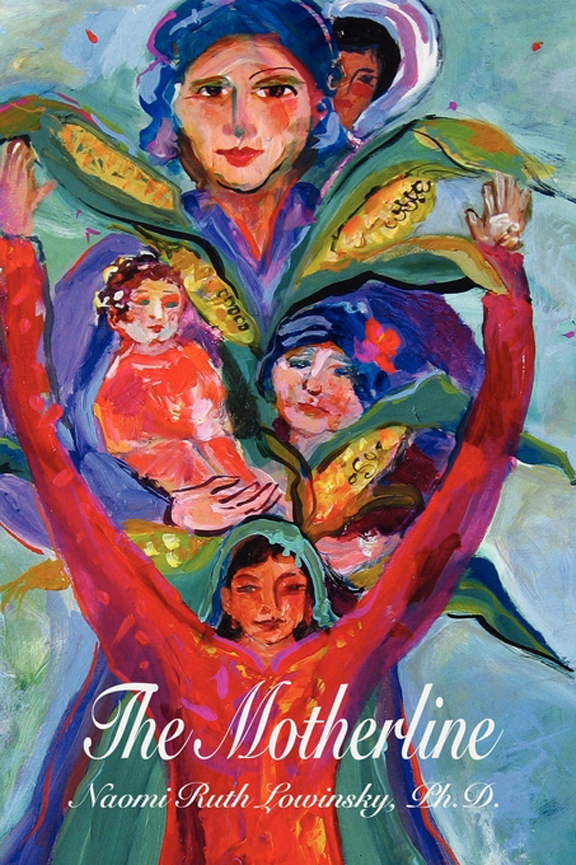
Mother is the first world we know, the source of our lives and our stories. Embodying the mystery of origin, she connects us to the great web of kin and generation. Yet the voice of her experience is seldom heard in our literature. Psychology, the field that examines human nature, has tended to be child-oriented. And much of the feminist literature has been daughter-identified. We are so full of judgments about what mother ought to be that we can barely see what mother is. This has been shattering to a woman's sense of self and her connection to roots. We have no cultural mirror in which to envision the fullness of female development; we are deprived of images of female wisdom and maturity. Finding our female roots, reclaiming our feminine souls, requires paying attention to our real mothers' lives and experience; listening to our mothers' stories, and our grandmothers' stories, is the beginning of understanding our own. When we hear these stories, we tap into the wisdom of our Motherline.
Being a mother is an experience of body and soul that ties one to the source of one's own life and to all life. In the deepest sense of the word it is a religious experience, for the word religion comes from the Latin religare, which means to bind back to, to reconnect with.
The Motherline will help you reconnect to the story of your origins, your Motherline, your body, and your soul.
I have been gathering material for this book all of my life, much like one gathers material for a patchwork quilt. I've taken the stories of the women of my Motherline, memories of childhood, journal entries, my experience raising children and stepchildren to adulthood, pieces of my master's and doctoral dissertations
[2] (both of them studies of mothers), the stories I've heard as a psychotherapist and the stories I've told as an analysand, what I've learned from students and colleagues at the Women's Therapy Center and the Pacifica Graduate Institute, and what I've learned at the C.G. Jung Institute of San Francisco where I trained as a Jungian analyst. I've gathered dreams and poetry and prose, and sewed them all together with journeys I have made to create a pattern that evokes female wholeness. Like most women's sewing projects, it has been worked on, put away while children are being raised and life makes other demands, felt guilty about, and brought back out to be worked on again. As in quilting, the design of the book has been created by combining many separate elements into one pattern.
Although
The Motherline
contains the voices of many women, its structure is based on my personal life because it is the flesh and blood of our female, subjective experience that I seek to bring to consciousness. Each of our stories is unique and yet there is an underlying Motherline pattern. Other women's stories set up sympathetic vibrations so that we can begin to near our own.
The process of finding one's Motherline is idiosyncratic and chaotic. It takes most of a lifetime. Every woman must engage in it in her own way and in her own time. The reclamation of feminine soul is not a process that can be readily taught. Rather it is a potentiality that can be evoked by shifting the way we listen to women's voices, and the way we see ourselves, our mothers, and our grandmothers. I hope to facilitate this process.
Each chapter of the book describes reclaiming an aspect of the feminine self. It is not the entire story. There are aspects of female nature, such as the warrior-amazon and the erotic lover, that are not addressed here.
The Motherline is a search for female continuity and the sense of wholeness that is gained when we find it.
OF SELF, SOUL, AND SHADOW
What is self and soul? Self has come to have specific meanings in psychology. In self psychology, it is used to mean an inborn potentiality for an authentic and vital identity. Jungians use the word
self in a similar but larger sense. For them, the self is the "potential for integration of the total personality"; it "contains the seeds of the individual's destiny";
[3] it includes the psychological, biological, and spiritual aspects of being human.
There has been much controversy among feminist thinkers about whether the experience of self is gender-specific. There are those who argue that a gendered sense of self is a by-product of culture. Though I agree that the culture may warp and damage the female experience of self, it makes no sense to me to separate one's sense of self entirely from one's body. Female identity is rooted in embodied experiences of menstruation, childbearing, lactation, and menopause, which are filtered through the veils that different cultures throw over them. Clearly a woman's identity consists of much more than her reproductive system, and this is where the feminist critique is invaluable in confronting cultural misogyny. But I believe that we go to the depths of our feminine selves in these primal, physical experiences, common to women of all cultures. Devaluing these depths is a function of our own cultural bias.
The word
soul is most commonly used in a religious context, and means the part of our being that is connected to the immortal. Some psychological thinkers such as James Hillman use soul in a broader way, to name the experience of seeing the gods or the sacred in all life forms. This book is about women's immortality through our birth-giving capacity. Soul here is not separate from body. It is through our full honoring of bodily experience that we become ensouled. Soul does not separate us from ordinary life. It does not float off into the stratosphere as spirit seems to in the distinction commonly made between spirit and flesh. In colloquial usage one who has soul is one who has acquired depth through suffering, often one who has been oppressed. Soul is born of the kind of suffering that brings us in touch with the mysteries of life.
One way we garner soul is through the integration of what Jungians call the shadow. The shadow is that part of our personality that is cast into darkness by our fears, values, temperament, and cultural prejudice–a part of ourselves we do not know. Traits that we deny and repress in ourselves and dislike intensely in others are usually parts of our shadow. Contemporary women are prone to project aspects of their shadows on their mothers. We cut off our natural energy flow when we disown our envy, rage, competitiveness, pettiness, sensuality. Paradoxically, when these traits are recognized and owned, they tend to soften and get humanized. Learning to suffer our own shortcomings and those of others, even to develop a sense of humor about it all, gives depth and richness to the personality. It is an aspect of maturation and of soul.
Jungian theory describes psychological experience on three levels: the personal, the cultural, and the archetypal. Most current psychology emphasizes the personal and neglects the cultural (leaving that to the anthropologists) and the archetypal (leaving that to the theologians). The problems created by this narrowness in psychological thought are more than academic. Mothers get saddled with cultural baggage or with archetypal expectations. Because the gods are dead, mothers are expected to stand in for them, taking the blame for much that more truly belongs to fate. Because we've lost a historical sense of how culture shifts, we are outraged that our mothers did not raise us according to the standards of our times but had the effrontery to be shaped by the values of their own generation. Thus painful intergenerational rifts and misunderstandings arise. Women whose mothers love them deeply feel estranged and unmothered. Women whose daughters long to know them can find no language of mutuality.
OUR MAMMALIAN MAMA
How do we distinguish between the three levels of experience–personal, cultural, and archetypal? Archetypal psychologist James Hillman sees Archetypes as the "roots of the soul."
[4] Jungian analyst Joseph Henderson describes the archetype as involving both a primordial image and an instinctual root that "create a pervasive sense of being gripped by an urge and dazzled by an image of compelling power."
[5] An archetype can be described as an underlying life pattern with both instinctive and symbolic poles of expression surrounding a core of great emotional charge. The Great Mother archetype, for example, is a primordial image that expresses our instinctual, mammalian nature. It takes many cultural forms, from images of the Virgin Mary to those of the death-dealing goddess, Kali, in India. But the female form with breasts is recognizable in all cultures. We are all born of woman. Her breasts and her womb permeate all times and all cultures. Every culture translates the mother archetype differently, and every biological, or personal, mother has her own unique psychology and connection to her child.
The personal experience of the mother-daughter relationship is shaped by the individual lives and temperaments of the two women. If, for example, the daughter is the longed-for only child of an older mother who tried for years to get pregnant, her experience of her personal mother will be very different from that of the sixth child of an exhausted mother who considered getting an abortion. The quiet, introverted child of a quiet, introverted mother will have a different experience of self than would the fiery, extroverted child of that same introverted mother. When a woman becomes a mother she embodies the archetypal mother and becomes the culture bearer who will socialize the child. At the cultural level a child will be schedule or demand fed, bottle or breast fed, told she should be seen but not heard, or encouraged to express her spontaneity, raised by her mother or a nanny or an au pair depending on the culture, historical period, class, and personal circumstances into which she is born. However, all these children need to be held and protected, praised and fed and played with, scolded and limited. Though this is done differently in various cultures, a child needs some manifestation of the mother archetype in her life or she will be severely damaged.
It is confusing to sort out the personal, cultural, and archetypal levels of our experience. Archetypes are mostly seen in their cultural manifestation, and changes in cultural attitude become personal battlegrounds between generations. But there are some areas in which the archetype shines through. For example, it is striking to consider how many cultures make similar sounds for naming the mother: Mama, Mutti, Ama, Ema. The "ma" sound brings the lips together as in reaching for the breast. Thus a linguistic form reveals the physiological nature of the archetype across cultures.
I remember seeing a television report about a gorilla mother who had just given birth in a local zoo. She held her baby close. When she lifted her great gorilla hand to tenderly pat its head, a shiver of archetypal energy burst through me. I knew that gesture. Every human being knows that gesture. The mother archetype in her gorilla form had been revealed to me on the evening news!
The words
male and
female refer to our biological natures, while the words
masculine and
feminine imply cultural and archetypal meanings as well. Jungians historically have been interested in the archetypal distinctions between the masculine and the feminine, not limiting them to one gender. Whether these concepts are useful or stereotypical has been controversial in both Jungian and feminist circles. The feminist critique is that these are culturally biased concepts. Jungians respond by pointing out that the masculine is not limited to men, or the feminine to women.
The terms
masculine and
feminine are vital concepts that are typically truncated by the tendency of cultures to make rigid gender distinctions. These hurt both men and women. There is an enormous overlap in what men and women can do. At all levels, including the physical, we are more alike than we are different. But we can rob ourselves of our deep instinctual roots in life if we deny the power of the differences between the sexes. The feminine experienced by a woman is very different from the feminine experienced by a man, and vice versa. Gender differences have biological roots that go far below the cultural level, below human history: they precede our evolution as a species and take us down to our mammalian beginnings.
All mammals are divided into males and females. Females have breasts and wombs. Males have testes and penises. These sexual differences are meaningful; far from being a curse or a limitation on women's lives, our mammalian experience is what grounds us in our feminine selves. My thinking resonates with that of the men's movement, of which poet Robert Bly is a central spokesperson. He and others argue for a recognition of the differences between men and women at the instinctual level. It is a relief and a pleasure to hear men honoring their own embodied experience. These differences are, indeed, empowering for both men and women.
A PATTERN OF FEMININE SOUL
The Motherline is arranged in ten chapters, each evoking an aspect of the feminine self and how it can be reclaimed. The sequence describes the journey I made, but it is not a linear path. One could begin from any place in the pattern to find one's way into the Motherline.
We begin with a conceptualization of the Motherline as the source of our stories. In the second chapter we consider the women's movement, which at once frees us and gets in our way as we seek our female roots. In the third chapter we pick up the thread of our Motherline search by going back to our forgotten knowledge of the mother tongue, remembering images we took in with our mother's milk, of the primal female experiences of bearing, bonding, and being in relation to children.
In Chapter 4, we confront the developmental problem of differentiation between mother and daughter, which forces both women to engage in the painful process of sorting out self from other, and acknowledging shadow. The thread of our story is taken up in Chapter 5 by four women who, in telling their stories from the middle of their lives, loop from the past through the present to the future and back, weaving a rich tapestry of contemporary female maturity.
In Chapter 6 we follow the thread of women's lives by looking at generational change and how we are shaped by the times we live in. Chapter 7 explores girlhood memories of a grandmother and how this process links a woman to her past and to her future and transforms the mother-daughter dyad into the ancient, sacred, female trinity: maiden, mother, and crone.
Throughout
The Motherline, my own Motherline story unfolds; I am confronted by the ghost of the grandmother I never knew. Her voice comes to me from before my birth and requires me to make a journey into the realm of my ancestors. This takes me to Israel in Chapter 8 to meet female relatives and learn their stories, and to Germany in Chapter 9 to see the landscape of my mother's childhood through the ashes of the Holocaust. My journey is part of a pattern of female development; you will see how many women make this descent into the past to find their roots.
In the end we must seek our spiritual roots in the old female religion. In Chapter 10 we traverse the land from the lost shore temples of the east coast of India to a sacred hill in Glastonbury and discover that the forbidden and taboo aspects of feminine soul are a part of our landscape as well as our dreams and our visions. What we have lost or forgotten of the feminine mysteries is hidden in our everyday lives.
About the Author
Naomi Ruth Lowinsky is the author of
The Sister from Below : When the Muse Gets Her Way
 and
The Motherline: Every Woman’s Journey to Find Her Female Roots and numerous prose essays, many of which have been published in Psychological Perspectives and The Jung Journal. She has had poetry published in many literary magazines and anthologies, among them After Shocks: The Poetry of Recovery, Weber Studies, Rattle, Atlanta Review, Tiferet and Asheville Poetry Review. Naomi has three published poetry collections:
Adagio and Lamentation
(2010),
red clay is talking
(2000) and
crimes of the dreamer
(2005).
Naomi has been nominated for a Pushcart Prize three times and is the recipient of the 2009 Obama Millennium Poetry award for "Madelyn Dunham, Passing On.” Naomi is a Jungian analyst in private practice, poetry and fiction editor of Psychological Perspectives, and a grandmother many times over.
Fisher King Press publishes an eclectic mix of worthy books including Jungian Psychological Perspectives, Cutting Edge Fiction, and a growing list of alternative titles.
- We Ship Worldwide.
- Credit Cards Accepted.
- Phone Orders Welcomed: +1-831-238-7799 skype: fisher_king_press
[1] Alice Walker, In Search of My Mother's Garden (San Diego: Harcourt, Brace, Jovanovitch, 1983), p. 240.
[2] Naomi Ruth Lowinsky "The Generation Cord: A Hand-Me-Down of Mothering in Four Families and a Changing Culture," (Master's thesis, Lone Mountain College, 1977). "All the Days of Her Life: A Study of Adult Development and the Motherline in Modern Women," (Ph.D. diss., Center for Psychological Studies, 1985).
[3] Andrew Samuels, Jung and the Post-Jungians (London: Routledge and Kegan Paul, 1985), p. 91.
[4] James Hillman, Re-Visioning Psychology (New York: Harper Colophon, 1975), p. xiii.
[5] Joseph Henderson, Shadow and Self (Wilmette, Ill: Chiron, 1990), P. 54.


