Showing posts with label music. Show all posts

Tuesday, April 21, 2015

Watsky's Walk-Up Music by il piccolo editions

Press Release - April 21, 2015

Just published by il piccolo editions:

Walk-Up Music
by Paul Watsky

Watsky does the work of 10 poets in this excellent, slim collection. An avid baseball fan, Watsky writes gorgeously of his passion for America’s pastime. To borrow a term from the sport: he’s a utility player. Watsky handles multiple positions with equal dexterity and skill. In fact, there’s not much he can’t do. Verse about Jungian archetypes? He’s got it: “Yes!! shouts Shadow, straight to hell! / Be nice, admonishes Persona. / Partially disrobed, Anima at the mirror peekaboos her hair / first across one breast then the other.” (Watsky is a trained clinical psychologist.) Verse about the Japanese poet Santoka? That’s here too: “Sake / his favorite koan got him / into trouble and then got / him out before the bent / nail of his personality / was pounded / flat.” How about a poem, out by out, of San Francisco Giant Matt Cain’s perfect game? “June 13, 2012, a Wednesday night against / the Astros, we’re down for one of Matt’s trade- / mark gems, especially Houston being nearly / impotent on the road—not that we’re entitled / to point fingers.” And it’s all good. Though he can ably write in a variety of forms, Watsky’s favorite weapon is a sort of prose poem divided cunningly into sharp, un-rhyming couplets. One particularly effective example is “Squaw Valley Pan Shot”: “white pine that nips / the heels of retreating / glaciers a mere ten / millennia ago this summer. God / knows, my timing / can be rotten but I haven’t bought any / ski areas lately.” In this form, the line breaks do the work; “God” is left out on a limb, separated from the knowing he will eventually do. Thus does an approachable meditation on a winter landscape become subtle, incisive theology. As if Watsky didn’t already have enough on his plate. Refreshing poetry that has a little something for everybody. —Kirkus Review

Thursday, July 11, 2013

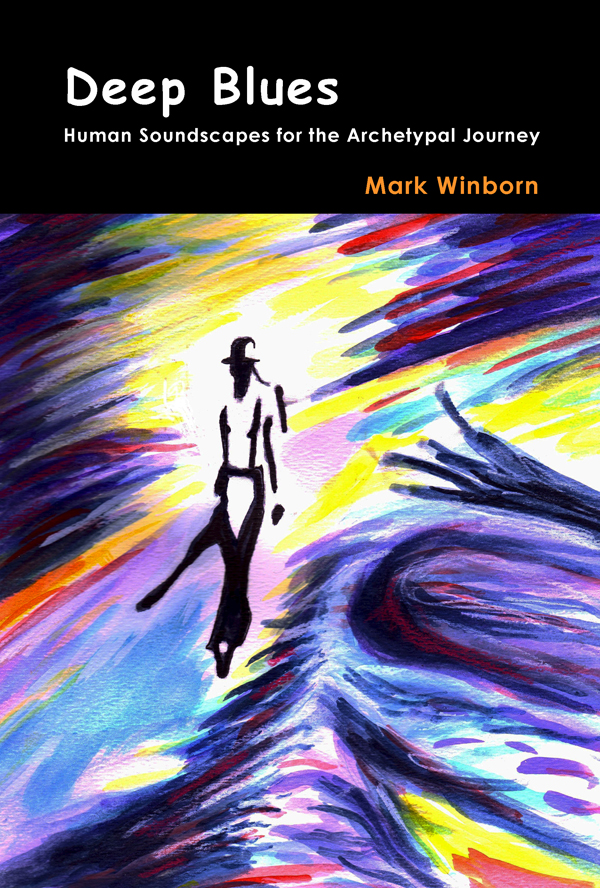
Mark Winborn Discusses Deep Blues on Shrink Rap Radio

Dr. Dave Van Nuys interviews Fisher King Press author Mark Winborn, PhD about his book Deep Blues: Human Soundscapes for the Archetypal Journey on his podcast show Shrink Rap Radio. Dr. Dave interviews a wide range of therapists, psychologists, psychiatrists, and psychoanalysts across a broad range of subjects. The interview can be listened to here: Winborn Interview or on ITunes.

In the interview, Dr. Winborn discusses the experiences that drew him to Jungian analytic work, his interest in the blues, various themes in the book, and a brief overview of the three main schools of Analytical Psychology.

Deep Blues explores the archetypal journey of the human psyche through an examination of the blues as a musical genre. The genesis, history, and thematic patterns of the blues are examined from an archetypal perspective and various analytic theories – especially the interaction between Erich Neumann’s concept of unitary reality and the blues experience. Mythological and shamanistic parallels are used to provide a deeper understanding of the role of the bluesman, the blues performance, and the innate healing potential of the music. Universal aspects of human experience and transcendence are revealed through the creative medium of the blues. The atmosphere of Deep Blues is enhanced by the black and white photographs of Tom Smith which capture striking blues performances in the Maxwell Street section of Chicago. Jungian analysts, therapists and psychoanalytic practitioners with an interest in the interaction between creative expression and human experience should find Deep Blues satisfying.
Fisher King Press publishes an eclectic mix of worthy books including 
Jungian Psychological Perspectives, Cutting-Edge Fiction, Poetry, 
and a growing list of alternative titles. 

Saturday, September 15, 2012

The Devil's Music . . . perhaps its Soul?


A Commentary on Mark Winborn’s Deep Blues: Human Soundscapes for the Archetypal Journey by Deborah Bryon

Originally published in Jung Journal: Culture & Psyche, Summer 2012, Vol. 6, Num. 3, pp. 96-97 (www.ucpressjournals.com/journal.php?j=jung)

I was surprised and delighted to encounter the colorful and poeticstyle in Mark Winborn’s Deep Blues: Human Soundscapes for the Archetypal Journey. Through his writing, he reminds us that blues music- like visual imagery - can be a rich, metaphoric language with the capacity to hold archetypal experience as a living entity. As a Jungian analyst pulling from his own background as a musician, Winborn creates a compelling space for the deep spiritual expression of blues experience as it surfaces on the pages of this book, giving it a voice of its own.

Winborn starts by tracing blues history back to its original roots, paralleling it with Greek tragedy and the perils of Orpheus and Odysseus. By asking the question, “What is the blues?” Winborn explores the music as both an internal psychological state and an attitude–a philosophy and way of being in the world. Similar to working with a dream, he circumambulates around symbolic themes found in blues material – first, in a historical context using amplification, and then by describing the blues as a vehicle for psychological healing and transformation. Winborn successfully moves back and forth from being in the actual experience of relating to the blues into expressing it through verbal language that is both imaginative and easily accessible to the reader.

Next, Winborn travels into universal themes encrypted in the lyrics of blues songs. The shared emotional state between the performer and the audience, arising from the human experience of daily living, becomes poetically transformed through musical metaphor. The blues is a language of the senses and a language of spirit. The human experience of love and heartbreak, the early mother-child bond, addictions, and sexual frustrations, for example, are remembered, and once again come alive.

In addition to considering the blues within the context of a personal frame of reference, blues is a collective energetic experience. Winborn explores the trance-like nature of the blues that is capable of bringing the listener, as well as the performer, into a field of unitary reality. Through the creative process of being touched by sound we become one with the experience. Besides offering a means for human emotional expression, the sounds of the blues penetrate the body in a way that brings visceral experience of sensual embodiment, and with this redemption and new awareness. Opposites are transcended through the immediacy of being in relationship with life that takes place in ontological time.

Winborn examines the cultural myths of the blues as “devil’s music.” The blues originated as a reaction to the oppression of slavery, manifesting in archetypal shadow figures of the “bad man,” the trickster, and other potentially self-destructive archetypal characters associated with possession by the death instinct. Yet the blues can also be regenerative–bringing the capacity for growth and new life. Jung stated that energy contained in our personal shadow is life force. Blues music is also about the ecstasy of initiation and being in the twilight of the crossroads of liminal spaces, between darkness and light–the places where magic happens and shamans cross bridges between ordinary and non-ordinary reality.

Winborn goes on to suggest that healing which takes place in hearing blues music is a shamanic rather than analytic process. Creating a contagion through the music is the elixir. The constantly changing lyrics provide context and meaning as the singer’s personality, feelings, and state of mind shines through with shifts and fluctuations of subjective experience in any given moment. If a feeling response is evoked by the performer, that brings the listener into the enchantment of the projection created by the music, then the song is effective. The blues narrative is one of the ways we can face and synthesize the unprocessed and repressed aspects of the shadow in our own journey, as well as the collective cultural psyche as a whole. The blues musician functions as a channel with access to the energy of the collective experience of pain by humanizing it and making it more tolerable.

Sparked by reading Deep Blues I found myself drifting into my own reverie, wondering if the powerful archetypal charge constellated in blues symbols is a reflection of the separation that is a bi-product of living in modern culture? Do the blues provide us with the needed cathartic experience that we have lost the ability to generate as easily on our own? Winborn reminds us of the personification and humor in first-person stories conveyed by blues singers, making us remember the feeling of being human, and with this, the capacity for relatedness.

I thoroughly enjoyed Deep Blues, and would highly recommend the book. In his writing, Winborn artfully moves the reader into an archetypal Dionysian experience residing in the body, and prompts us to remember that blues music makes us feel alive. He follows blues experience into the alchemical realm of the prima material – instinct in its most raw and vital form--by using the metaphor of color to describe how blues music can resonate in our psyches. In reading Deep Blues, I wished for an expanded discussion of the alchemical healing that a blues melody has on the psyche. Shadow material can emerge not only in the words but in the energy generated from the relationship between the notes of the blues scales bending on guitar strings. This phenomenon might add additional fodder for exploring archetypal expression–but perhaps this will be a topic Winborn will explore in greater length in a future book.

To quote Winborn, citing Chicago blues disc jockey Purvis Spann, “If you don’t like blues, you’ve got a hole in your soul.” Anyone who has listened to a captivating blues melody knows that these sounds come from the heart and the soul, from deep inside. As Winborn has describes, the listener cannot resist the inward pull of the melody, just as it is impossible to refrain from tapping to the beat. when we are captured in the spell of listening to the blues.

Deborah Bryon, PhD, is an analyst with the Inter-Regional Society of Jungian Analysts and practices in the Denver, Colorado area. She is the author of a book on shamanic experiences, Lessons of the Inca Shamans: Piercing the Veil, released by Pine Winds Press in August 2012 (http://lessonsoftheincashamans.com/)

Read more reviews of Deep Blues and listen to an audio interview with Dr. Winborn at www.deepblues.org.

Fisher King Press publishes an eclectic mix of worthy books including Jungian Psychological Perspectives, Cutting-Edge Fiction, Poetry, and a growing list of alternative titles. 

Sunday, January 8, 2012

If You’ve Got “The Blues,” Play 'em

Review of Mark Winborn's Deep Blues
by Laura Sentineri Harness

Mythopoetry Scholar Annual eZine vol. 3. Stephanie Pope, Editor. Fountain Hills: mythopoetry.com, January 2, 2012 (© 2012)

Deep Blues, Mark WinbornDeep Blues: Human Soundscapes for the Archetypal Journey
Publisher: Fisher King Press
September 1, 2011 1st edition
140 pages, Illustrations, Index, Bibliography
ISBN-10: 1926715527
ISBN-13: 978-1926715520

In the midnight hours, long ‘fore the break of day
              When the blues creep on you and carry your mind away
                                -Leroy Carr, Midnight Blues1

What Is It About “The Blues” That So Deeply Stirs The Soul?

In Deep Blues: Human Soundscapes for the Archetypal Journey, Jungian psychoanalyst, Mark Winborn brings the astute lens of depth psychology to this question, exploring “Blues” music as a psychological, archetypal and cultural phenomenon. The strength of this book is its ability to cross between two vastly different worlds juxtaposing the gritty emotions and simple earthy lyrics of the Blues with the expansive intellectual framework of Jungian Psychology.

Winborn’s brilliant analytical skills and personal passion for the subject is evident and this book often reads like a love story to the muse of the Blues. Although the genre of Blues music is his focus, there is a breadth to his writing that distills many valuable insights into human nature. Winborn applies a variety of Jungian analytic theories as well as elaborates upon the interface of creativity and alchemy, the shamanic role of a “Blues” performer and Neumann’s theory of Unitary Reality.2 Deep Blues is a poignant testimony to the power of Blues music to heal and redeem the “midnight hour” sufferings of the soul.

Tracing the origins of the Blues to slavery and the African-American experience of devastating loss, tragedy, trauma and personal pain, Winborn calls the Blues “survival music.” He then gives a brilliant in-depth analysis of the healing, medicinal qualities inherent in Blues music which contribute to emotional resilience, redemption and restoration of wholeness.

Music has long been used to help people deal with their emotions. In the 17th century the scholar, Robert Burton's The Anatomy of Melancholy3 argued that music was critical in treating mental illness especially melancholia. He noted that music has an "excellent power ...to expel many other diseases" and he called it "a sovereign remedy against despair and melancholy."4 Back before Prozac and Zoloft music was prescriptive, often used as a homeopathic remedy as “like cures like.”

Simply Stated, If You’ve Got “The Blues,” Play Them

I merely took the energy it takes to pout and wrote some Blues.
-Duke Ellington5, US jazz bandleader, musician, & songwriter (1899 - 1974)

Listening to, singing, writing and playing the Blues facilitates a release and deepening into the murky emotional aspects of life and helps us to integrate the dark, split off, unconscious aspects of the archetypal shadow in both the personal and collective psyche. As Winborn illustrates, Blues music is an excellent depictation of the alchemical process of psychological transmutation. Through the telling of one’s personal story, the narrative of life’s tragic aspects and the cathartic action of putting strong feelings into song “the prima materia of everyday life becomes the gold of unitary reality.”6 The experience of unitary reality is “a reciprocal coordination between world and psyche”7 and Winborn illustrates how music and the Arts have the power to invoke this expanded consciousness of oneness which transcends polarities, divisions and limitations of time and space. As we listen to the Blues we have the opportunity to emotionally empathize and resonate with archetypal themes of longing, grief, hope, and abandonment, connecting us to what’s universal and meaningful in our common struggles.

Because Blues music often deals with shadow themes it can help us to develop non-polarized attitudes towards human suffering, bringing acceptance and transcendence. In Winborn’s words, “Ultimately, the blues has an innate healing potential: it is a form of therapy which incorporates elements of humor, alchemical imagination, personification and the narrative impulse.”8 As a music therapist I’ve witnessed firsthand how music, specifically the Blues, can provide healing support to people who are vulnerable, disempowered or socially marginalized.

In psychiatric hospitals, nursing homes, pediatric cancer wards, or programs for the developmentally disabled this music has a powerful way of meeting people in the trenches of the deepest, darkest experiences that life brings. Blues music is direct, emotional, and above all, accessible. To write a Blues song we can simply start with the question “What’s bothering you today?” Raw, heartfelt lyrics flow easily into the reassuring form of the 12 bar blues where even the most challenging and overwhelming emotions are contained, accepted, validated and transformed.

In the final chapter “Imaging the Blues,” Winborn encourages us to listen with an active imagination approach, allowing the music to evoke feelings, images, and memories which emerge from the unconscious. At this point it would have been helpful to clarify the role of Music Therapy in the prescribed use of music as a therapeutic catalyst vs. music as therapy, the awareness that music is intrinsically therapeutic. There is great potential for interface with the field of Music Therapy since Blues music is widely used in clinical settings with great therapeutic success. Winborn’s depth psychological perspective lends itself to further inquiry into practical applications in the field of Music Therapy as well as the interface between Depth Psychology and the Creative Arts Therapies.

An Antidote For Rationalism?

Is Blues music an antidote to Western society’s tendency to intellectualize, compartmentalize and defend against emotions? Winborn makes a good argument for this and illustrates how the Blues can deepen and expand our emotional vocabulary via universal acoustic images that speak to the heart. The musical elements of rhythm, timbre, and vocal tone create a physiological response which overrides the mental and ego defenses and gets underneath our skin. The instinctual, visceral, emotional energy of the Blues is the shadow of Western classical music idioms and provides a means for reckoning with both our collective and personal shadow.9

Paradoxically the Blues helps us to both accept and transcend painful emotions since Blues lyrics are often laced with humor, wisdom, signification and elements of the trickster archetype. Winborn provides an excellent analysis of how the Blues-man performer can play a shamanic role as a catalyst for transformation in the listener, encouraging us to accept the reality of human misery and hear the Blues as a “joyful participation in the sorrows of the world.”10

Deep Blues is well crafted with research in the areas of music history, aesthetics, philosophy, and depth psychology. Got the blues? Deep Blues infuses the midnight hour with meaning and provides the reader with a homeopathic remedy for what ails the soul.
notes
1 American “blues” singer, songwriter, pianist, see http://www.elijahwald.com/carrtimes.html
2 Neumann states, “The archetype always refers to a unitary reality embracing world and psyche.” See The Journal of Analytic Psychology, Vol. 4, Issue 2, 1959, p.126.
3 Burton, Robert and Gass, William H., New York: NYBR, 2001.
4 Ibid. p.117.
5 For more on Duke Ellington see http://ellingtonweb.ca/ and Duke Ellington
6 p. 66.
7 Neumann states, “The archetype always refers to a unitary reality embracing world and psyche.” See The Journal of Analytic Psychology, Vol. 4, Issue 2, 1959, p.126.
8 p.7
9 p. 11. Shadow- “Hidden or unconscious aspects of oneself, both good and bad, which the ego has repressed or never recognized.” (Sharp, Jung Lexicon)
10 p.21.

Reviewer Bio

Laura HarnessLaura Sentineri Harness, MA, MT-BC has a Masters degree in Integral Counseling Psychology from the California Institute of Integral Studies and a Bachelor’s degree in Music Therapy from Arizona State University. She has worked as a Board Certified Music Therapist for over 25 years, using music and expressive arts therapies in a variety of clinical settings. She is currently a Jungian oriented therapist in private practice and is the director of Sedona Music Therapy Services, a state funded agency which provides Music Therapy services to the developmentally disabled throughout northern Arizona. Laura plays the guitar, piano, harp and harmonium and writes songs and poems, many of them inspired by her dreams and inner work. She lives in Sedona, Arizona where she and her husband are co-directors of Temenos Healing Arts Center and they lead personalized, mythic retreats in the majestic beauty of Sedona’s red rock cathedrals.

Fisher King Press publishes an eclectic mix of worthy books including 
Jungian Psychological Perspectives, Cutting-Edge Fiction, Poetry, 
and a growing list of alternative titles. 

Monday, September 19, 2011

"Deep Blues - Relational Healing" by Mark Winborn


The blues have been close to my heart since I was about 13 or 14 years old. I didn’t know why I was attracted to the blues but I knew it resonated with something in me as soon as I heard it. The gritty, visceral, deep feel of the blues expressed something for me that I couldn't express for myself.  Some have even referred to the blues as the "education of the heart."

This blues is about hearing and resonating with the pain, suffering, joy, or sadness in the voice of the singer.  The understanding of the blues comes through the direct experience of the music rather than through the intellect.  In this respect, understanding the blues is similar to a perspective about images offered by Carl Jung - "Image and meaning are identical . . . the pattern needs no interpretation: it portrays its own meaning."

It is this universally felt and understood meaning that gives power to the blues for both the performer and the audience.  The music of the blues is the only genre specifically created for the evocation of an emotional response.  In fact, the phrase “the blues” refers to both the music and a feeling.  While all forms of music create a connection on an emotional level – it is only with the blues that this becomes the primary focus.  The word “blues” is derived from the term “blue devils” which referred to contrary spirits that hung around and caused sadness.

The early influences of the blues originate in West Africa, transported to America by African slaves. The first generation of African slaves sang African songs and chants. By the second generation those songs were replaced by work songs with the conditions of their American environment as the focus.  It is impossible to identify when the unique pattern of musical form, now labeled the blues, first emerged. However, most evidence suggests that it originated in the Delta cotton country of northwest Mississippi during the late 1800's from the work songs of former slaves, sharecroppers, and chain gang prisoners.  The music is typically sung from an individual perspective but about issues and emotional experience common to all – for example - lost love, joy, sexuality, rage, sadness, grief, oppression, relief, addiction, migration, or transcendence. 

When a blues musician refers to himself as a "bluesman" he is not only referring to the type of music he plays but also the type of life he has led and the attitude he has about life. It is in this last sense that the blues begins to comment upon or amplify the anima mundi, or world soul. An awareness of the world soul can be detected in many blues songs,  such as Elmore James’ - The Sky is Crying where the tears of the singer and the tears of the world run together: 

The sky is crying, look at the tears roll down the street
I'm waiting in tears for my baby, and I wonder where can she be?
I saw my baby one morning, and she was walking down the street
Make me feel so good until my poor heart would skip a beat
I got a bad feeling, my baby, my baby don't love me no more
Now the sky been crying, the tears rolling down my door  

            The blues philosophy, expressed through the music, includes the idea that the blues is something to be accepted; not something to be gotten rid of or fixed.  The blues is experienced, lived through, and survived; not conquered or overcome. One hopes to eventually feel better but the intent is to acknowledge and cope with the deeply visceral experience of the blues as in Going Down Slow by Mance Lipscomb:  

Don't send no doctor, he can't do me no good.
It's all my fault, mama, I didn't do the things I should.

But I think it is in the power to transcend boundaries of individual and group experience that the blues speaks and acts most powerfully.  A Jungian psychoanalyst, Erich Neumann, uses the phrase “unitary reality” to describe experiences in which the boundaries and distinction between individuals becomes blurred and there is an experience of a shared reality.  At times this blurring occurs between the individual and their environment and such experiences are common in the blues.  Blues musician Little Whitt Wells says, "You know, the blues is a trance music. If it can't take you there, it ain't worth the effort, and if folks can't get there, well I guess it’s not meant for them . . . The blues is where it’s at with me. I am the blues, it’s my life."  This blurring can occur between the musician and the music, between performer and instrument, and between audience and performer.  Mythologist Joseph Campbell draws our attention to similar patterns between the mystic and the artist:

For the reality in which the artist and the mystic are exposed is, in fact, the same. It is of their own inmost truth brought to consciousness: by the mystic, direct confrontation, and by the artist, through reflection in the masterworks of his art. The fact that the nature of the artist (as a microcosm) and the nature of the universe (as the macrocosm) are two aspects of the same reality. 

In our increasingly isolated and technologically engrossed culture there are fewer and fewer opportunities to move into these shared experiences of unitary reality in which the bubble of our individualism is pierced and we are able to move into felt, relational connection to our environment and those around us.  The blues allows us to move into a deeper communion with our own emotional life, especially the more difficult emotions that are often shunned in our relentless pursuit of happiness, material acquisition, and activities designed to occupy time rather than expand soul.  Often it is only by moving into and through sadness that we can be released into an experience of joy.  The blues facilitates this process.  In this regard the bluesman, by communicating feelings in song that resonate within the listener, serves as a modern day shaman who heals through the ritual of music.  The blues originated in experiences of trauma, oppression, and enslavement but now serves to liberate our emotional lives and facilitate a deeper union with our environment and those around us.  Robert Johnson, Muddy Waters, and Howlin Wolf  all have something significant to contribute to the care of our soul.

*This article includes some excerpts from the book Deep Blues: HumanSoundscapes for the Archetypal Journey.
           Click to Listen to Son House - Death Letter Blues
Fisher King Press publishes an eclectic mix of worthy books including Jungian Psychological Perspectives, Cutting-Edge Fiction, and a growing list of alternative titles.

  • International Shipping.
  • Credit Cards Accepted.
  • Phone Orders Welcomed: +1-831-238-7799 skype: fisher_king_press

Monday, August 8, 2011

News Release: Deep Blues and Unitary Reality

Fisher King Press is pleased to present

Deep Blues: 
Human Soundscapes for the Archetypal Journey

by Mark Winborn
Deep Blues explores the archetypal journey of the human psyche through an examination of the blues as a musical genre. The genesis, history, and thematic patterns of the blues are examined from an archetypal perspective and various analytic theories – especially the interaction between Erich Neumann’s concept of unitary reality and the blues experience. Mythological and shamanistic parallels are used to provide a deeper understanding of the role of the bluesman, the blues performance, and the innate healing potential of the music. Universal aspects of human experience and transcendence are revealed through the creative medium of the blues. The atmosphere of Deep Blues is enhanced by the black and white photographs of Tom Smith which capture striking blues performances in the Maxwell Street section of Chicago. Jungian analysts, therapists and psychoanalytic practitioners with an interest in the interaction between creative expression and human experience should find Deep Blues a worthy contribution. Deep Blues also appeals to ethnomusicologists and enthusiasts of all forms of music.
In his ever-fascinating book, Dr. Mark Winborn goes where few authors on the blues have ever gone: into the profoundly psychological implications of the genre. A Jungian by training, Winborn argues convincingly how the blues communicates for reasons that extend to the symbolic language of the unconscious. His results are sure to inspire future research in not just the blues but in other areas of traditional culture and the creative act.
—Dr. William L. Ellis, Saint Michael’s College, Colchester, Vermont Ethnomusicologist - Musician - Music Critic
Just like a fine bluesman, Winborn ‘riffs’ on the various psychological aspects of his topic: the genesis of the sound, the unitary reality created in playing and listening to the blues, its archetypal manifestations and healing potential, and the influence of the personality of performer and performance. As he states, ‘the blues belongs among the great arts because of its extraordinary capacity to embrace, embody, and transcend the opposites, especially as they become manifest in the experience of tragedy and suffering.’ Using original lyrics throughout, Winborn invites us to reimagine the power of the blues in its ability to deepen our own soulfulness.
—August J. Cwik, Psy.D., Jungian Analyst & Musician
Mark Winborn, PhD, NCPsyA is a Jungian Psychoanalyst and Clinical Psychologist. He is a training and supervising analyst of the Inter-Regional Society of Jungian Analysts. Dr. Winborn maintains a private practice in Memphis, Tennessee where he is also currently the Training Coordinator for the Memphis Jungian Seminar.

Fisher King Press publishes an eclectic mix of worthy books including Jungian Psychological Perspectives, Cutting-Edge Fiction, and a growing list of alternative titles.
    International Shipping.
    Credit Cards Accepted.
    Phone Orders Welcomed: +1-831-238-7799 skype: fisher_king_press

    Saturday, March 26, 2011

    Jigging in the Deep Blues: News Release

    Another Fisher King Press title is on the way:

    Deep Blues: Human Soundscapes for the Archetypal Journey

    by Mark Winborn

    Deep Blues explores the archetypal journey of the human psyche through an examination of the blues as a musical genre. The genesis, history, and thematic patterns of the blues are examined from an archetypal perspective and various analytic theories. Mythological and shamanistic parallels are used to provide a deeper understanding of the role of the bluesman, the blues performance, and the innate healing potential of the blues.  Universal aspects of human experience and transcendence are revealed through the creative medium of the blues. The atmosphere of Deep Blues is enhanced by the black and white photographs of Tom Smith which capture striking blues performances in the Maxwell Street section of Chicago.  Jungian analysts, therapists and psychoanalytic practitioners with an interest in the interaction between creative expression and human experience should find Deep Blues satisfying. Deep Blues should also appeal to enthusiasts of music, ethnomusicology, and the blues.

    about the author
    Mark Winborn, PhD, NCPsyA is a Jungian Psychoanalyst and Clinical Psychologist. He is a training and supervising analyst of the Inter-Regional Society of Jungian Analysts and is also affiliated with the National Association for the Advancement of Psychoanalysis and the International Association for Analytical Psychology. Dr. Winborn maintains a private practice in Memphis, Tennessee where he is also currently the Training Coordinator for the Memphis Jungian Seminar, a training seminar of the IRSJA.
    Fisher King Press publishes an eclectic mix of worthy books including Jungian Psychological Perspectives, Cutting Edge Fiction, and a growing list of alternative titles.
      • We Ship Worldwide.
      • Credit Cards Accepted.
      • Phone Orders Welcomed: +1-831-238-7799 skype: fisher_king_press

      Tuesday, February 15, 2011

      On Void States

      article by Paul W. Ashton

      I have used the term "void states" to describe a very varied set of mental conditions that have a subjective commonality. By this I mean that individuals with very different psychopathology (and even individuals who are simply going through one of life's precarious stages) may describe themselves as "being in a void." Having a way of thinking about and differentiating these states, one from another, is of significance because these states are so different from each other and their management is varied. The condition of "being in a void" may be the result of some trauma or life-event or it may be part of the structure of an individual. That is, it might be a sort of developmental stage in, say, the creative cycle of synthesis, thesis and antithesis, or due to an actual arrest in development, one that leads to a condition of stuck blackness and sense of meaninglessness. Or it may even be an indication of profound spiritual development.

      While some void states are "pure hell" and like hell they are full of pain but lead nowhere, others may be filled with meaningful "psychic suffering" that enables the sufferer to move through the purgatorial fires and thus attain paradise. As the mystics from any of the various religious groups have attested, the experience of God is one of non-differentiation, an immersion in Oneness, in the "Cloud of Unknowing" as the English Mystic called it. I have come to think of the hell-type void as the black void, because that is the colour that sufferers use to depict it, and I contrast that with the white-void which seems to be the state in which boundaries are lost as spiritual "perfection" is approached. Clearly the management of these two conditions will be very different although they may both be described in similar terms, e.g. "I do not know who I am", "I do not know who God is", "I feel lost or abandoned" etc.

      In my monograph From the Brink: Experiences of the Void from a Depth Psychology Perspective, I have attempted to delineate different examples of void states in an initial section entitled The Territory. The chapters in this section comprise "On the territory of the void," "A walk on the wild side: connecting the void with people," "Primary or secondary?" and "Psychotherapy and spirituality." A section on The Origins of the Void Experience comprises five chapters: "Empty of oneself," "The void in psychogenic autism," "Another 'black hole,'" "Memory within the borderline condition" and "Trauma as a void experience." In this section, as can be guessed from the chapter titles, the focus is on the origin of various "pathological" void states. They have as their origins

      The third section is Amplifications, and this section gives examples, from mythology, literature and religion, that amplify the concept of the void. Chapters here are "Myths and legends of the Creation," "Dimitri's void," "The King's sacrifice" (from a play by a South African playwright), "The 'Birthday Present'" and "The dark night of the soul." This more poetic understanding of the void gives way to a section on Treatment that contains chapters on "Aspects of treatment of void states," "Connections, walls and windows" (about musical explications as well as ideas of containment and linking), and "On active imagination." This latter is because I consider Active Imagination to be an important adjunct to treatment. There is a final section on Individual Experiences that has two chapters describing how gender effects an individual's experience of the void.

      The overall purpose of the book was to increase therapists' awareness of the void, to help them categorise individual's experience of it, and finally to offer some constructive ideas about managing "void dwellers."

      While From the Brink was in the process of being written I embarked on another project that was aimed at showing that the void was not just an arbitrary concept that I had invented. To this end I invited a variety of individuals to write essays about the void from the point of view of their particular professions or passions. The result was Evocations of Absence: Multidisciplinary Perspectives on Void States. This book was published by Spring Journal Books in 2007.

      What makes Evocations of Absence so special is that its authors, who were only guided in the sense of being asked to write from their present interest, all had their own take on the void. The authors were: a poet and professor of Creative Writing, four Jungian analysts (one of whom was a theologian too), a political philosopher, a music therapist, an Authentic Movement practitioner and an artist. Some of the chapters described very personal encounters with the void whereas other authors wrote describing aspects of the void (and the different types of void) from the point of view of music, art, poetry, movement or religion. One of the analysts wrote a profound essay on the neurobiology of void states. Interestingly there was a common sense that through allowing a conscious encounter with the void, instead of avoiding it, some transformation could happen. So, despite its title, this turned out to be a profoundly optimistic book.

      These two books can be seen as companion books. One explores in depth and the other expands in breadth, this difficult and painful but ultimately rewarding encounter with an intrapsychic experience that has received scant attention in the psychoanalytic literature.

      Paul Ashton is a psychiatrist and Jungian analyst in private practice in Cape Town. In addition to his many books, he has published various reviews and articles and lectures about music, art, literature, and the Void. He is a member of the South African Association of Jungian Analysts and is the editor of Mantis, the journal of the Southern African Association of Jungian Analysts.


      Fisher King Press publishes an eclectic mix of worthy books including Jungian Psychological Perspectives, Cutting Edge Fiction, and a growing list of alternative titles.
        • We Ship Worldwide.
        • Credit Cards Accepted.
        • Phone Orders Welcomed: +1-831-238-7799 skype: fisher_king_press

        Wednesday, December 8, 2010

        Music and Soul

        About Music and Psyche

        Paul Ashton and Stephen Bloch are Jungian Psychoanalysts living and working in Cape Town. They both have an abiding interest in music of different sorts and Music and Psyche came together from that interest as well as a fascination and curiosity about how music functions both as an agent of healing and as a medium that touches areas of the psyche that words cannot. Realising that they could not themselves cover such a vast subject in the depth that they wanted to, they invited authors with differing interests and backgrounds to participate in the project by submitting essays on any aspect of music that gripped them at the time of writing.

        The result is a lovely book which has been written by 13 different authors. Two of them are music therapists, one a composer, one a singer and theologian, another a psychoanalyst and the remainder from a Jungian background. All share a love of music. To enhance the experience of what the writers are expressing a CD accompanies the book. About half the chapters in the book are "illustrated" on this CD.

        There are two interviews, both with individuals who may be referred to as "grandfathers" in the tradition of depth-psychology, as well as having been steeped in music. Mario Jacoby was a professional classical violinist before he became a Jungian analyst and author of many books and papers. Michael Eigen is a psychoanalytic psychotherapist with a passion for music. He is also a prolific writer with about 18 books to his credit. These interview subjects use music primarily as a metaphor for the analytic process and encourage psychotherapists to listen within theirsessions with a musical ear.

        Although Kevin O'Connell's essay on Stravinsky's Rite of Spring is written from a musician's point of view, it is deeply psychological too, raising ideas that connect as much with "soul" as with compositional techniques. When William Willeford writes about "the blues" he is writing as much about the human condition as he is about the music of that name. His essay is one that has been put with two others that demonstrate the healing power of music in a more communal setting. One of these is Melinda Haas's chapter that describes the Venezuelan-developed idea called El Sistema. This is based on a concept that true democratic principles as well as feelings of self-worth can be developed through orchestral playing and that every child should have that opportunity. Chris Wildman writes about his experience as musician in a "playback" theatre type group that assists individuals and groups deal with difficulties that have affected them as a community. His examples bring us insight into the lives of the people he describes as well as into music itself.

        Recently a journal appeared with a paper describing the usefulness of music in a neuroscience institution in the US. There was no mention of what type of music was being played and when one of the authors was contacted her response was: "Well we just play music." What an undifferentiated reply! There are so many different types of music and so many individuals in the world who reacte differently to the same music. In Stephen Bloch's chapter on the Black Sun he describes music as an "acoustic image" and demonstrates how different compositions evoke different psychological experiences of what has been described in largely visual terms as "The Black Sun". That chapter and his chapter on Mercy deepen one's psychological understanding as well as supplying examples of music from many different sources that are outside our usual ambit.

        In another idiom Paul Ashton writes about the varied effects of sounds generated by different instruments and brings together diverse theories about the different parts of the brain that are implicated in processing the various aspects of which music is composed. These encompass rhythm, tone, tune or melody, and harmony, etc. Music can have an effect on the body and the mind, generating pain relief or aggravating pain, causing excitement or restfulness and giving rise to distinct emotions. How that happens is the subject of his chapter.

        Larry Wetzler has written two chapters that link clinical and theoretical concepts (of Winnicott, Bion and Lacan) with the idea of music as a healing "substance." Something similar is discussed, but in a very different way, by Helen Anderson who explores the nature of Beethoven's Piano Sonata No 31. Both authors' give clinical examples from their practices. It is apparent that one of them chose the music for the patient whereas the other worked with the music brought. In both cases the music, and the process, was healing.

        Two New Yorkers describe musical compositions as products, or at least descriptors, not only of the composer's individual time and place, but of his psychological make-up too. Melinda Haas writes movingly about Mahler and his Ninth Symphony and Laurel Morris about Robert Schumann's life and music. Both writers broaden one's understanding of both music and the psyche.

        Bringing us into the 20th Century by exploring particularly its less formal music, John Beebe develops the idea of the anima as expressed though the voices of popular singers. This soulful chapter deepens our thinking about voices, performers, men, women and human psychology. William Willeford in his chapter about "the blues" expands our understanding of that very human condition and demonstrates how effective "singing the blues" or listening to "the blues" can be in alleviating it. Patricia Skar describes her development as musician and analyst and articulates the idea of music being a bridge to the deepest recesses of one's mind or to the widest reaches of the infinite, whichever way one would like to see that.

        Music and Psyche ends appropriately with a chapter by the Irish singer and theologian Noirin Ni Riain. Through her writing, and her voice on the accompanying CD, the reader/listener is transported, through silence and music, into a new experience of the ineffable beyond.

        Fisher King Press publishes an eclectic mix of worthy books including Jungian Psychological Perspectives, Cutting Edge Fiction, and a growing  list of alternative titles.
        • We Ship Worldwide.
        • Credit Cards Accepted.
        • Phone Orders Welcomed. +1-831-238-7799. skype: fisher_king_press