Showing posts with label celebrating soul. Show all posts

Friday, December 16, 2011

Annunciation and Mythos

by Mariann Burke
In the sixth month the angel Gabriel was sent by God to a town of Galilee called Nazareth, to a virgin betrothed to a man named Joseph, of the House of David; and the virgin’s name was Mary. He went in and said to her, “Rejoice, so highly favored! The Lord is with you.” She was deeply disturbed by these words and asked herself what this greeting could mean, but the angel said to her, “Mary, do not be afraid; you have won God’s favor. Listen! You are to conceive and bear a son, and you must name him Jesus. He will be great and will be called Son of the Most High.” (Luke:1:26-38)
I had read this passage many times but it was soon to take on richer meaning.

Since we know nothing of Jesus’ conception and birth, legend and myth “fill in.” The word ‘myth’ comes from the ancient Greek word ‘mythos’ meaning ‘word.’ Both ‘logos’ and ‘mythos’ mean ‘word.’ While ‘logos’ refers to rational thinking, ‘mythos’ describes poetic or intuitive thinking. “Biblical accounts of Jesus’ birth and resurrection are ‘mythos.’ Biblical historical facts of his life are ‘logos.’ Both are true.”(1) Myths or mythos express truth closer to life’s meaning than facts. Myths resonate in the soul. For example, stories about the quest for the Grail resonate with all “searchers.” We long to experience the Holy, the numinous. The Annunciation, the birth in the stable, the shepherds’ adoration, and the journey to Egypt, all of these give valuable insights into our personal spiritual journey. And the artists who have painted these scenes have provided us with “windows” into depths unknown perhaps even to them.

Some of these “windows” would eventually open for me into other images of Mary, as Virgin Mother, Black Madonna, and Wisdom Sophia. But, at that moment down in my basement study, I was captivated only by the Annunciation. I longed to see other artists’ versions of the scene. In Milan, Arezzo or Florence, I sat in churches just looking at sculptures and frescoes. In museums, I marveled at the number of artists who had painted the scene with such depth, delicacy and power. Now these images of Mary, masterpieces from another age, stirred something vital within me. Writing these pages helped awaken me to their personal and symbolic meaning.

Over many years of paying attention to images from my unconscious in dreams and in artistic works, I was beginning to “see” a connection between the image and myself. I had known that through the history of Christianity there have been two ways of interpreting images or symbols: the historical and the poetic or imaginative. I had been exposed to the historical or literal. Now I began to realize that the two are not mutually exclusive. Early Christians honored both approaches but the historical and literal gradually took precedence. In this view the Annunciation is something that happened in the past. In the poetic or mythic approach, we are not so much viewing an image as experiencing it. My personal experience and my study of Jung would open me to see the Annunciation not as history, but as something happening now.(2) Taken in this way, the image reflects something within me. Like a dream, the image is happening within.

Certainly this is not new, for mystics of every religious tradition are “seers.” And the early Christian Gnostics valued the inner knowledge of God, but they were regarded as heretics. The thirteenth century Dominican Meister Eckhart suffered a similar fate for expressing his beliefs that God and the soul are somehow united. One of Eckhart’s favorite sayings found in his sermons is that the Divine Birth is always happening. If it does not happen within our soul, of what value is it? This insight we find echoed in the writings of Angelus Silesius, a seventeenth century mystic, speaking of the Annunciation:
If by God’s Holy Ghost thou art beguiled,
There will be born in thee the Eternal Child.
If it’s like Mary, virginal and pure
Then God will impregnate your soul for sure.
God make me pregnant, and his Spirit shadow me,
That God may rise up in my soul and shatter me.
What good does Gabriel’s ‘Ave, Mary’ do
Unless he give me that same greeting too?(3)

1. Seminar notes by Dr. Richard Naegle, Guild for Psychological Studies, San Francisco, 1995. In St. John’s Gospel “Logos” refers to the eternal existence of the Word. See also Karen Armstrong, A Short History of Myth, p. 31.
2. Joseph Campbell, The Mythic Image, p. 58.
3. C.G. Jung, Mysterium Coniunctionis, CW, Vol. 14, p. 319.


You're just read an excerpt from Mariann Burke's:

Wednesday, November 2, 2011

Drawing a Line in the Sand

Drawing a Line in the Sand and 
Cultivating the Unlived Promise 
of Your Creativity . . .


Listen to Bonnie Bright Interview Naomi Ruth Lowinsky

Bonnie Bright is the founder of Depth Psychology Alliance, a central gathering place, a global village for academic discussion, research, and development of Depth Psychology ideas and views as well as a place to connect with like-minded colleagues, old and new. As the first online community of its kind, it is quickly building a powerful collection of content and methods, enabling Depth Psychology to emerge more fully into the everyday world.

Naomi Ruth Lowinsky is a Jungian analyst and the author of several books, including The Sister From Below: When the Muse Gets Her Way, and her latest poetry collection Adagio & Lamentation. Visit Naomi's blog at www.sisterfrombelow.com and read about the many forms of the muse.
Fisher King Press publishes an eclectic mix of worthy books including Jungian Psychological Perspectives, Cutting-Edge Fiction, and a growing list of alternative titles.
    • International Shipping.
    • Credit Cards Accepted.
    • Phone Orders Welcomed: +1-831-238-7799 skype: fisher_king_press

    Tuesday, October 25, 2011

    Trickster, Narcissism, and the Search for Soul

    by Deldon Anne McNeely

    From the new revised edition of Mercury Rising: Women, Evil, and the Trickster Gods

    Since what “seems to be” has higher priority than what “is” in narcissism, Trickster is always evoked by the narcissistic complex. Pelton says the Trickster “pokes at, plays with, delights in, and shatters what seems to be until it becomes what is.”(1) Trickster tells it like it is, for communication is uppermost, how-it-is is uppermost, how it seems to be or should be is meant to be shattered. This puts the Trickster at the center of the narcissistic dynamics, paradoxically as the antagonist of the narcissistic defenses, yet simultaneously as the only one who can truly understand and accept them. For there is a paradoxical aspect of the narcissist’s preoccupation with the mirror, and it is this: if we can ever find the Self in the image, we can be free! If we can find the Self, separate and emerge from it, know its Otherness, we can relate to it rather than identify with it. We can have the mirror inside, have it speak to us, hold us, wait for us, instead of having to be so omnipotently self-protective. We would let go, and know.

    In the Trickster something wants to show us “how it is,” not only by pointing to our shadiest qualities, but holding them up to the sun’s gaze for the greatest possible multitudes to see. Trickster doesn’t hold up only our conventionally positive traits; she brings the shadowy, unattractive, and shameful elements into the sunlight of collective consciousness too. And that is what appears to be happening in a tricksterish way as our society becomes more enamored of seeing itself. In our current preoccupation with exposure we have taken the old first lines of the primer which for many of us was the introduction to collective life, “See Dick, See Jane,” and exaggerated it to enormous proportions. Jane and Dick’s every tear, dream, and orgasm is enlarged for the super-screen in the sky. Yet we are finite, and limited to seeing only a few things at a time. What is missing from this picture? What nuances are overlooked, what shades lurking out of range of the camera’s eye, what small secrets of the soul slipping through the cracks? What data are we, in our narcissistic society, refusing to take in? And what is it we are looking for as we scrutinize our own reflection?

    Schwartz-Salant, by noting the similarity between Trickster and narcissism, suggests that what is being looked for and overlooked is the relationship to the feminine and its capacity for reflection:
    Narcissism is a trickster, leading one to all kinds of inflation and self-importance with nothing in the end to show for it.... Generally, narcissistic character structures are involved with individuation much as Mercurius is.... They represent both the urge toward individuation and the drive toward the regressive fusion of ego and Self. Narcissistic character structures can lead to a birth of the feminine or to the repression of this realm of being and body with its own spirit and consciousness. As well, they can lead to a capacity for reflection, or to its continual suppression under the dominance of a grandiose-exhibitionistic power drive.(2) (Italics-DM.)
    Mythical Narcissus gives us an image of one whose longing for connection to his own soul is so great that it overrides all other concerns. Similarly, the narcissistic character is preoccupied with seeking the truth of herself, and to care for anything or anyone else at this stage of her development would only divert her from her primary task: that of finding the soul she hid protectively so long ago that she does not remember that it is hidden, although she feels compelled to retrieve it from the mirror. Here we meet ourselves today, bereft and thoroughly preoccupied with retrieving what we know not. Taking our cues from the narcissistic personality, we can surmise that modern society’s urge toward self-absorption means that we are seeking the truth of ourselves. We must find the Self in the mirror in order to separate from it and to relate to it instead of improperly identifying with its power. Our relationship to the feminine inner world is out of balance. As a narcissistic society, we can assume that we are probably skewed toward too much masculinity; we identify with power and extroversion, as we project into our god-images. We search the mirror for our missing soul parts, which will bring us closer to completion and help us to experience affection without fusion.

    In the West African Ashanti theology, there is a balance of male and female powers, as we have seen is also true in the Fon. Ashanti goddess Asase Yaa is equal in power to the male god Nyame. She is neither his wife nor his creation, but the likelihood is that “each has a hidden aspect somehow reflecting the chief characteristics of the other.”(3) The social order of the earthly society reflects this double divinity: the King has a Queen Mother who shares his rule, and each chief and subchief shares power with a Queen Mother. “The Queen Mother is to the King as Asase Yaa is to Nyame: the resource out of which the source of life draws life and renews life.”(4)

    It is practically impossible for us, so long steeped in Western tradition, to imagine a psychological foundation that is informed by an early teaching of the masculine and feminine nature of God and that can assign true value to the psyche and to introversion. More often our way is to tolerate the inner life only if it proves pragmatic or attention-getting in some way. Our extroverted values bias us toward seeing other cultures as less successful if their technology and levels of material comfort are less advanced than our own. Like a narcissistic personality who disdains the experience of others, a narcissistic society tends to overlook the wisdom and information conveyed by the philosophies, arts, and music of other cultures, which are often much more sophisticated and differentiated than its own. In our society we tend to overlook the closeness that some other cultures have with animals and children, and with nature herself, connections which are often far more advanced than our own, stressing as they do cooperation with nature rather than conquering.

    Cut-off as we have been from our feminine soul as a culture, we express our condition through our narcissistic adaptation, vacillating between fears of fusion and abandonment. Although there may seem to be a developing reverence for “The Goddess,” there are still women and men mutilating their bodies and souls to fit into a masculine image of how we should be. Relatively few of us are at peace with who and how we are. In psychology our bias shows in the experience of the ego in terms of what I think of as “yang functions,” functions of doing, actively participating in, even “overcoming” both outer and inner worlds. Yet we know from experience and from numerous examples in universal stories that it is sometimes adaptive to do nothing but contemplate or wait, to live what is.

    Because of our bias toward extroversion, and in spite of Jung’s explorations of the need for balance, introverted behavior is still often pathologized and regarded as weak ego-functioning, when it may be exactly what is needed in order to mediate the unconscious. This bias towards extraversion was abetted by Freud’s view of the unconscious as Id, which was seen as something to be mastered by Ego. It is less so under Jung’s influence, which bids us to respect the information from the unconscious as a valuable source of survival data, data which can balance our over-weighted conscious vantage point. I like to think of the ego-functions as representing the yin-yang principles, able to be active or passive, assertive or reflective, as called for by the circumstances.

    With an androgynous view of the ego functions, with regard to the resolution of the narcissistic adaptation, the acceptance of the yin-ego opens one to retrieving the lost element of soul that is being sought in the mirror. We have images for this which indicate the importance of Trickster in the process: for example, Hermes bringing the abducted feminine, Persephone, back to the upperworld; Hermes rescuing the Divine Child, Dionysus, when he was born of Zeus and had to be taken from Hera’s sight to be cared for by nymphs; Biblical nomadic wise-men throwing the plotting king off track to allow the escape of the Divine Child, Jesus. These images of the recovery of the lost soul (represented by the feminine, or by the archetype of renewal and creativity, the Divine Child), with the help of the shrewd and caring Trickster, all imply that there is a central organizing principle by which the fragments are related in their process of continual flux. The notion of a center need not imply stasis, but rather a purposive order as opposed to unrelated random events.

    1.  Carol Gilligan, In a Different Voice (Cambridge: Harvard University Press, 1982), 62.
    2.  This is not to say that every man thinks in a predominantly masculine style, nor every woman in a predominantly feminine style, any more than we can say that every man values independence more than attachment. It does imply that there are gender differences in principle, reflected in generalized differences between males and females. 
    3.  Rosemarie Tong, Feminine and Feminist Ethics (Belmont, CA: Wadsworth Publishing Co., 1993). 
    4.  Charles Derber, The Pursuit of Attention: Power and Individualism in Everyday Life (Oxford: Oxford University Press, 1979).

    Order  Mercury Rising: Women, Evil, and the Trickster Gods 

    Saturday, March 26, 2011

    Jigging in the Deep Blues: News Release

    Another Fisher King Press title is on the way:

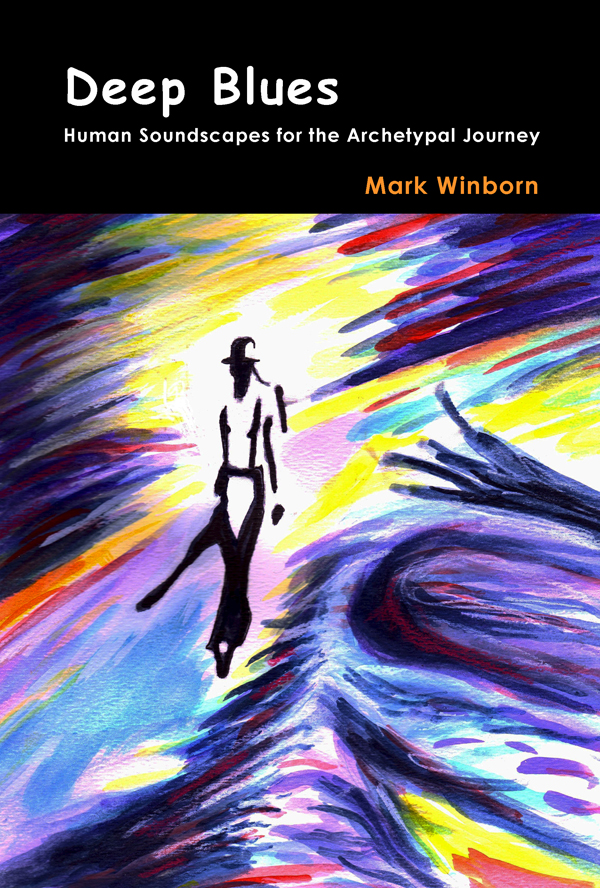
    Deep Blues: Human Soundscapes for the Archetypal Journey

    by Mark Winborn

    Deep Blues explores the archetypal journey of the human psyche through an examination of the blues as a musical genre. The genesis, history, and thematic patterns of the blues are examined from an archetypal perspective and various analytic theories. Mythological and shamanistic parallels are used to provide a deeper understanding of the role of the bluesman, the blues performance, and the innate healing potential of the blues.  Universal aspects of human experience and transcendence are revealed through the creative medium of the blues. The atmosphere of Deep Blues is enhanced by the black and white photographs of Tom Smith which capture striking blues performances in the Maxwell Street section of Chicago.  Jungian analysts, therapists and psychoanalytic practitioners with an interest in the interaction between creative expression and human experience should find Deep Blues satisfying. Deep Blues should also appeal to enthusiasts of music, ethnomusicology, and the blues.

    about the author
    Mark Winborn, PhD, NCPsyA is a Jungian Psychoanalyst and Clinical Psychologist. He is a training and supervising analyst of the Inter-Regional Society of Jungian Analysts and is also affiliated with the National Association for the Advancement of Psychoanalysis and the International Association for Analytical Psychology. Dr. Winborn maintains a private practice in Memphis, Tennessee where he is also currently the Training Coordinator for the Memphis Jungian Seminar, a training seminar of the IRSJA.
    Fisher King Press publishes an eclectic mix of worthy books including Jungian Psychological Perspectives, Cutting Edge Fiction, and a growing list of alternative titles.
      • We Ship Worldwide.
      • Credit Cards Accepted.
      • Phone Orders Welcomed: +1-831-238-7799 skype: fisher_king_press

      Saturday, August 15, 2009

      Honoring the Assumption of Mary

      An Introduction to Re-Imagining Mary by Mariann Burke

      Re-Imagining Mary
      is about meeting Mary in image and imagination. It is about the Mary image mirroring both an outer reality and the inner feminine soul. My first meeting with Mary began with an experience of Fra Angelico’s Annunciation (Cortona). I cannot account for my unusual response to the image except to say that, at the time, over twenty years ago, I was studying Jungian psychology in Zürich, Switzerland and was then probably more disposed to respond to the imaginal world. One day as I sat in my basement apartment reflecting on a picture of his Annunciation, energy seemed to surge through me and lift me above myself. Tears brought me to deep center.
      Annunciation, painted by Fra Angelico (1387-1455) 
      (Florence) Museo San Marco, courtesy Wikimedia Commons
      It does not matter whether my experience was religious or psychic. The two are very similar since any religious experience always affects our psyche and changes it. It was as if I was restored to my truest self. This was an awakening for me, not an ecstasy. Far from leaving my body-self, I seemed to recover it. At the time I had no desire to study Art History or Iconography. Instead, wishing to stay in the world of the symbolic, I returned to the Biblical inspiration for the image in St. Luke.

      This is what St. Luke tells us about Jesus’ conception:
      In the sixth month the angel Gabriel was sent by God to a town of Galilee called Nazareth, to a virgin betrothed to a man named Joseph, of the House of David; and the virgin’s name was Mary. He went in and said to her, “Rejoice, so highly favored! The Lord is with you.” She was deeply disturbed by these words and asked herself what this greeting could mean, but the angel said to her, “Mary, do not be afraid; you have won God’s favor. Listen! You are to conceive and bear a son, and you must name him Jesus. He will be great and will be called Son of the Most High.” (Luke:1:26-38)
      I had read this passage many times but it was soon to take on richer meaning.

      Since we know nothing of Jesus’ conception and birth, legend and myth “fill in.” The word ‘myth’ comes from the ancient Greek word ‘mythos’ meaning ‘word.’ Both ‘logos’ and ‘mythos’ mean ‘word.’ While ‘logos’ refers to rational thinking, ‘mythos’ describes poetic or intuitive thinking. “Biblical accounts of Jesus’ birth and resurrection are ‘mythos.’ Biblical historical facts of his life are ‘logos.’ Both are true.”(2) Myths or mythos express truth closer to life’s meaning than facts. Myths resonate in the soul. For example, stories about the quest for the Grail resonate with all “searchers.” We long to experience the Holy, the numinous. The Annunciation, the birth in the stable, the shepherds’ adoration, and the journey to Egypt, all of these give valuable insights into our personal spiritual journey. And the artists who have painted these scenes have provided us with “windows” into depths unknown perhaps even to them . . .
      _ _ _ _ _ _ _ _ _ _ _ _ _ _ _ _ _ _ _ _

      Mariann Burke is a Jungian analyst in private practice in Newton, MA. She holds graduate degrees from the University of Pittsburgh, Andover-Newton Theological School, and the C. G. Jung Institute in Zurich, Switzerland. She has done graduate work in Scripture at Union Theological Seminary and La Salle University. Her interests include the body-psyche connection, feminine spirituality, and the psychic roots of Christian symbolism. She is a member of the Religious of the Sacred Heart (RSCJ)


      Order a copy of Re-Imagining Mary 
      1.The work of art depicted in this image and the reproduction thereof are in the public domain worldwide. The reproduction is part of a collection of reproductions compiled by The Yorck Project. The compilation copyright is held by Zenodot Verlagsgesellschaft mbH and licensed under the GNU Free Documentation License. http://commons.wikimedia.org/wiki/File:Fra_Angelico_069.jpg
      2. Seminar notes by Dr. Richard Naegle, Guild for Psychological Studies, San Francisco, 1995. In St. John’s Gospel “Logos” refers to the eternal existence of the Word. See also Karen Armstrong, A Short History of Myth, p. 31.

      Friday, July 31, 2009

      The Father Spirit: At the Turning Point

      an article by Bud Harris, Ph.D.

      A Guide for Rediscovering and Renewing
      the Foundations of Fatherhood


      The Father Spirit at the Turning Point

      As I was reflecting on Fathers' Day this year and developing the material I'm going to use in a Fall lecture and workshop, "The Father Quest: A Guide for Rediscovering and Renewing the Foundations of Fatherhood," I was moved to write the following article. I titled it "The Father Spirit at the Turning Point." Good friends who publish Western North Carolina Woman magazine included it in their June issue; every year their June issue is "Honoring the Y Chromosome." Because of the enthusiastic response to the article, I've decided to share it with you. I hope that you will find it inspiring and enriching.

      A few mornings after Christmas my wife and I were sitting at the breakfast table with my daughter. While I slowly sipped my tea, she was explaining how the slump in the economy had impacted their holidays. As a family of five with three children, finding their income reduced substantially had ushered in a holiday stress that was new to them. When she finished talking she sighed and added, "I've given up any hope that we can leave our children any better off than we were."

      I was shocked by the discouragement in her voice. Leaving our children better off than we were when we started adult life has been a major part of the American Dream for as long as I can remember. I don't know how old that part of our dream is but I'm sure my father, who lived through the Great Depression, devoted much of his life to it. For his age-group, being sure your children went to college was considered a guarantee for the chance at a better life. My father's generation came out of the depression, World War II and the atomic age with a colossal yearning to create a healthy, sound world. They wanted their children to have lives that were smooth and prosperous. As we lived into the nineteen fifties our society and our families tried to make problems taboo. We wanted to have certainties. Or, rather, our parents wanted to have them for us even as the world was spiraling into the chaos of the nineteen sixties. I don't blame them for their longings because I know they were born out of the fear and traumas they endured and their desire to create a safer world for themselves and their children. Yet, this longing eventually became the root of their problems as it narrowed their perspective on life and now it has become the root of our problems as we have concretized the symbols of well-being onto financial success and material abundance.

      I can easily remember that in the nineteen seventies our societal goal was to have more leisure time for our families and recreation. But, as we moved into the recession and energy shortage of the early nineteen eighties our old economic terrors began to re-emerge and we refocused on becoming workaholics; the trend-setting movie of that decade was Wall Street, famous for the speech in it that "greed is good." Instead of being a warning, this movie forecast the future.

      The fear, anxiety and profound challenges that had caused a generation of men to become our "greatest generation" left them so wounded that they were unable to train and mentor their sons to be capable of meeting new challenges. My father and my coaches and teachers were more concerned that we be able to get "good" jobs than they were with teaching courage and the importance of character. They had lost track of the fact that the world is always spinning into a future of new challenges that we can rarely predict. This kind of a world can only be met effectively when we have learned something about the importance of having character, which includes love, openness, courage, integrity, and the respect for creativity. The dream of our Founding Fathers was to create a country where individuals could experience freedom, dignity, respect, equal protection under the law, the right to a representative government, the right to worship according to our own conscience and the pursuit of happiness. While this vision was imperfectly implemented it was the most profound social vision in history.

      Let us remember now that the reason we call these men the Founding Fathers is no accident. In archetypal terms it is the positive, inspiring Father Spirit that calls for transformation, a renaissance of the spirit of the times in the culture or in each of us. From the perspective of Jungian psychology it is the positive Father Spirit that has called me to transform myself and grow through and beyond the crises in my life, and it is the positive Father Principle (both coming from the same archetype) that demands I must give a personal response to new life and a protective field for it to grow in. This is an important part of the definition of father love whether it is to mother and child or to the concerns of culture. It is the responsibility of father love to build a place for new life to thrive in.

      Let us remember also that every archetypal image has a negative, destructive side as well as a positive, nurturing one. There is a negative destructive Father Spirit that we must watch out for. We have seen this image pictured in stories and movies. Darth Vader may be the one that is best known, or the father whose son committed suicide in Dead Poets' Society. Of course, some of us have experienced personifications of the destructive father spirit personally if our father was abusive or supported the Great Santini approach to sports, confrontation or aggression. The negative father spirit is also one that is fearful, afraid of being overwhelmed by life, and is therefore afraid of change, new life, and creative potentials. When we are possessed by this spirit we live in the illusionary hope that the way we did it in the past will be the best way to do it in the future.

      These descriptions of the negative father spirit remind me of the experiences of an old college friend. We went to Georgia Tech and he majored in industrial engineering. His father owned a plant that produced concrete blocks. My friend looked forward to the day he could join his father and uncles in the family business. After his graduation his father said he wanted to teach him the business from the ground up and he started him at a low-paying, nasty, back-breaking job in the plant. In reality, my friend learned to hate the business and the true nature of his father that he discovered in the process. He realized his father had no respect for his intelligence or achievements in a tough university, and little respect for his desire to be close to him. And he was unable to nurture his son's ability to bring a new spirit of creativity into the business. His father's interest in maintaining his power and superiority was more important to him than his love for his son.

      When my daughter spoke to me a few days after Christmas, I was too surprised to answer her very well. But after thinking about what she said I realized that we are at a turning point in history. I believe that we can leave our children and our grandchildren better off than when we entered adult life. But I also believe that our quest today is to leave them better off spiritually than we were. We can teach them more about reality than we were taught. We can help them learn while they are still in the safety of our love that life is full of uncertainty and anxiety, faith and nagging doubts, profound emotions, health and sickness, love, despair and grandeur. Our goal should not be to help them search for security but for competence in adult endeavors and for meaning along with the kind of passion that is soul deep rather than settling for the good life based on materialism. We must also teach by example or our efforts will be without substance.

      If we are going to leave them better off spiritually than we were, we must be living a life supported by a spiritual purpose that is more profound than appearances, the security of fundamentalism, practices that help us avoid looking into our own souls, or the naïve answers of groups immersed in positive thinking. We should be able to show by how we live that we are aware of our ability to confront our deepest fears and hopes, our joys and sorrows, our wounds of love and how we've failed our own ideals at times. And, as our children mature we must be able to share some of what we've learned from these experiences.

      The new president we've elected symbolizes a turning point. So far, he is facing our many problems with foresight and intelligence. I'm impressed that he doesn't see war as the solution to every problem ranging from cancer to terrorism. It is about time we learned, or relearned the lesson from our Founding Fathers, that masculine strength, wisdom and courage, when used in support of life's greatest principles, can overcome the efforts of mighty empires whose major focus is on power and commerce.

      Our new president is a symbol of the new potential that has been aroused in our country. But, he is not a savior and he knows it. We must answer our own call to transform our model of living into one that isn't based on the fear of losing our never-ending material growth. The Father Spirit at its best calls us to look for balance and depth, for spiritual growth to balance our material growth and spiritual depth to provide the meaning that can give purpose and support to our lives-because neither the material alone nor the spiritual alone can give us the needed fullness of life.

      We are also in a dangerous time. When great new potentials are born, the forces of the old order are threatened and fight back. Just as King Herod slaughtered the innocents, all of the new creative potentials he could get his hands on, the voices of conventional wisdom, of fear and the status quo, will fight viciously to retain their power and control. But, this is an era for men to live with new courage, creativity and love-in the support of life. I am looking forward to seeing my grandsons live into this world, and I want to do everything I can to help prepare them for it and it for them.


      The Father Quest: Rediscovering and Elemental Force
      by Bud Harris
      ISBN 978-0-9810344-9-2
      Available from your local bookstore, a host of online booksellers, and directly from Fisher King Press by phoning 1 831-238-7799.

      Wednesday, July 8, 2009

      Give me that old time religion. It’s good enough for me . . . Or is it?


      Perhaps that 'Old Time' religion has failed us, or at least the deeper meaning of symbols and metaphors have been lost to misinterpreted literalism and that 'old king,' religious fundamentalism. Blindly following old time beliefs and attitudes in their many forms and guises is following our forefathers right over the cliff and into a vast sea of disillusionment and meaninglessness. Will we repeat this by following along with a host of fundamentalist ideals, the endless pursuit of materialism at the expense of our ecology, and other forms of meaningless neurotic suffering, or we will be moved to willingly and consciously suffer the unknown, until these old time religious symbols become alive within and take on authentic meaning as opposed to being a useless, lifeless, hand-me-down relic?


      Instead of completely running away from, or blindly following, perhaps we could begin to question these old religions and fundamentalisms, begin to confront and dialogue with these calcified God-Images, and find that lost nugget of gold - the transcendent. After all, like a reoccurring nightmare, these haunting literalized religious concepts and other 'old king' values will not go away until their embedded images are exposed and truly given their due.

      Edward F. Edinger’s Transformation of the God-Image and Lawrence W. Jaffe’s Celebrating Soul are two fine Inner City Book publications that address such concerns.

      Transformation of the God-Image
      by Edward F. Edinger
      with a foreword by Lawrence W. Jaffe

      "Whoever knows God has an effect on him." C.G. Jung, Answer to Job.

      From Lawrence W. Jaffe’s Foreword of Transformation of the God-Image:

      Despite the Biblical imagery, this book is not concerned with traditional religion. Its subject, rather, is psychology, the scientific study of the soul. References are to Job, God and Christ because our deepest feelings still resonate to that imagery. Put another way, the reason for the Biblical references is because "Jungian psychology has the task of introducing to the world a new world view" (Edinger, Aion). The roots of this new world view lie in the Judeo-Christian myth.

      If, as Edinger predicts, Jung's works are one day read as Scripture once was--for sustenance of our souls, for moving words that touch us to the heart, for reassurance, guidance and orientation--Answer to Job will surely occupy a unique place in the Jungian canon. The special status of Answer to Job as the most complete statement of Jung's essential message has long been acknowledged by Jungians, who have discussed it in countless seminars and conferences since its publication in 1952.

      What has sparked all this interest is that the central theme of Answer to Job--the transformation of God through human consciousness--is the central theme, too, of Jungian psychology. Not long before his death Jung himself affirmed its importance, remarking that he would like to rewrite all of his books except Answer to Job, which he would leave just as it stands.

      Answer to Job contains the kernel, the essence, of the Jungian myth, and Edinger's study of it, at once erudite and down-to-earth, thoughtful and heartfelt, evokes that essence with unequaled clarity and power.

      Celebrating Soul: Preparing for the New Religion

      by Lawrence Jaffe

      ‘Man has a soul and there is a treasure buried in the field.’ --C.G. Jung.

      People are beginning to bump up against the limits of materialism and rationalism, realizing that these fail to offer something essential, a purpose in life. Although a few turn back to institutional religion for orientation, many find that road barred to them by their reason and their skepticism. Whatever form the new religion takes it must leave a large place for reason. The new religion will therefore be the product of a marriage between reason and faith, science and religion.

      We cannot do without meaning in our lives. Meaning cannot be established objectively; it arises only through a relationship with the inner, subjective world. But it is precisely that realm that has been discredited in our day by the misapplication of the scientific spirit. In compensation, this book describes and gives examples of the inner life in order to help the reader sense the reality of the soul. It explores the spiritual significance of Jungian psychology--its message of personal and cultural renewal for a civilization that has lost its sense of purpose.

      In Celebrating Soul, Lawrence Jaffe helps to expose what has been lost in literal translations and brings us into deeper relationship with the symbolic and metaphoric value of concerns such as:
      * The New Religion
      * The Jungian Myth
      * Jungian Spirituality
      * What Is Our Purpose in Life?
      * The Hymn of the Pearl
      * Breaking the Chain of Suffering
      * The Golden Rule and the Iron Rule
      * The Wounded Inner Child in the Bible
      * The Lesson of Job
      * The Meaning of Suffering
      * Holding the Opposites As Service to God
      * Wrestling with the Angel
      * The Redemptive Value of Consciousness
      * A New Form of Worship
      * The Healing of Childhood Wounds
      * Success Versus Consciousness
      * Jung on the Life of Christ
      * Studying Torah and Studying Jung
      * Redemption Through Shadow Work
      * A Psychological View of the First Commandment
      * Testimony to the Holocaust
      * Death and Resurrection
      * Being "Born Again"
      * Individuation and the Bible
      * Jung and the Bible on Love
      * New Life in Late Life
      * A Psychological Gloss on a Benediction
      * The Problem of Prayer
      * Christ As a Model for Individuation
      * Reason and Statistics
      * Self-Knowledge Gives Meaning to Life
      * The Answer Lies Within
      * Psychotherapy As Sabbath