Showing posts with label fisher king press. Show all posts

Monday, January 7, 2019

Press Release: Just Published - Fairy Tales with a Mexican Twist


January 7, 2019

Fisher King Press announced today their newest publication:

Fairy Tales with a Mexican Twist: Soul Stories

by Jacqueline Gerson

illustrations by Saúl Kaminer

Fairy tales convey life’s magic, reflecting the deep psychological themes that govern the outcomes of our lives. Written in simple language, these stories take us along soul’s path once more, revealing how the issues of today can still yield new restorative meanings. This fresh set of tales introduces characters who invite the reader to think the unthinkable, explore the unknown, and feel what is irreconcilable—resulting in a deeper experience of life itself. Staged in remote corners of the world where healing mysteries can be summoned when life’s dilemmas emerge and right and wrong are no longer clear, Gerson’s fairy tales show that there are still Gods and Goddesses who can intervene when humans lose their way on life’s journey.

In simple language, deep psychological themes concerning the soul’s path are illustrated through new fairy tales which bring up life’s magic into often present everyday issues. 28 color illustrations.

About the Author
Jacqueline Gerson is a Jungian analyst with a private practice in Mexico City, where she works as an analyst, teacher, and supervisor. With a lifelong passion for dance and movement, she first approached dreams as spontaneous choreographies created by the psyche. Eventually, that discovery led her to the study of Analytical Psychology to become an individual member of the IAAP. She lectures on topics related to analytical psychology and has been published in The San Francisco Jung Institute Library Journal, with Daimon Verlag, Brunner-Routledge, Spring Journal, as well as the Mexican magazine Epoca. As a new way for her to relate to most sensitive aspects in life, writing stories became apparent. Her special joys are grandmothering, dance movement, writing, poetry, and nature.

About the Illustrator
Saúl Kaminer was born in Mexico City on July 8, 1952. He graduated as an architect from the Mexican National University (UNAM). He started his artistic work in 1970 and moved to Paris in 1976 where he worked intensely in his paintings and sculptures. After 22 years in France, Saul continued his artistic work in Mexico. So far, he has had 65 individual expositions and participated in 160 collective expositions in various countries in the Americas, Europe, and Asia.
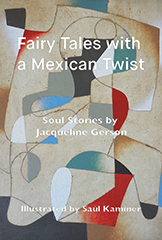


Title: Fairy Tales with a Mexican Twist: Soul Stories
Author: Jacqueline Gerson
Illustrator: Saúl Kaminer
Paperback: 170 pages with 28 color illustrations
Condition: New
Publisher: Fisher King Press (January 7, 2019)
Language: English
ISBN-10: 1771690461
ISBN-13: 978-1771690461
Also available as an eBook from Google Play
Fisher King Press publishes an eclectic mix of worthy books including Jungian Psychological Perspectives and a growing list of Cutting-Edge alternative titles. www.fisherkingpress.com

Monday, January 10, 2011

Threshold Experiences

Now available from Fisher King Press

Threshold Experiences: The Archetype of Beginnings 
by Michael Conforti
First Edition, Trade Paperback, 168pp, Index, Bibliography
 — ISBN 978-0-9441879-9-9

This seminal volume represents the foundation of Michael Conforti's 25-year pioneering exploration of the confluence of psyche and matter.

"In the beginning", so goes many a great story. These familiar words beckon us across a threshold, often transporting us into unknown worlds and novel experiences. So too our lives are filled with many such "beginnings" -- new jobs, relationships, adventures, and even the inception of life itself. Each of these "threshold experiences" not only introduces us to new domains, but also draws us into the realities of archetypal fields. Learning to creatively interact with these prefigured, a priori fields can allow us rich access to sources of eternal wisdom.

Jungian analyst Michael Conforti's examination of the initial clinical interview as a "threshold experience" shows that the same archetypal processes responsible for the generation of life itself also shape patient-therapist relationships, creating fascinating, highly patterned dynamics. These powerful fields structure events so that core issues in clients', and often even therapists', lives are re-enacted in the therapeutic setting with remarkable fidelity to the archetypal field within which each is embedded. Conforti's deft weaving together of psychological and scientific theory, dream analysis, and clinical vignettes elucidates the ways that the psyche entrains both client and therapist into a synchronized pattern. An understanding of the role of the Self in this process reveals the profound meaning and purpose that can be gleaned from careful attention to the communications occurring during the early phase of the therapeutic dialogue.

Drawing from the fields of jungian psychology, biology, quantum physics, and the new sciences, the author provides a unique lens for viewing the central archetypal dynamics operating within an individual life. His findings demonstrate how past experiences not only shape the initial stages of therapy, but also allow us to understand the future trajectory of treatment. This important study confirms C.G. Jung's assertion of the need for an interdisciplinary perspective if we are to truly comprehend the workings of the psyche.

Michael Conforti, Ph.D., a pioneer in the field of matterpsyche studies, is a practicing Jungian Analyst. An international consultant and lecturer. He has taught at the C.G. Jung Institute Zurich, as well as in Canada, Venezuela, the Caribbean, Denmark, and Italy. He works with individuals, organizations, and businesses, including the film industry, to identify and understand the role of the archetypal patterns underlying human behavior. Dr. Conforti is the Founder and President of the Assisi Institute for the Study of Archetypal Pattern Analysis, and the author of Field, Form, and Fate: Patterns in Mind, Nature and Psyche
Fisher King Press publishes an eclectic mix of worthy books including Jungian Psychological Perspectives, Cutting Edge Fiction, and a growing list of alternative titles.
    International Shipping.
    Credit Cards Accepted.
    Phone Orders Welcomed: +1-831-238-7799 skype: fisher_king_press

    Thursday, August 26, 2010

    Isn’t it time for some serious work on Toni Wolff?

    Four Eternal Women: Toni Wolff Revisited

    By Mary Dian Molton and Lucy Anne Sikes
    ISBN 978-1-926715-31-5
    320 pages, Bibliography, Index

    Isn’t it time for some serious work on Toni Wolff?

    Toni Wolff was at first the patient, and later the friend, mistress for a time, long-term colleague and personal analyst of Swiss Psychiatrist Carl Jung. In addition to her work as the founder, leader and teacher for the Psychological Society in Zurich which led to the establishment of the world-renowned C.G. Jung Institute in Zurich/Kusnacht, she published a seminal but little known work called “Structural Forms of the Feminine Psyche” (“Der Psychologie”, Berne, 1951). This treatise, certainly one of the first studies in Analytical Psychology, has been the subject of the authors’ investigation, attention, research and study for the past twelve years. Toni Wolff’s original outline of her four archetypes barely filled fifteen pages of the journal, and was written in the academic style of professional journals of that period, sans illustration or commentary.

    While Wolff’s work has been mentioned in short form in the work of several writers, Four Eternal Women is the first full and serious archetypal delineation of her original thesis, and examines each of her four feminine archetypes from several perspectives:
    •  Wolff’s Own Words
    •  An Overview of History and Myth
    •  Familiar Characteristics
    •  Lesser known (Shadow) Possibilities
    •  Career Inclinations
    •  Relationships to Men
    •  Relationships to Children
    •  Relationships to Each of the Other Types
    The tension of the opposites set up by Wolff’s own diagrammatic representation of these archetypes provided an additional dynamic to this study. Those who have followed Jung’s individuation path will recognize aspects of Jung’s Transcendent Function. All readers may well become personally sensitized to discover their own type preferences, and how some aspects of shadow may be present in their ‘opposite’ partner.

    About the Authors

    Lucy Anne Sikes, MS, ARNP, is a Senior Diplomate Jungian Analyst and is an Advanced Registered Nurse Practitioner. She is in private practice of Analysis and Psychotherapy in Prairie Village, Kansas, close to Overland Park, Kansas and Kansas City, Missouri. She currently serves as a lecturer in Jungian Theory and Practice and is past Coordinator for the Kansas City - St Louis Training Seminar of the InterRegional Society of Jungian Analysts.

    After her retirement in 1983 from a full career as an educator and later an executive for the Public Broadcasting System, Mary Dian Molton began her Jungian studies and took an advanced degree in clinical social work. She has studied at the C.G. Jung Institute in Zurich, has trained extensively in psychodrama, and has worked as a Jungian psychotherapist since 1987. She also holds a BFA in Fine Arts, and an MS Ed. with a specialization in Secondary Theater Education. For several years she wrote, produced and chaired a weekly television series which showcased creative teaching.

    Fisher King Press publishes an eclectic mix of worthy books including Jungian Psychological Perspectives, Cutting Edge Fiction, and a growing  list of alternative titles.
    • International Shipping.
    • Credit Cards Accepted.
    • Phone Orders Welcomed: +1-831-238-7799

    Monday, February 22, 2010

    Fisher King Press resurrects another timeless classic: Divine Madness and Romantic Love

    With Great Please Fisher King Press presents another resurrected Jungian classic:

    Available April 2010

    Divine Madness: Archetypes of Romantic Love
    By John R. Haule
    ISBN 978-1-926715-04-9, Index, Biblio, 300pp, 2010

    Divine Madness: Archetypes of Romantic Love examines the transforming experience of romantic love in literature, myth, religion, and everyday life. A series of psychological meditations on the nature of romantic love and human relationship, Divine Madness takes the perspective that human love is a species of divine love and that our experience of romantic love both conceals and reveals the ultimate Lover and Beloved. John Haule draws on depth psychology, the mystical traditions of the world, and literature from Virgil to Milan Kundera to lead the reader inside the mind and heart of the lover.

    Each chapter explores a characteristic aspect of relationship, such as seduction and love play, the rapture of union, the agony of separation, madness, woundedness, and transcendence. Focusing on the soulful and spiritual meaning of these experiences, Divine Madness sheds light on our elations, obsessions, and broken hearts, but it also reconnects us with the wisdom of time immemorial.

    As a practicing Jungian analyst and former professor of religious studies, John Haule masterfully guides his readers through the labyrinth of everyday experience, and the often hidden layers of archetypal realities, sketching a philosophy of romantic love through the stories of the world's literature and mythology.

    About the Author
    John Ryan Haule holds a doctorate in religious studies from Temple University. He is a Jungian analyst trained in Zurich and is a faculty member of the C.G. Jung Institute-Boston.

    Reviews
    John R. Haule’s wonderful study of Romantic Love . . . is a first-rate psychological, literary and spiritual study . . . The author’s passion and courage in delving into his own experience . . . makes reading it a powerful experience in its own right. . . . One cannot help seeing oneself reflected in the magic mirror of Haule’s study and deriving light and succor therefrom.
    Divine Madness is one of the rarest of books—one that really does speak to the heart as well as to the mind.
    —Timothy O’Neill, Gnosis Magazine

    The author brings us wonderful stories from all over the world that point to the lover’s task: to see through to the soul of the beloved. Even our tangled relationships hide this task in their sufferings. Even the love of God brings us to this work. A moving and helpful book.
    —Ann Belford Ulanov, Christiane Brooks Johnson Professor of Psychiatry and Religion, Union Theological Seminary

    Haule has the clear eye of an analyst, the spirit of a theologian, and the heart of a troubadour. His lyrical prose invites the reader into the depths and breadth of romantic love by exploring its rich and varied imagery in literature and music. . . .There are some little surprise jewels tucked in and under the main theme, such as some fresh definitions of classical Jungian concepts.
    —Elizabeth S. Strahan, Past President of the C. G. Jung Institute in Los Angeles

    Order Divine Madness: Archetypes of Romantic Love with Fisher King Press online Bookstore.
     
    Featuring an eclectic mix of worthy books including 
    Jungian Psychological Perspectives, Cutting-Edge 
    Fiction, and a growing list of Alternative titles.

    Friday, December 11, 2009

    Daughters and Well-meaning Mothers

    This past summer, Daryl Sharp of Inner City Books contacted us, explaining that he had edited a manuscript for Kehinde Ayeni. Daryl suggested that the manuscript was a real winner and encouraged us to consider it for publication. We had a closer look and soon contracted to published this body of work. We are now pleased to announce the publication of:

    Feasts of Phantoms
    a novel by Kehinde Adeola Ayeni
    ISBN 978-0-9813939-2-6, 346 pp

    How is a well meaning mother to protect her daughter from a culture where the birth of a baby girl is met with despair because the only future open to her is that of sexual assault and teenage pregnancy, which would doom her to a life of illiteracy and poverty as it has doomed her lineage before her? Genital mutilation has many causes but at the root of all of them is fear. A fear that pushes a mother to do the unthinkable to a daughter that she loves? What does a scapegoat do with the fate she has been handed? Accept it and roll with it, or reject it? How is she to reject it when the acceptance of her role is needed for her culture's psychic equilibrium? In the theater of the mind where all springs forth, is there such a thing as an innocent victim, and a victimizer? Feasts of Phantoms is a novel that explores these questions, and more.

    Kehinde Adeola Ayeni, MD., a public health physician, psychiatrist and psychoanalyst was born in Nigeria. A mother of two children, she is in private practice in Farmington Hills, Michigan. Her first novel Our Mother's Sore Expectations explored the plight of women under dictatorship government in Nigeria. Dr. Ayeni founded the Foundation for Indigenous Development and Advocacy (Foundida.org), a nonprofit organization whose goal is that every Nigerian child has at minimum an elementary school education, and she works closely with Educare Trust Fund based in Ibadan, Nigeria (Educaretrust1994.org).

    Feasts of Phantoms can be purchased directly from the Fisher King Press Online Bookstore.

    Thursday, May 28, 2009

    On Being a Man in the 21st Century

    Resurrecting the Unicorn—that's what Bud Harris and Fisher King Press have up their sleeves!

    A few months ago, Bud Harris phoned and we visited about the possibility of bringing one of his out-of-print titles back into production. "What’s the title?" I asked. “Emasculation of the Unicorn: The loss and rebuilding of Masculinity in America,” Bud answered. My knees shuttered a bit before I crossed my legs. “We did quite well with this book and it has even been translated into Spanish,” Bud explained. “Well, why don’t you send a copy and we’ll have a look,” I answered, thinking, holy Moses, how the heck are we gonna sell a book titled Emasculation of anything?

    The Emasculation of the Unicorn arrived a week or so later. After reading the first 15 to 20 pages I was thoroughly convinced that this book had been written and originally published before its time, in an era when men were reading Robert Bly’s Iron John and desperately gathering in vain on weekend retreats in hopes of reclaiming their lost masculinity, in an era when we were just beginning to understand that something wasn’t quite right—when we were just beginning to realize that things were out of balance. The men’s movement of the 90s withered and fell along the wayside, as so many fads do, but the issues at hand did not go away—instead, they faded back into shadowland. But as we know, sooner or later, these discarded images come back to haunt us, and that’s where Bud Harris, Fisher King Press, and a revised edition of the Unicorn, Resurrecting the Unicorn comes into play to pick up the scattered pieces that were left behind in the 20th century.

    Unicorns, being strong and wild, are usually associated with the lion, the eagle, and the dragon. Ancient stories of the unicorn exist in almost every culture: in the world of the Old Testament, in Persia, India, China, as well as in the West. In one legend the unicorn was so strong and independent it refused to enter the ark and swam throughout the flood. It was also believed that the horn of the unicorn signified health, strength and happiness, and to drink from it cured or provided immunity to incurable diseases.

    During the Middle Ages the unicorn symbolized the creative masculine spirit, so fierce and powerful that only a virgin could tame him and only then through deception. When we speak of the unicorn and the virgin, we are speaking of two great sets of psychological opposites, the masculine and feminine principles seeking balance and reconciliation. The unicorn represents male vitality, the rampant and penetrating force of the masculine spirit. The virgin represents his receptive feminine aspect.

    Myth tells us that through the virgin's deception, the unicorn was delivered into the hands of human hunters who killed and allowed its red blood to flow. From this betrayal the uni-corn was transformed and resurrected; he became the powerful energy contained in the virgin's holy garden next to the Tree of Life. So, reviving a healthy masculine spirit does not entail denying our feminine natures—quite the contrary. Honoring both of these inter-dependent aspects of our psyches is vital to living a balanced life.

    In the present day, our culture's evolving masculine spirit seems to be sputtering out. We began with that powerful, creative spirit, and somewhere along our path, phallus has been rendered impotent. The unicorn, that wondrous masculine symbol, has been reduced to a limp-horned stuffed animal found in novelty stores—or worse yet, discarded to a dusty old shelf of a second-hand thrift shop.

    Resurrecting the Unicorn addresses the impoverished state of masculinity in the 21st century. Without a strong masculine image, our souls become fragmented and we lose our way. In fact, this is how many men feel today—and women, too—as we all have these inner components. When we are in such a state of psychological confusion and imbalance, we must begin again to search for the "Holy Grail." The Grail is the symbolic container of the psycho-spiritual contents that can nourish, balance, and renew our lives.

    All the compensatory posturing, chest-pounding or drum-beating in the world won't revive this great masculine spirit! This can only be accomplished by developing a deeper relationship to soul. The mental landscape of metaphors—dreams, stories, myths, fairy tales—deal with the eternal truths of human nature and are the language of soul. In Resurrecting the Unicorn, Bud Harris guides us deep into the realm of metaphors so we can examine the evolution and development of human consciousness and reclaim discarded, yet much needed, aspects of our humanity.

    Bud Harris is a diplomate of the C.G. Jung Institute in Zürich, Switzerland. He and his wife, Massimilla Harris, are practicing Jungian analyst in Asheville, NC. Dr. Harris is the author of several publications including Sacred Selfishness: A Guide to Living a Life of Substance and The Fire and the Rose: The Wedding of Spirituality and Sexuality.

    Resurrecting the Unicorn:
    Masculinity in the 21st Century
    ISBN 978-0981034409
    Available from your local bookstore,
    from a host of online booksellers,
    and directly from Fisher King Press.

    Friday, May 15, 2009

    News Release: The Sister From Below

    With Great Pleasure Fisher King Press announces the publication of:

    The Sister From Below: When the Muse Gets Her Way 
    by Naomi Ruth Lowinsky
    (Recent recipient of the for Obama Millennium first prize writing award.)

    Who is this Sister from Below? She’s certainly not about the ordinary business of life: work, shopping, making dinner. She speaks from other realms. If you’ll allow, She’ll whisper in your ear, lead your thoughts astray, fill you with strange yearnings, get you hot and bothered, send you off on some wild goose chase of a daydream, eat up hours of your time. She’s a siren, a seductress, a shape-shifter . . . Why listen to such a troublemaker? Because She is essential to the creative process: She holds the keys to the doors of our imaginations and deeper life—the evolution of Soul.

    The Sister emerges out of reverie, dream, a fleeting memory, a difficult emotion—she is the moment of inspiration—the muse. Naomi Ruth Lowinsky writes of nine manifestations in which the muse visits her, stirring up creative ferment, filling her with ghosts, mysteries, erotic teachings, the old religion—bringing forth her voice as a poet. Among these forms of the muse are the “Sister from Below,” the inner poet who has spoken for the soul since language began. The muse also appears as the ghost of a grandmother Naomi never met, who died in the Shoah—a grandmother with ‘unfinished business.’ She visits in the form of Old Mother India, whose culture Naomi visited as a young woman. She cracks open her Western mind, flooding her with many gods and goddesses. She appears as Sappho, the great lyric poet of the ancient world, who engages her in a lovely midlife fantasy. She comes as “Die Ür Naomi,” an old woman from the biblical story for which Naomi was named, who insists on telling Her version of the Book of Ruth. And in the end, surprisingly, the muse appears in the form of a man, a long dead poet whom Naomi loved in her youth.

    The Sister from Below is a personal story, yet universal, of giving up a creative calling because of life’s obligations, and being called back to it in later life. This Fisher King Press publication describes the intricate patterns of a rich inner life; it is a traveler’s memoir, with outer journeys to Italy, India and a Neolithic cave in Bulgaria, and inward journeys to biblical Canaan and Sappho’s Greece; it is filled with mythic experience, a poet’s story told. The Sister conveys the lived experience of the creative life, a life in which active imagination—the Jungian technique of engaging with inner figures—is an essential practice.

    The Sister speaks to all those who want to cultivate an unlived promise—those on a spiritual path, those interested in a Jungian approach to life, those who are filled with the urgency of poems that have to be written, paintings that must be painted, journeys that yearn to be taken…

    Here's what others are saying about The Sister from Below:
    “Naomi Lowinsky has given us a remarkable, fearless, and full autobiography. Speaking in poetic, psychologically sensitive, scholarly dialogues with her shape-shifting muse, she has created a new form . . . This is a beautiful book to treasure and spread among worthy friends.”
    —Sylvia Perera, Author of Descent to the Goddess and Celtic Queen Maeve and Addiction.
    “. . . Naomi Ruth Lowinsky offers us a superbly detailed investigation of the powerful, mythic forces of the world as they are revealed to the active creative self. Don’t miss this enlightening and fascinating book.”
    —David St. John, Author of Study for the World’s Body: New and Selected Poems and Prism.

    “Naomi’s poetry and prose is infused with the suffering and joys of humans everywhere. Insightful and deeply moving, she brings us the food and water of life.”
    —Joan Chodorow, Author of Dance Therapy and Depth Psychology, Editor of C.G. Jung on Active Imagination.

    “A passionate love letter to those who yearn to be heard. A must read for every woman who longs to write poetry.”
    —Maureen Murdock, Author of The Heroine’s Journey and Unreliable Truth: On Memoir and Memory.

    “Naomi Ruth Lowinsky reinterprets mythic and historical reality in provocative versions of the stories of Eurydice, Helen, Ruth, Naomi, and Sappho. The voice of the Sister from Below argues, cajoles, prods, explains, and yes, loves her human counterpart, and becomes the inspiration for Lowinsky’s stunning poetry in this highly original book.”
    —Betty de Shong Meador, Author of Inanna, Lady of Largest Heart and Princess, Priestess, Poet.

    In addition to The Sister from Below: When the Muse Gets Her Way and The Motherline: Every Woman’s Journey to Find Her Female Roots, Naomi Ruth Lowinsky is the author of numerous prose essays, many of which have been published in Psychological Perspectives and The Jung Journal. She has had poetry published in many literary magazines and anthologies, among them After Shocks: The Poetry of Recovery, Weber Studies, Rattle, Atlanta Review, Tiferet and Runes. Her two poetry collections, red clay is talking (2000) and crimes of the dreamer (2005) were published by Scarlet Tanager Books. Naomi is a Jungian analyst in private practice and poetry and fiction editor of Psychological Perspectives.

    Naomi Ruth Lowinsky has recently been awarded first prize in the Obama Millennium contest for her poem “Madelyn Dunham, Passing On” in which she imagines the spirit of of Obama’s deceased grandmother visiting him as he speaks to the crowds in Chicago after his election. The poem will be published in the literary magazine New Millennium Writings this fall.

    The Sister from Below:
    When the Muse Gets Her Way 
    —ISBN 978-0-9810344-2-3

    Published by and available for purchase directly from Fisher King Press.
    Also available from your local bookstore, and a host of on-line booksellers.
    Publication Date: June 1st, 2009

    Thursday, May 14, 2009

    News Release: The Motherline

    With Great Pleasure Fisher King Press announced the publication of:

    The Mothering: Every Woman's Journey to Find Her Female Roots

    by Naomi Ruth Lowinsky
    (Recent recipient of the for Obama Millennium first prize writing award.)

    Our mothers are the first world we know, the source of our lives and stories. Embodying the mysteries of origin, they tie us to the great web of kin and generation. Yet, the voice of their experience is seldom heard. The Motherline describes a woman’s journey to find her roots in the personal, cultural, and archetypal realms. It was written for women who have mothers, are mothers, or are considering motherhood, and for the men who love them. Telling the stories of women whose maturation has been experienced in the cycle of mothering, it urges a view of women that does not sever mother from daughter, feminism from “the feminine,” body from soul.

    Here what a few reviewers have had to say about The Motherline:

    “(In) this perceptive and penetrating study . . . (Naomi Ruth Lowinsky) imaginatively applies Jungian, feminist and literary approaches to popular attitudes about . . . mothers and daughters and movingly, to personal experience.”
    —Publisher’s Weekly

    “A combination of years of scholarship and recordings of personal journeys, this book belongs in every woman’s psychology/spirituality collection.”
    —Library Journal

    “In this accessible volume, Jungian psychologist Lowinsky explores the pain that women feel when their mother-love is undervalued or erased.”
    —ALA Booklist
    In addition to The Motherline: Every Woman’s Journey to Find Her Female Roots and The Sister from Below: When the Muse Gets Her Way, Naomi Ruth Lowinsky is the author of numerous prose essays, many of which have been published in Psychological Perspectives and The Jung Journal. She has had poetry published in many literary magazines and anthologies, among them After Shocks: The Poetry of Recovery, Weber Studies, Rattle, Atlanta Review, Tiferet and Runes. Her two poetry collections, red clay is talking (2000) and crimes of the dreamer (2005) were published by Scarlet Tanager Books. Naomi is a Jungian analyst in private practice and poetry and fiction editor of Psychological Perspectives.

    Naomi Ruth Lowinsky has recently been awarded first prize in the Obama Millennium contest for her poem “Madelyn Dunham, Passing On” in which she imagines the spirit of of Obama’s deceased grandmother visiting him as he speaks to the crowds in Chicago after his election. The poem will be published in the literary magazine New Millennium Writings this fall. www.sisterfrombelow.com

    The Motherline: 
    Every Woman’s Journey to Find Her Female Roots
    —ISBN 978-0-9810344-6-1
    Published by and available for purchase directly from Fisher King Press.
    Also available from your local bookstore, and a host of on-line booksellers.
    Publication Date: June 1st, 2009

    Wednesday, May 13, 2009

    Fisher King Press Author wins Obama Millennium Award

    Naomi Ruth Lowinsky has won first prize in the Obama Millennium contest for her poem “Madelyn Dunham, Passing On” in which she imagines the spirit of of Obama’s deceased grandmother visiting him as he speaks to the crowds in Chicago after his election. The poem will be published in the literary magazine New Millennium Writings this fall.

    On May 24th, 2009, Naomi will interviewed on-line on the Jane Crown show at 2 pm Pacific time, 4 pm Central time, 5 pm Eastern time. She will read the prize winning poem among others.

    Naomi Lowinsky's newest book of poems, Adagio and Lamentation was published June, 2010. Other Naomi Lowinsky titles include The Sister From Below: When the Muse Gets Her Way (2009 Fisher King Press) and The Motherline: Every Woman's Journey to find Her Female Roots (2009 Fisher King Press). You can order books directly from Fisher King Press or purchase from your local bookstore or from a host of online booksellers.

    Saturday, December 13, 2008

    A Powerful Kick at the American Way of Life

    "LeRoi is ostensibly a novel, and not overtly psychological, but it lays bare the psychic plight of a middle-aged salesman looking for meaning. It is a powerful kick at the American way of life—ambition, success, money and power—but it is redemptive in the narrator's search for internal Eros and an outer relationship he can trust himself to believe in."
    —Daryl Sharp, Publisher, Inner City Books

     learn more about LeRoi and The Chronicles of a Wandering Soul series at fisherkingpress.com

    Wednesday, June 4, 2008

    Obama, McClellan, and Guilt the Promethean Way

    by Lawrence H. Staples

    In the conventional view, guilt is important because it helps us remain "good." It helps protect society's boundaries. While the conventional view of guilt is part of the truth, it is not the whole truth. The meaning of guilt is far more complicated.

    While guilt does play an important role in the maintenance of society's stability, it also creates an enormous problem. It can deter us from being "bad" when that is exactly what is needed. Increasingly, during my years of work as a psychoanalyst, it became clear to me that if individuals could not sin, and then suffer the subsequent guilt, they could not fully develop themselves and their gifts. If individuals could not develop fully, neither could society, as society is a sum of the individuals that comprise it. I began to wonder what human development would look like, if all of us could actually live innocently behind the barbed wire fence of guilt that convention erects to separate us from forbidden territory, and its forbidden fruit. I was curious as to what kind of fruit might come from trees that grow only on conventionally sanctioned ground. Would we have had a Socrates, or a Galileo, or a Solzhenitsyn or a Rushdie?

    My suspicions about the exclusive value of a life of innocence led me to an idea I call "Good Guilt". The idea was born from the commonplace observation that there are times in our lives when the experience of guilt actually was a signal of having done something good, even essential to nurture us. While the guilt probably did not feel like "Good Guilt" at the time of transgression, the "sin" that caused the guilt is sometimes viewed in retrospect as having brought something valuable to our lives. Examples might include divorces, separations from partners and friends, giving up family-approved or family-dictated careers, or even marriages that are opposed by one's family on the grounds of race, religion, gender, or social status. It might also include the expression of qualities previously rejected as unacceptable, like anger and selfishness. Later in life we may look at guilt thus incurred in a different light.

    There are many examples of "Good Guilt." Two recent examples are Barack Obama and Scott McClellan. No doubt they suffered guilt as a result of their decisions to sever relations with beloved church in the case of Barack Obama, and beloved leader and current political regime in the case of Scott McClellan. It is "Good Guilt" because what they did needed to be done for the country, their own interests, and their souls. In these cases, guilt, which is inevitable, should nevertheless be incurred and borne.

    In the struggle between the conflicting human tendencies to be both "good" and "bad," there is a problem, if we try to be exclusively good. We may, by staying inside the fence, avoid being castigated by society. We may also avoid castigating ourselves with self-punishing guilt. In the process, however, we also avoid large parts of our self. In so doing, we may please parents and society, but sin against our self.

    Reflections on the well-known myth of Prometheus reinforced my unconventional line of thought concerning guilt. This myth tells us Prometheus stole fire from the gods and made it available for use by humans. He suffered for his sin. Zeus had him chained to a rock where an eagle pecked and tore daily at his liver. But human society would have suffered if he had not committed it. Thus, the life of Prometheus portrays a mythological model for guilt that is different from the conventional view. The Promethean model of guilt suggests the importance of sinning and incurring guilt in order to obtain needed—but forbidden things. This is the conclusion I reach in my recently published book, Guilt with a Twist: The Promethean Way, except that I state the case a bit stronger. I assert that we must sin and incur guilt, if we are to grow and reach our full potential.

    "Life inevitably confronts us with the Promethean dilemma: Do we live our lives without fire and the heat and light it provides, or do we sin and incur guilt to achieve the important developments we need? The contribution virtue can make to society must be acknowledged. There indeed are sins that are destructive; there also are sins that benefit."

    I have also concluded that we miss the point, if we think guilt has only a moral function. Guilt is in many ways morally neutral. We can feel guilty if we work too hard or too little. We can feel guilty if we are too assertive or not assertive enough. A woman feels guilty if she has a career and she feels guilty if she doesn't have one. We might feel guilty, if we refuse to steal, while we watch our children die of starvation. We can feel guilty at either of the opposite poles. An important purpose of guilt, in my view, is to compensate, to help keep one side of the opposites from hijacking the psyche and driving the other side out. Here, guilt's purpose is not the maintenance of morals; it is the maintenance of the opposites and psychic wholeness. It follows, then, that guilt is an important instrument in the psyche's system of self-regulation. Just as our physical body has a mechanism of homeostasis, where, for example, we sweat automatically to cool ourselves when we get overheated, so our psyche has a similar mechanism.

    "Despite its contribution to psychic stability, guilt disturbs our emotional and mental tranquility. Like Prometheus, we suffer the pain of guilt, even if it was incurred for something beneficial. Promethean Guilt contains the seeds of its own atonement. What is "sinfully" and "guiltily" acquired is given back to the community as an expiation."

    An important lesson we need to learn is simply this: If we are feeling guilty, we should not be too quick to conclude or interpret that those feelings of guilt necessarily mean that we are doing something "bad". We may actually be doing something "good" for our own growth as well as society's. The guilt feelings always need to be acknowledged and always, and I emphasize always, need to be examined and evaluated on their merits and in accordance with one's conscience. But it is important to note that the meaning of guilt is probably far more complicated than we have ever been taught.

    About the Author:
    After receiving AB and MBA degrees from Harvard, Lawrence Staples spent the next 22 years with a Fortune 500 company, where he became an officer and a corporate vice president. When he was 50, he made a midlife career change and entered the C.G. Jung Institute, Zurich, Switzerland, where he spent nine years in training to become a psychoanalyst. Lawrence has a Ph.D. in psychology and a Diploma in Analytical Psychology from the Zurich Institute.

    Learn more about the many Lawrence Staples publications